Description
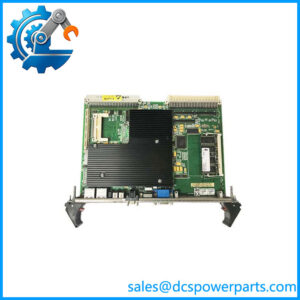
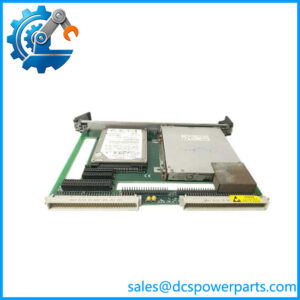
GE IS220PPROS1B | PPRO Backup Turbine Protection I/O Pack | Mark VIe
Key Technical Specifications
| Parameter | Specification |
|---|---|
| Product Model | IS220PPROS1B |
| Manufacturer | GE |
| Product Family | Mark VIe |
| Functional Designation | PPRO |
| Product Type | Backup Turbine Protection I/O Pack |
| Protection Function | Backup turbine / emergency protection |
| Architecture | Simplex or TMR, depending system configuration |
| Supply Voltage | 28 VDC |
| Module Current | 0.37 A DC |
| Speed Input Range | -15 to +15 VDC |
| SPRO/TPRO PT Input | 0 to 138 VAC, 5–66 Hz |
| TREA Voltage Input | 16–140 VDC |
| TREA E-Stop Input | 18–140 VDC |
| TREA Contact Output | 28 VDC, 7 A DC |
| TPRO Speed Sensor Supply | 24 VDC, 25 mA DC |
| Communication | Ethernet / IONet |
| Ambient Temperature | -30°C to +65°C |
| Compatible Terminal Boards | SPRO, TPRO, TREA family variants |
The electrical values above are supported by GE’s certification documentation for IS220PPROS1B. The same document identifies the applicable SPRO/TPRO/TREA terminal boards, including IS200SPROH1A/H2A, IS200TPROH1C/H2C, IS200TPROS1C/S2C, and IS200TREAH1A/H3A.
Product Introduction
The GE IS220PPROS1B is the PPRO Backup Turbine Protection I/O Pack used in the Mark VIe turbine control architecture. It works with dedicated protection terminal boards to provide an independent backup layer for turbine overspeed protection, primary-control supervision, and generator synchronization checking. The PPRO is separate from the normal PTUR primary protection path.
A typical TMR arrangement uses three PPRO I/O packs, with each pack connected to a different Mark VIe control network. Depending on the installation, the packs can be mounted on an SPRO terminal board and connected to an emergency trip board, or three PPRO packs can be installed directly on a TREA-based arrangement.
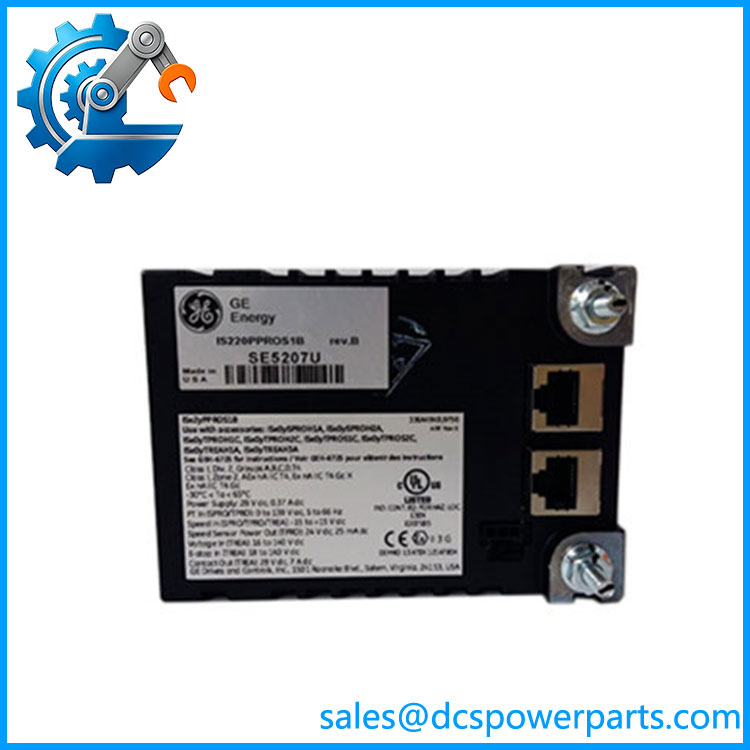
IS220PPROS1B
Application Scenarios & Field Pitfalls — Engineer’s Perspective
Engineering Pain Point
The PPRO is part of the turbine protection chain, so replacing it is not simply an I/O-card swap. The terminal board, IONet arrangement, speed-signal wiring, trip-board architecture, and protection configuration all affect whether the replacement is appropriate.
Typical Applications
- Gas turbine backup protection — monitoring turbine speed and initiating an independent trip when required.
- Steam turbine protection — used with the appropriate emergency trip-board architecture.
- Generator synchronization supervision — provides backup checking associated with synchronization to a utility bus.
- TMR turbine protection — three PPRO packs can be deployed across R/S/T control networks for redundant protection.
- Primary-controller watchdog — independently monitors the primary control and can initiate protective action when abnormal operation is detected.
Technical Pitfalls to Avoid
- Do not confuse PPRO with PTUR.
PTUR is the primary turbine protection I/O pack. PPRO provides the backup protection path and uses a different protection architecture. Substituting one for the other is not a normal field replacement procedure. - Match the terminal board exactly.
IS220PPROS1B has approved combinations with SPRO, TPRO, and TREA terminal boards. The board determines the field interface and protection arrangement, so the I/O pack should not be evaluated independently of its mating terminal board. - Check the P-Pack processor generation and configuration.
PPRO hardware revisions should not be treated as interchangeable solely because the enclosure and connector arrangement look similar. The Mark VIe software and controller configuration need to support the installed PPRO revision. - Do not assume one Ethernet connection means a non-redundant system.
PPRO deployments can use different network arrangements depending on simplex, dual-control, or TMR architecture. The actual IONet topology should be checked against the turbine control drawings. - Treat speed-input wiring as protection-critical.
The PPRO handles basic overspeed, acceleration/deceleration, and hardware-implemented overspeed functions. Shielding, signal quality, sensor type, and terminal-board wiring should therefore be verified before commissioning.
Related Products
- IS220PPROH1A — PPRO Backup Turbine Protection I/O Pack variant used with the Mark VIe protection architecture. Its approved terminal-board combinations differ from some IS220PPROS1B configurations.
- IS220PTURH1B — Primary Turbine Protection I/O Pack. Used for the primary rather than backup protection path.
- IS200SPROH1A — SPRO protection terminal board used with PPRO configurations.
- IS200SPROH2A — Related SPRO terminal-board variant.
- IS200TPROH1C — TPRO terminal board for PPRO protection applications.
- IS200TPROH2C — Related TPRO terminal-board variant.
- IS200TREAH1A — TREA Turbine Emergency Trip terminal board compatible with PPRO.
- IS200TREAH3A — Related TREA terminal-board variant.
- TREG / TREL / TRES — Emergency trip terminal-board families for gas turbines, large steam turbines, and small/medium steam turbines respectively.
Procurement Note
For an replacement, specify the complete GE part number rather than ordering only a “PPRO module.” Record the installed terminal board, turbine type, simplex/TMR architecture, IONet topology, processor/P-Pack revision, and Mark VIe software configuration.
For a used or surplus unit, inspect the DC power connector, Ethernet ports, terminal-board mounting interface, connector pins, enclosure, and signs of thermal or electrical stress. A basic power-up test is not sufficient acceptance for a turbine protection component; the installed protection configuration and required overspeed/trip validation should be checked before returning the system to service.