Description
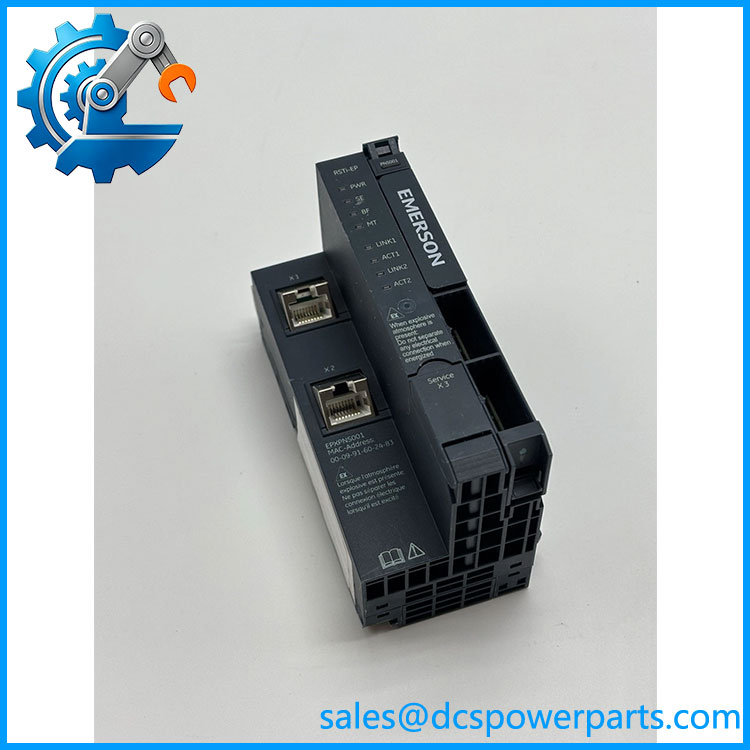
GE EPXPNS001-AAA
Key Technical Specifications
| Parameter | EPXPNS001-AAA |
|---|---|
| Product Type | RSTi-EP PROFINET IRT/RT Network Adapter |
| PROFINET Class | Class C I/O Device |
| PROFINET Version | Version 2.3 |
| Ethernet Ports | 2 × RJ45 |
| Ethernet Speed | Up to 100 Mbps |
| RSTi-EP System Bus | Up to 48 Mbps |
| Maximum Active Modules | 64 |
| Maximum Input Data | 512 bytes |
| Maximum Output Data | 512 bytes |
| Parameter Data | Up to 4,362 bytes |
| Diagnostic Data | Up to 1,408 bytes |
| I/O Update Rates | 1–512 ms, configurable |
| MRP | Supported |
| Configuration Interface | Micro USB 2.0 |
| System/Input Supply | 20.4–28.8 VDC |
| Output Supply | 20.4–28.8 VDC |
| Max. Input Module Feed-In | 10 A |
| Max. Output Module Feed-In | 10 A |
| System Current Consumption | 116 mA |
| Operating Temperature | -20°C to +60°C |
| Storage Temperature | -40°C to +85°C |
| Humidity | 5–95%, non-condensing |
These values come from GE/Emerson RSTi-EP documentation. The two RJ45 ports use an integrated switch, allowing line, star, or ring arrangements; MRP is supported for the documented network adapter.
Product Introduction
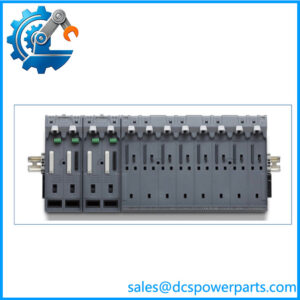
The GE EPXPNS001-AAA is an RSTi-EP PROFINET IRT network adapter used as the head-end module of a distributed I/O station. It sits between the plant PROFINET network and the RSTi-EP slice I/O bus, handling cyclic process data, parameter information, and diagnostic communication. The station can contain up to 64 active RSTi-EP modules, making the adapter a central architectural component rather than simply an Ethernet interface.
For an existing RSTi-EP installation, the GE EPXPNS001-AAA must be evaluated as part of the complete I/O station. The controller-side PROFINET configuration, device name, I/O module sequence, data mapping, update time, firmware, and network topology all matter. Replacing the adapter without preserving these details can produce configuration or diagnostic problems even when the physical I/O modules remain unchanged.
EPXPNS001-AAA
Engineering Pain Point
The common field mistake is treating a PROFINET network adapter as an interchangeable Ethernet component. It is not. The EPXPNS001 defines the RSTi-EP station’s process image and communication behavior, while the attached slice modules determine the actual I/O configuration. GE documentation specifies configurable PROFINET update rates from 1 ms through 512 ms and supports Motorola or Intel data formatting, so controller configuration and byte-order assumptions need to be checked during replacement.
Typical Applications
- Distributed PLC I/O: Connects RSTi-EP digital and analog modules to a PROFINET controller.
- Machine automation: Suitable for compact distributed I/O stations where the controller is physically separated from field wiring.
- Process equipment: Provides centralized PROFINET communication for locally assembled RSTi-EP I/O.
- PROFINET ring architectures: Two switched RJ45 ports and MRP support allow the adapter to participate in appropriate line or ring network designs.
Technical Pitfalls to Avoid
- Do not confuse EPXPNS001 with EPXPNS001LITE. The standard supports up to 64 active modules, while the LITE version is documented for a smaller 16-module configuration and RT operation.
- Verify the complete suffix. Documentation identifies hardware/firmware combinations such as -AAAA and -AAAB. The suffix is not safe to ignore when matching an installed unit or historical configuration.
- Check firmware before commissioning. Published release documentation associates particular hardware revisions with specific firmware versions and module-support changes. A physically compatible replacement may still require firmware/configuration validation.
- Preserve the PROFINET configuration. Device name, station configuration, I/O order, process-image size, update rate, and data format should be compared against the controller project before energizing the replacement.
- Check power-path loading. The network adapter distributes separate input and output current paths, with documented 10 A maximum feed-in current for each path. The total connected slice load needs to remain within the system design limits.
- Do not substitute EPXPNS101 automatically. EPXPNS101 adds support for Type S1 simplex and Type S2 system redundancy; that does not make it an automatic drop-in replacement for an installation.
Related Products
- EPXPNS001LITE — PROFINET RT network adapter for smaller RSTi-EP configurations; documented for up to 16 active modules.
- EPXPNS101 — PROFINET network adapter supporting S1 simplex and S2 system redundancy; architecture differs from the standard .
- EP-1214 — RSTi-EP digital input module; used downstream of the network adapter.
- EP-1218 — RSTi-EP 8-point digital input module.
- EP-225F — RSTi-EP digital output module used within the distributed I/O station.
- EP-700F — RSTi-EP power distribution module for the input current path.
- EP-710F — RSTi-EP power module providing 24 VDC potential distribution.
- EP-750F — RSTi-EP power module associated with the output current path.
Procurement and Replacement Note
For an replacement, verify the complete catalog number printed on the existing adapter, hardware revision, firmware version, connected RSTi-EP module list, PROFINET controller configuration, station/device name, and I/O data mapping. The current Emerson documentation still identifies as the RSTi-EP PROFINET IRT/RT network adapter, but historical GE documentation and later Emerson documentation use different suffix and firmware designations.
Procurement rule: do not approve a replacement from the base string alone. Match the installed hardware and firmware revision first, then validate the complete RSTi-EP station configuration.