Description
Foxboro FBM233 P0926GX
Product Introduction
The Foxboro FBM233 P0926GX is a Field Device System Integrator (FDSI) module designed to bring Ethernet-connected field equipment into a Foxboro Evo process control environment. Unlike conventional Foxboro FBMs that terminate discrete or analog field signals directly, the Foxboro FBM233 P0926GX operates as an Ethernet-based integration layer. It provides a 10/100 Mbps copper Ethernet connection through a single RJ-45 connector and communicates with external field devices through Ethernet switches or hubs. Schneider Electric documentation specifies UDP/IP or TCP/IP at the Ethernet level, while the actual device protocol is determined by the downloadable I/O driver installed for the application.
A key point for engineers replacing or expanding an existing system is that the Foxboro FBM233 P0926GX is not simply an Ethernet switch or generic Modbus gateway. The FDSI architecture includes device-specific software drivers, configuration of IP parameters, and data mapping into Foxboro Distributed Control Interface (DCI) blocks. One FBM233 can communicate with up to 64 external devices, subject to application performance and driver limitations, with up to 2,000 DCI connections. The resulting data can include analog values, digital values, packed digital groups, integers, floating-point values, and other data types supported by the selected driver.
For high-availability installations, two FBM233 modules form a redundant pair. One operates as the Master and the other as the Tracker, with automatic role switching when the configured system detects an applicable communication or device-heartbeat problem. The module supports 24 VDC power, 10/100 Mbps Ethernet, Foxboro’s redundant 2 Mbps module fieldbus architecture, and Class G3 harsh-environment suitability. This makes P0926GX particularly relevant where existing PLCs, packaged equipment, intelligent instruments, or other Ethernet-capable field systems must exchange process data with an established Foxboro control database.
Technical Specifications
| Parameter | Specification |
|---|---|
| Product Model | |
| Manufacturer | Foxboro / Invensys / Schneider Electric |
| Part Number | P0926GX |
| Product Type | Field Device System Integrator (FDSI) / Ethernet communication module |
| System | Foxboro Evo / I/A Series |
| Ethernet Interface | 10/100 Mbps copper Ethernet |
| Ethernet Connector | 1 × RJ-45 per module |
| Ethernet Protocol | UDP/IP or TCP/IP |
| IP Configuration | Fixed IP or DHCP |
| Field Device Capacity | Up to 64 devices |
| DCI Connections | Up to 2,000 |
| Data Types | Integer, IEEE single-precision floating point, binary and driver-supported types |
| Fastest Allowed ECB Block Period | 500 ms |
| Module Fieldbus | Redundant 2 Mbps module fieldbus |
| Power Supply | 24 VDC +5% / -10% |
| Maximum Consumption | 7 W per module |
| Operating Temperature | -20°C to +70°C |
| Storage Temperature | -40°C to +70°C |
| Relative Humidity | 5–95%, non-condensing |
| Environmental Rating | Class G3 harsh environment |
| Mounting | Modular baseplate; DIN rail or 19-inch rack via baseplate |
| Dimensions | 102 × 45 × 104 mm |
| Dimensions with Mounting Lugs | 114 × 45 × 104 mm |
| Weight | Approx. 284 g |
| Ethernet Cable Length | 1–100 m |
| Calibration | Not required |
Specifications above are based primarily on Schneider Electric/Foxboro’s product specification.
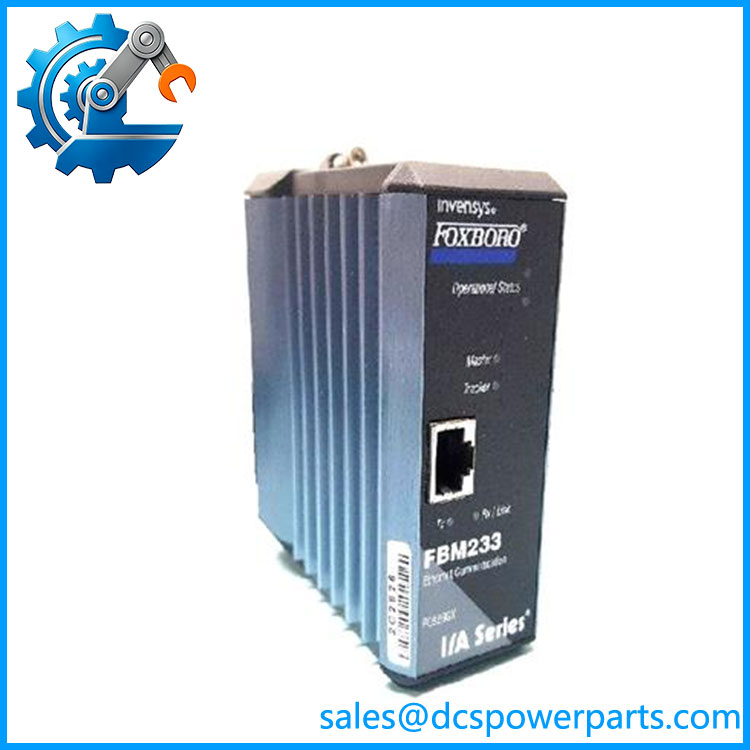
P0926GX
Main Features and Engineering Considerations
1. Ethernet field-device integration
The main job of the is protocol-based data integration, not direct signal termination. It can connect Foxboro Evo to Ethernet field devices through an Ethernet switch or hub. The downloadable driver determines how the target device is recognized and how its data is converted into Foxboro DCI data types.
2. Redundant architecture
A single provides the Ethernet interface, while redundancy is achieved using a pair of modules. The modules operate as Master and Tracker. Automatic role switching is part of the architecture, and the documentation specifies that either module can be replaced without removing power from the other FBM modules on the modular baseplate.
3. Capacity depends on the driver
The headline figure of 64 field devices should not be interpreted as a guaranteed 64-device installation at any arbitrary scan rate. Foxboro explicitly notes that actual device capacity is performance-dependent. Driver behavior, device response time, data layout, network architecture, and DCI configuration all affect practical performance. The specified fastest allowed ECB block period is 500 ms.
4. One RJ-45 does not mean one external device
Each has one physical RJ-45 Ethernet connector, but the module can reach multiple devices through Ethernet switches or hubs. Foxboro specifies communication with up to 64 external devices. This distinction is important when checking drawings and network architecture: is an Ethernet endpoint/interface, not a multiport Ethernet switch.
5. Protocol compatibility must be checked
Do not purchase solely because a third-party device is advertised as “Ethernet compatible.” The correct question is whether an appropriate driver exists for the exact device and protocol, and whether the required data points can be mapped into the Foxboro DCI structure. Foxboro states that drivers may be selected from available protocol libraries, with custom drivers possible for specific requirements.
Application Scenarios
- Ethernet integration of PLCs with Foxboro Evo
- Intelligent packaged equipment interfaces
- Ethernet-connected field instruments
- Motor control and electrical equipment data integration
- Third-party field device communication
- Legacy I/A Series installations requiring Ethernet device connectivity
- Redundant communication architectures for process plants
- Data acquisition from multiple intelligent field devices
- Integration of analog and digital data into Foxboro DCI blocks
Engineer’s Guide: Field Pitfalls
Do not treat as a standard I/O card. It does not provide conventional 4–20 mA, thermocouple, RTD, or discrete termination channels.
Do not assume that every Ethernet protocol is supported. Ethernet is only the physical/network transport. The device-specific driver determines the actual integration capability.
Check the driver before checking the hardware price. A physically correct can still be unusable if the required driver or device configuration is unavailable.
Verify whether the application requires one module or a redundant pair. The ‘s redundancy architecture uses two modules operating as Master and Tracker.
Check the baseplate position. Redundant modules must occupy adjacent odd/even positions on the Foxboro modular baseplate, such as positions 1/2, 3/4, 5/6, or 7/8.
Do not confuse with FBM analog modules. Some secondary catalogs incorrectly describe as an analog or digital input/output module. The Schneider Electric specification clearly identifies it as a Field Device System Integrator module.
Check network architecture and cable distance. The documented connection from the module to a hub, switch, or device is 1–100 m. Longer plant networks require the appropriate Ethernet infrastructure rather than simply extending the module cable.
Frequently Asked Questions
Is Foxboro an I/O module?
It is an FBM, but it is specifically an Ethernet Field Device System Integrator module. It should not be treated as a conventional analog or digital signal I/O card.
What is the corresponding Foxboro model?
is the ordering part number for . Schneider Electric’s product specification identifies the module as “ Field Device System Integrator Module, 10/100 Mbps Ethernet, Redundant.”
Does support Ethernet?
Yes. Each provides one 10/100 Mbps copper Ethernet connection through an RJ-45 connector.
Does it support redundant operation?
Yes, but redundancy is implemented using a pair of modules. One operates as Master and the other as Tracker.
How many field devices can it communicate with?
The documented maximum is 64 field devices per , with actual capacity dependent on device and driver performance. Up to 2,000 DCI connections are supported.
What power supply does require?
The specified input is 24 VDC +5% / -10%, with maximum consumption of 7 W per module.
Is suitable for harsh industrial environments?
Foxboro specifies Class G3 harsh-environment suitability under ISA S71.04, with an operating temperature range of -20°C to +70°C and 5–95% non-condensing humidity.
Procurement Note
For a replacement purchase, specify the complete identification as Foxboro , . Verify the existing Foxboro Evo/I/A Series architecture, modular baseplate, firmware/software environment, required Ethernet driver, external device protocol, network topology, and whether the application requires a redundant pair. Do not accept a generic “Ethernet communication module” as an equivalent without confirming the driver and DCI integration requirements.
The exact part number matters because this module is tightly tied to the Foxboro FBM architecture and its software-driver model. For installed systems, hardware compatibility alone is not enough; the driver, configuration files, device addressing, and DCI mapping are part of the functional replacement.