Description
Product Overview
The Foxboro FBM214B RH101AB is a Compact 200 Series fieldbus module designed to acquire analog signals from process instruments and support HART communication with compatible smart transmitters. Installed within a Foxboro I/A Series distributed control system, it converts field measurements into signals the control system can process. Typical applications include monitoring pressure, flow, level, and other process variables transmitted as 4–20 mA signals. Unlike a basic analog input module, the FBM214B also supports digital HART communication superimposed on the analog signal, allowing access to supported field-device information.
The Foxboro FBM214B RH101AB provides eight individually isolated input channels and can accommodate a mix of conventional 4–20 mA transmitters and HART-capable instruments. Individual channel isolation helps limit electrical interaction between field circuits, which is useful when transmitters have different grounding conditions or operate across separate process areas. HART communication can provide access to supported device information and commands, although available functions depend on the transmitter, control-system software, and configuration. The module’s installation also depends on the correct Compact 200 Series baseplate and compatible field termination hardware.
For replacement projects, matching the model alone is not enough. Confirm the RH101AB part number, the existing baseplate, termination assembly, field cable, and control-system configuration. The documented termination assembly RH924JH is associated with the Compact FBM214b, but the installed wiring arrangement must still be checked. If the original module is being replaced after a channel fault, verify the field loop, loop power, and termination wiring before assuming the module itself caused the problem. After installation, test all eight channels as applicable, verify analog scaling, and confirm HART communication with representative instruments before returning the system to normal operation.
Product Introduction (Non-Templated)
A process measurement can remain visible as a 4–20 mA signal while important digital transmitter diagnostics are unavailable. The Foxboro FBM214B RH101AB supports both analog acquisition and HART communication across eight individually isolated input channels, making it relevant to plants that need process measurements alongside smart-instrument data.
Before replacing the module, verify the Compact 200 Series baseplate, termination assembly, and control-system configuration. Correct channel isolation and field wiring are essential to a reliable return to service.
Key Technical Specifications
| Parameter | Value |
|---|---|
| Manufacturer | Foxboro / Schneider Electric |
| Model | FBM214B |
| Part number | RH101AB |
| Product type | HART communication input interface module |
| Product family | Compact 200 Series |
| Control-system family | Foxboro I/A Series |
| Number of channels | 8 |
| Input signal | 4–20 mA DC |
| Digital communication | HART FSK signal superimposed on the analog input |
| Channel isolation | Individual channel isolation |
| Field-device support | Standard 4–20 mA and compatible HART transmitters |
| Loop power | Individually isolated loop supplies are documented for the module |
| Loop supply rating | Check the applicable manufacturer datasheet and unit configuration |
| Termination assembly | RH924JH, subject to system configuration |
| Mounting | Compact 200 Series baseplate |
| Communication architecture | Foxboro module fieldbus |
| Firmware compatibility | Confirm against the installed I/A Series or Foxboro Evo configuration |
| Operating temperature | Confirm against the applicable module datasheet and installation conditions |
| Protection rating | Confirm the complete installed assembly’s specifications |
| Condition | Must be confirmed for the individual unit |
The table focuses on features established by the manufacturer documentation. Electrical limits and environmental ratings should be taken from the applicable datasheet for the exact assembly rather than inferred from reseller listings.
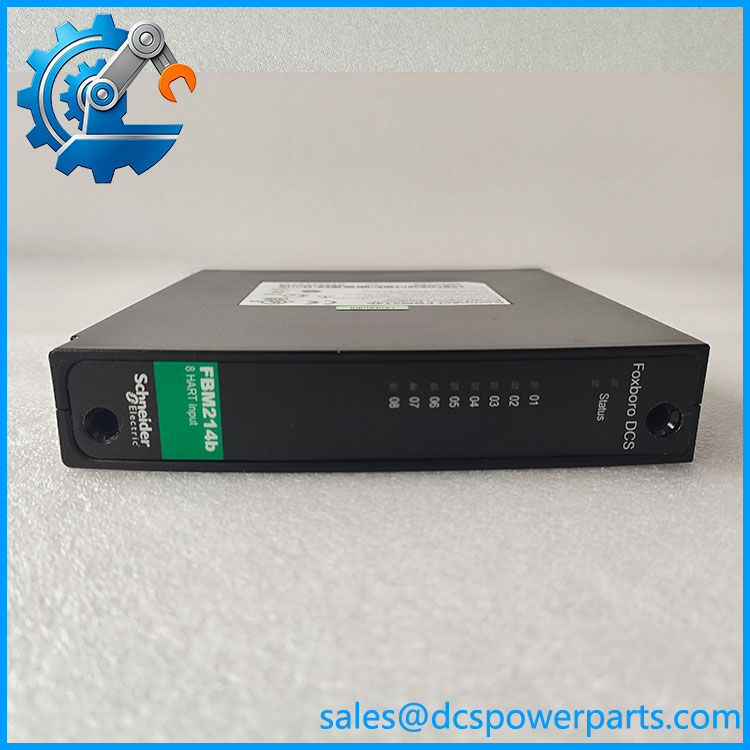
FBM214B RH101AB
Related Products
These Foxboro modules and accessories are relevant when maintaining an I/A Series or Compact 200 Series installation. Their functions and hardware formats differ, so verify compatibility before substitution.
- FBM214 (P0914XQ / P0922VT) — Earlier or standard FBM214 family analog/HART input module. Its group-isolation architecture differs from the individually isolated FBM214B.
- FBM214b RH927AH — Standard 200 Series version of the FBM214b HART input module. It is not the same Compact 200 Series execution as RH101AB.
- FBM216b — Redundant eight-channel HART input module family. Consider it only when the system design supports the required redundant configuration.
- FBM215 — HART analog output module. It serves an output function and is not a direct replacement for an input module.
- FBM201 — Analog input module for conventional signal acquisition; verify supported signal ranges and HART requirements before considering it.
- RH924JH — Termination assembly associated with the Compact FBM214b. Confirm terminal style, cable, and system arrangement before ordering.
Frequently Asked Questions
1. What does the Foxboro do?
It acquires up to eight 4–20 mA process input signals and supports HART digital communication with compatible field instruments. The module is designed for the Compact 200 Series architecture used with Foxboro control systems.
2. Can I hot-swap this module while the DCS is running?
Do not assume hot-swapping is safe or supported in every configuration. Check the applicable Foxboro installation and maintenance instructions, the system’s redundancy arrangement, and the effect of losing the affected input channels. Follow plant procedures before removing the module, and verify channel status after replacement.
3. Does the support firmware v3.1?
A specific firmware version designated v3.1 has not been verified for . Compatibility depends on the installed control-system software and the module’s supported hardware configuration. Confirm the exact controller, software release, and module revision against the applicable documentation.
4. Can I use the in place of RH927AH?
Not as an automatic substitution. is associated with the Compact 200 Series FBM214b, while RH927AH is identified as the standard 200 Series version. Confirm the baseplate, mounting format, termination hardware, cabling, and control-system configuration before selecting either part.
5. Does the module provide loop power to field transmitters?
The FBM214b documentation describes individually isolated loop supplies for its input channels. Verify the exact supply rating and wiring requirements in the applicable manufacturer specification before connecting field devices. External loop supplies may require additional attention to the termination arrangement and HART signal integrity.
6. How can I verify whether a supplied module is genuine and in acceptable condition?
Check the Foxboro identification label, full part number , revision details, and serial information where available. Request clear photographs and written condition disclosure. For used or refurbished modules, ask for test records showing that the input channels, isolation-related checks, and HART functions were evaluated to an appropriate procedure.
7. What should be checked after installation?
Verify the baseplate and termination connections, channel wiring, loop power, analog scaling, and transmitter readings. For HART instruments, confirm communication with the relevant field devices and ensure the required device data is available to the control system. Test the affected process signals and alarms before releasing the system for normal operation.
Procurement recommendation: Specify Foxboro , Compact 200 Series, eight-channel isolated HART input module. Confirm the installed baseplate, RH924JH termination assembly where applicable, cable arrangement, and control-system software before purchase. For a replacement following a channel fault, test the field loop and termination hardware as well as the module to avoid replacing a functioning board unnecessarily.