Description
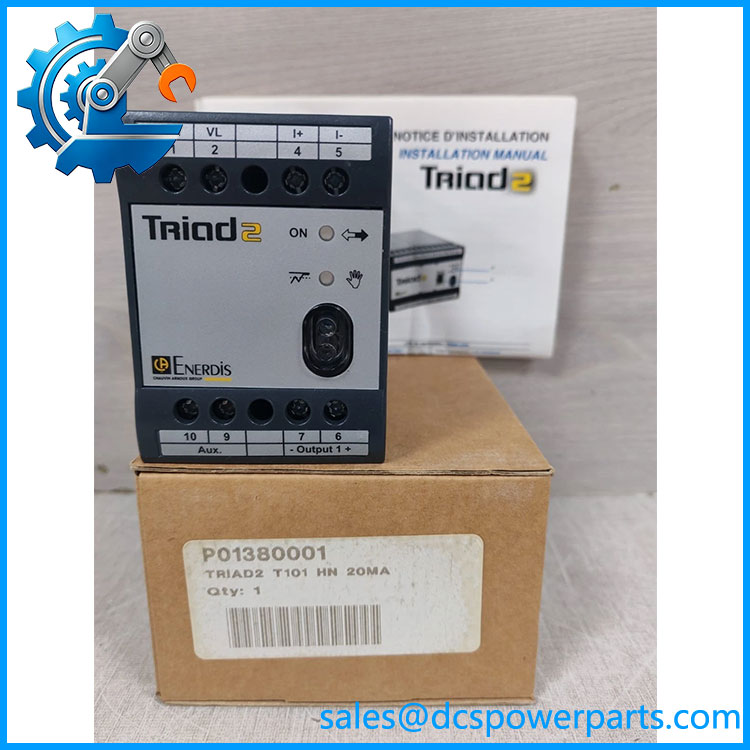
ENERDIS TRIAD 2 T303
Product Overview
The ENERDIS TRIAD 2 T303 is a programmable digital electrical transducer designed to measure electrical quantities and retransmit selected measurements as analog signals for control, monitoring, instrumentation, or SCADA systems. It belongs to the TRIAD2 family developed for electrical-network measurement and signal conversion. The T303 designation identifies the large TRIAD2 format with three configured channels, while the actual electrical configuration is determined by the complete product reference. Chauvin Arnoux Energy documentation confirms that TRIAD2 devices can be configured for voltage or current outputs, with the number of outputs and firmware information read from the instrument itself.
In practical control-system architecture, the ENERDIS TRIAD 2 T303 sits between electrical measurement circuits and downstream automation equipment. It can process quantities such as voltage, current, frequency, power, and phase-related measurements, then provide corresponding analog signals to a PLC, DCS, recorder, regulator, or SCADA input. The configuration software allows CT ratios, VT ratios, wiring diagrams, output channels, transfer functions, classes, and communication parameters to be configured.
The main procurement issue is configuration. T303 is not a single fixed electrical specification. Documented T303 variants include 20 mA output versions and 10 V output versions, as well as high-level and low-level supply configurations. For example, the P01380105 variant is specified with 80–265 V AC/DC auxiliary supply and three configurable 0–20/4–20 mA outputs, while other references use voltage outputs.
For that reason, the complete ENERDIS order code or nameplate should be treated as part of the technical specification.
Product Introduction
Electrical transducers are often replaced incorrectly because the visible model designation is mistaken for the complete configuration. The ENERDIS TRIAD 2 avoids that trap only when its full reference is checked: three analog outputs are part of the platform, but output type, auxiliary supply, communications, and special environmental treatment can vary by order code.
For a legacy measurement-system replacement, this distinction is critical. TRIADJUST 2 provides access to the actual configured measurement and output parameters, while the TRIAD2 diagnostic functions can check voltage inputs, current inputs, wiring, phase sequence, analog outputs, and the Fresnel diagram.
Key Technical Specifications
| Parameter | Specification |
|---|---|
| Product Model | TRIAD 2 |
| Manufacturer / Brand | ENERDIS / Chauvin Arnoux Energy |
| Product Family | TRIAD2 |
| Product Type | Programmable digital electrical transducer |
| Model Format | Large TRIAD2 format |
| Number of Analog Outputs | 3 |
| Output Type | Configuration-dependent: current or voltage |
| Typical Current Output Options | 0–20 mA / 4–20 mA on documented current-output variants |
| Voltage Output Options | 0–10 V / -10 to +10 V on documented voltage-output variants |
| Accuracy Class | Class 0.1 according to IEC 60688 on documented variants |
| Input Measurement | AC voltage and AC current measurement |
| Frequency Measurement | Supported |
| True-RMS Measurement | Supported |
| Active / Reactive Power Calculation | Supported |
| Phase-Angle Calculation | Supported |
| Input Galvanic Isolation | Supported |
| Analog Output Response | Up to 50 ms |
| Input Response | Less than 50 ms according to IEC 60688 on documented variants |
| Configuration Software | TRIADJUST 2 |
| Communication | Configuration-dependent |
| Mounting | DIN rail / direct mounting depending variant |
| Protection Rating | IP20 on documented variants |
| Dimensions | 81 × 120 × 120 mm on documented variants |
The table intentionally distinguishes platform-level specifications from variant-specific values. Current references demonstrate that output type and auxiliary supply are not universal across every .
Major Features / Practical Advantages
1. Programmable Electrical Measurement
The platform is designed around configurable electrical measurement rather than a single fixed signal conversion function. TRIADJUST 2 allows the user to define CT and VT characteristics, network wiring, output channels, transfer functions, and measurement classes.
That matters in retrofit work. A transducer can be matched to the actual measurement architecture rather than forcing the control system to accept whatever fixed scaling happened to be built into an older converter.
ENERDIS TRIAD 2 T303
2. Three Analog Output Channels
The configuration provides three analog outputs. Depending on the complete reference, those outputs may be current or voltage type. Documented variants include 0–20 mA and 4–20 mA current outputs as well as 0–10 V and -10 to +10 V voltage-output versions.
This allows one measurement device to retransmit multiple calculated electrical quantities to separate automation channels. For example, one application may require active power, reactive power, and current, while another may use voltage, frequency, and power factor.
Do not assume those three values are factory-fixed. The output assignment is part of the configuration.
3. IEC 60688 Class 0.1 Capability
Documented variants specify Class 0.1 accuracy according to IEC 60688. This is relevant where the transducer is used as an instrumentation interface rather than merely as a rough process-status converter.
Actual system accuracy still depends on the measurement transformers, wiring, configuration, installation conditions, and the selected measurement function. A Class 0.1 transducer does not turn an inaccurate CT or VT installation into a Class 0.1 measurement system.
4. Fast Signal Retransmission
Documented variants specify analog-output response of approximately 50 ms, with input response below 50 ms under IEC 60688 conditions.
That response is useful for control and monitoring applications where an analog retransmission needs to follow changing electrical conditions without the delay associated with slower supervisory calculations.
For protection functions, however, do not substitute a measurement transducer for a dedicated protection relay merely because its response time appears short.
5. Electrical Quantity Calculation
The family can calculate more than basic RMS voltage and current. Documented functions include frequency measurement, active/reactive power calculation, phase-angle calculation, and true-RMS measurement.
This makes the device useful as a measurement-processing layer between electrical switchgear and an automation system.
6. TRIADJUST 2 Configuration
Chauvin Arnoux Energy provides TRIADJUST 2 specifically for configuration. The software supports input configuration, CT and VT settings, connection diagrams, output configuration, transfer functions, measurement class, communication settings, diagnostics, instantaneous-value visualization, and recording.
For maintenance engineers, the diagnostic capability is particularly useful. The software can examine voltage inputs, current inputs, wiring, phase sequence, analog outputs, and the Fresnel diagram.
7. Galvanic Isolation
Documented variants specify galvanic isolation of the inputs, with product literature for these versions identifying 4 kV isolation.
Isolation is valuable when the transducer interfaces directly with electrical measurement circuits and a control-system analog input. It should still be considered part of the overall protection and grounding design, not as a substitute for proper CT/VT wiring practice.
8. Configurable Communication
supports communication options depending on the installed communication card. The TRIADJUST2 documentation identifies optical, RS-485, and Ethernet configurations within the family.
The model designation alone should not be used to assume that a particular contains RS-485 or Ethernet. Verify the communication-card configuration from the nameplate, software identification, or physical hardware.
9. Industrial and Power-Network Applications
The family is intended for fixed electrical measurement, control, and supervision applications. Chauvin Arnoux Energy identifies applications across electricity generation, transmission and distribution, renewable energy, marine, and other industrial sectors.
That makes the relevant to switchgear monitoring, generator systems, electrical distribution panels, energy-management systems, and PLC/DCS analog acquisition.
Related Products
- — Related transducer model with a different channel/output configuration. Verify the complete reference before treating it as a substitute.
- — Higher-channel family configuration for applications requiring more measurement/retransmission channels.
- — Related three-channel configuration; the exact communication and output configuration must be checked against the full reference.
- — Smaller-format family configuration, useful where cabinet space and channel requirements differ.
- — Custom configuration intended for applications requiring a specified combination of analog outputs and measurement functions. Chauvin Arnoux Energy currently describes CFG as a programmable digital transducer with 1–4 analog outputs.
- TRIADJUST 2 — Configuration and diagnostic software for instruments rather than a transducer itself. It handles CT/VT settings, wiring, outputs, communication, diagnostics, visualization, and recording.
- ENERIUM 50/150 — Electrical measurement products from the same Chauvin Arnoux Energy product ecosystem, oriented toward power monitoring rather than the dedicated analog retransmission role of .
- ENERIUM 100/200/300 — Larger electrical measurement platform for applications requiring broader monitoring and communication functionality.
- TRIAD IEC 60688 — Earlier ENERDIS TRIAD measurement-transducer family associated with the IEC 60688 measurement-converter concept.
FAQ
What is the ENERDIS TRIAD 2 ?
The is a programmable digital electrical transducer in the family, intended to measure electrical quantities and provide configurable analog retransmission. It is not a PLC CPU or conventional DCS I/O module.
How many outputs does have?
The configuration provides three analog outputs. The electrical output type depends on the complete order reference. Documented variants include current outputs such as 0–20 mA / 4–20 mA and voltage outputs such as 0–10 V / -10 to +10 V.
Is a 4–20 mA module?
Not necessarily. Some variants have three 4–20 mA-capable outputs, but other references use voltage outputs. The full ENERDIS/Chauvin Arnoux Energy reference must be checked before specifying the output interface.
Can I use with a PLC or DCS?
Yes, provided the selected output configuration matches the receiving analog input. A 4–20 mA can interface with a compatible current-input channel, while a voltage-output version requires a suitable voltage analog input.
Check scaling, isolation, load requirements, signal polarity, and the configured transfer function before commissioning.
Can I hot-swap the ?
Do not assume unrestricted hot-swapping. The is a measurement transducer with electrical measurement connections, and removing it can interrupt the associated voltage/current measurement circuits and analog retransmission.
In particular, CT secondary circuits require proper maintenance practice. Never open a live CT secondary circuit simply to remove a transducer without following the site’s approved CT shorting and isolation procedure.
Does support firmware v3.1?
Firmware is a separate configuration attribute. TRIADJUST2 can read the installed firmware version from the connected device, but the model designation alone does not establish firmware v3.1. Chauvin Arnoux Energy’s documentation explicitly treats firmware version as a device information field read during communication.
What does TRIADJUST 2 do?
TRIADJUST 2 is used to configure inputs, CT and VT ratios, wiring diagrams, analog outputs, transfer functions, accuracy class, and communication parameters. It also provides diagnostic functions for voltage, current, wiring, phase sequence, analog outputs, and the Fresnel diagram.
What should I verify before buying a replacement ?
At minimum, verify:
- Complete manufacturer reference, not only “”
- Auxiliary supply voltage
- Number and type of analog outputs
- Current versus voltage output range
- Communication-card configuration
- CT/VT measurement configuration
- Wiring/connection diagram
- Firmware and stored configuration where applicable
- Physical revision and nameplate
- Whether the unit is standard or tropicalized
This is particularly important because multiple variants exist under the same basic model designation.
Procurement Note
The ENERDIS TRIAD 2 should be purchased as a configured electrical measurement transducer, not simply as a generic “.” The family supports three analog outputs, IEC 60688 Class 0.1 configurations, electrical quantity calculations, galvanic isolation, and TRIADJUST2 programming, but the exact auxiliary supply, output type, communication interface, and special options depend on the complete reference.
For a legacy replacement, request a clear photograph of the actual nameplate and capture the complete P0138xxx reference if present. If the existing unit is still accessible, connect with TRIADJUST 2 before removal and record the configuration. That can save considerable commissioning time because the replacement may be physically correct while carrying the wrong CT ratio, VT ratio, wiring diagram, output scaling, or communication configuration.
Do not approve a quotation that identifies the item only as “ENERDIS TRIAD 2 ” when the application depends on an exact electrical configuration.