Description
Key Technical Specifications
| Parameter | Specification |
|---|---|
| Product Model | CN4-BELL / CN4-1-BELL |
| Manufacturer | EKF Elektronik GmbH |
| Product Type | Four-port Ethernet interface board |
| Host System | ALSTOM MFC3000 |
| Controller Family | ALSPA Series 6 |
| Ethernet Ports | 4 |
| Port Indicators | ACT (activity), LINK (link status) |
| Network Interface | Ethernet |
| Port Assignment | Depends on the MFC3000 system configuration |
| Installation | Controller rack / compatible board assembly |
| Ethernet Speed | Not independently verified for the exact board revision |
| Communication Protocols | Application-dependent; confirm configured MFC3000 networks |
| Supply Voltage | Not verified |
| Operating Temperature | Not verified |
| Protection Rating | Not verified |
The MFC3000 manual identifies two compatible four-port Ethernet board options: the CP3-QUAD 100TX and EKF CN4-1-BELL. It also shows four Ethernet ports with separate activity and link indicators.
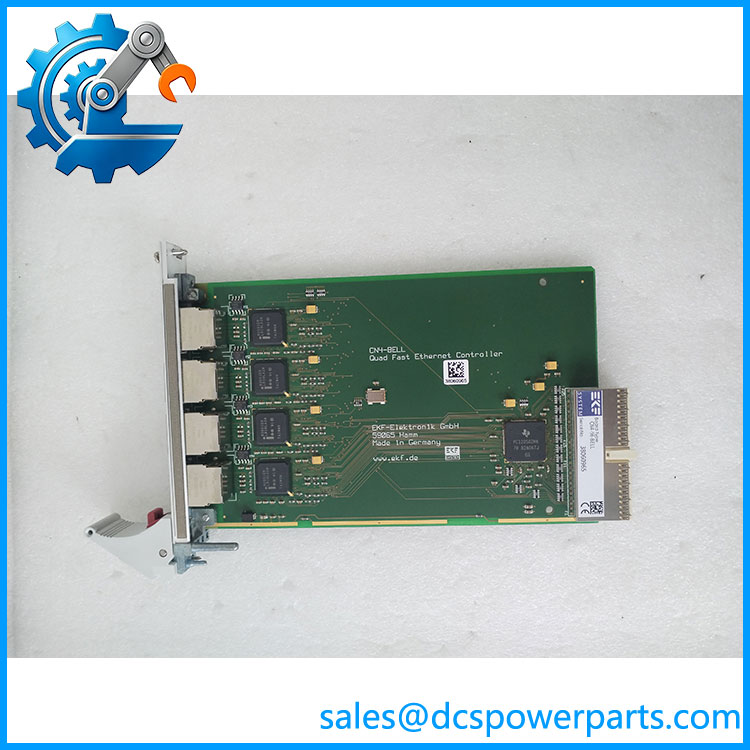
CN4-BELL
Product Introduction
The EKF CN4-BELL is a four-port Ethernet interface board associated with the ALSTOM ALSPA Series 6 MFC3000 controller platform. It provides multiple network connections for controller communication, redundancy links, and external system interfaces. Its role is particularly important in configurations where the MFC3000 must communicate with several separate networks through one controller rack.
The documentation assigns different network functions to the four ports according to the installed control-system configuration. These can include a redundancy connection, E8000 or P8000 network, Modbus TCP communication, and an engineering or HIL access connection. Port assignments must therefore be taken from the actual system configuration, not copied from another installation.
Application Scenarios & Field Pitfalls
Typical applications
- ALSPA Hydro control systems: Ethernet connections for supported hydroelectric control configurations.
- Thermal power control: Network connectivity between the controller and associated control-system networks.
- Small turbine control: Multi-network communication in supported turbine configurations.
- CONTROSTEAM / CONTROGAS systems: Ethernet connectivity for controller networking and redundancy functions.
Field checks before replacement
- Verify the full model marking. Confirm whether the installed board is marked CN4-BELL, CN4-1-BELL, or CN4-96-BELL. Do not assume these designations represent identical hardware revisions.
- Record all four port assignments. Document which network is connected to each port before disconnecting the original board.
- Check ACT and LINK indicators. After installation, verify physical link establishment and traffic activity on each required port.
- Confirm network configuration. Check IP addresses, subnet settings, redundancy topology, and the intended Modbus TCP or controller-network connections.
- Do not assume Gigabit Ethernet. The available documentation identifies the EKF board as a four-port Ethernet option but does not establish a 10/100/1000 Mbps rating for every CN4-BELL revision.
- Check system-specific compatibility. The manual lists the CN4-1-BELL as an alternative to the CP3-QUAD 100TX. This does not establish unrestricted interchangeability in every rack or firmware configuration.
Related Products
- CP3-QUAD 100TX – Four-port Ethernet board from SBS / GE Fanuc, listed as an -compatible alternative.
- – ALSPA Series 6 controller that uses the Ethernet interface board.
- cPCI-8211 – Ethernet interface board identified in the hardware documentation.
- CIF 80-PB – Hilscher PROFIBUS interface board used in supported configurations.
- STI300 – measurement I/O board used for shaft-speed measurement.
These components serve different controller functions. The CP3-QUAD 100TX is the closest related Ethernet-board alternative, but replacement suitability requires confirmation of the installed system configuration.
Procurement and Replacement Notes
For procurement, request photographs showing the complete EKF board label, PCB revision, connector arrangement, and all four Ethernet ports. Ask the supplier to confirm the exact CN4-BELL variant rather than relying on a shortened model description.
For incoming inspection, check connector condition, port link indicators, and board identification. Before returning the to service, verify each network connection individually and confirm that redundancy and process communication functions operate as intended.