Description
Product Overview
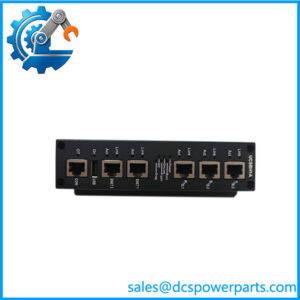
IS420PPNGH1A is the standalone PROFINET gateway of the Mark VIe platform — the module that lets a Mark VIe or Mark VIeS controller own I/O that is not GE I/O. The functional code says what the job is: PPNG is the designation GE uses for its PROFINET gateway function, and the gateways described in GE’s controller documentation are certified as PROFINET RT Version 2.2 I/O controllers, mapping I/O from PROFINET slave devices onto the Mark VIe controller. That sentence is the whole product: a controller that speaks a private I/O network cannot otherwise see a third-party PROFINET device, and this module is how it does.
The confirmation of what this part physically is comes from GE’s own hazardous-location certificate rather than from a datasheet. In the annex to IECEx UL 21.0073X, IS420PPNGH1A appears in the table headed I/O Pack / Controller Modules, in the same block as IS420UCSBH1A, IS420UCSBH3A, IS420UCSBH4A, IS421UCSBH1A and IS421UCSBH4A, with no accessory terminal board listed against it, and with its input declared in the same line as those controllers at 28 V DC, 1.1 A max. Three things follow. It is a controller-class module rather than an I/O pack; it has no terminal board because a gateway’s field connection is an Ethernet port, not a terminal strip; and it is independently powered, which means it is a module in its own right and not a daughtercard inside another controller.
That distinction matters because the gateway function also exists in embedded form. GE’s quad-core IS420UCSCH1A carries an “Embedded PPNG” — a PROFINET gateway running as one virtual machine inside the controller, with the controller’s ENET2 port dedicated to the PROFINET LAN. The standalone IS420PPNGH1A and the embedded function carry the same PPNG designation because they are the same gateway; one is a box on the panel, the other is a partition inside a quad-core controller. For an installation that already has UCSC hardware, the capability may need no separate module at all; for a UCSB-class controller, an existing PROFINET segment, or a gateway that must be replaced without disturbing the controller, the standalone module is the item.
The behaviour of the gateway is documented in GE’s controller manual in enough detail to be useful. It supports third-party PROFINET I/O devices including RSTi-EP Slice I/O, and device update rates are configurable from 1 ms to 512 ms rather than fixed. Configuration is driven by GSDML files for the IO devices, MRP ring parameters where a ring is used, and assignment of PROFINET I/O data to Mark VIe variables in ToolboxST. Data exchange on the PROFINET side is asynchronous to the Mark VIe controller’s scan: the gateway refreshes its devices on its own cycle and hands the latest values to the control logic through an internal path, which is precisely the arrangement that keeps a slow PROFINET device from stretching a fast turbine control loop.
Three communication relation types are established with each PROFINET device — Record Data CRs for non-real-time parameters and diagnostics, IO Data CRs for the cyclic process data that is the point of the gateway, and Alarm CRs for real-time alarms and events. That structure is why the device diagnostics are readable at all: the gateway is a PROFINET I/O controller in the protocol’s own terms, not a protocol translator improvising on top.
The part number itself decodes from GE’s own nomenclature legend printed in the same certificate: the first position is 2 for non-RoHS or 4 for RoHS-compliant, the second is 0 for a printed wiring assembly, 1 for PWAs mounted on a base or 2 for a module containing PWAs, and the third is 0 for the standard operating environment or 1 for conformal coating. IS420PPNGH1A therefore reads as a RoHS-compliant enclosed module in the standard operating environment — no conformal coating. That last field is a maintenance instruction in disguise, and it is worth more than the marketing adjectives: a standard-environment module in a wet or chemically aggressive cabinet needs the cabinet’s protection to be real, because the module does not carry its own.
Two trade descriptions of this part should be discarded. One listing sells it as a redundant power supply converting AC to 24 V DC, which cannot be right for a device whose certified input is 28 V DC at 1.1 A and whose certified role is a network gateway; another calls it an emergency turbine protection plate, a function already occupied in the same certificate by IS220YPROS1A with IS200TREAS1A and by IS220YTURS1A with IS200TRPAS1A. One further point deserves stating plainly rather than glossed: no GE datasheet describing the standalone module’s own port count, enclosure dimensions or processor was retrieved, so those are not asserted here.
Technical Specifications
| Parameter | Value |
|---|---|
| Model | IS420PPNGH1A — IS4 RoHS, 2 module containing PWAs, 0 standard operating environment, PPNG function, H1A revision string |
| Manufacturer | Nexus Controls LLC (GE Mark VIe product line), 1800 Nelson Rd., Longmont, CO 80501, USA |
| Product type | PROFINET gateway module — controller-class, standalone, no accessory terminal board |
| Functional class | PROFINET RT Version 2.2 I/O controller |
| Supply | 28 V DC, 1.1 A maximum input (certified rating, same line as the IS420UCSB controllers) |
| PROFINET peer devices | Third-party PROFINET I/O devices, including RSTi-EP Slice I/O |
| Device update rate | Configurable 1 ms to 512 ms, asynchronous to the Mark VIe controller scan |
| Communication relations | Record Data CRs, IO Data CRs, Alarm CRs per device |
| Configuration | GSDML import per IO device; MRP ring parameters; I/O assignment to Mark VIe variables in ToolboxST |
| Diagnostics | PROFINET I/O device diagnostics and gateway diagnostics available through the controller |
| Hazardous location | Ex ec IIC T4 Gc; IEC 60079-0:2017, IEC 60079-7:2017, IEC 60079-11:2011; IECEx UL 21.0073X Issue 6 (2025-07-02) |
| Ambient temperature | −30 to +65 °C |
| Construction | Enclosed module containing PWAs; standard operating environment, no conformal coating per the 0 field |
| Certified model grouping | Listed with IS420UCSBH1A/H3A/H4A and IS421UCSBH1A/H4A; no S variant of PPNG appears in the certified model list |
| Embedded counterpart | “Embedded PPNG” — gateway function available inside the quad-core IS420UCSCH1A with ENET2 dedicated to PROFINET |
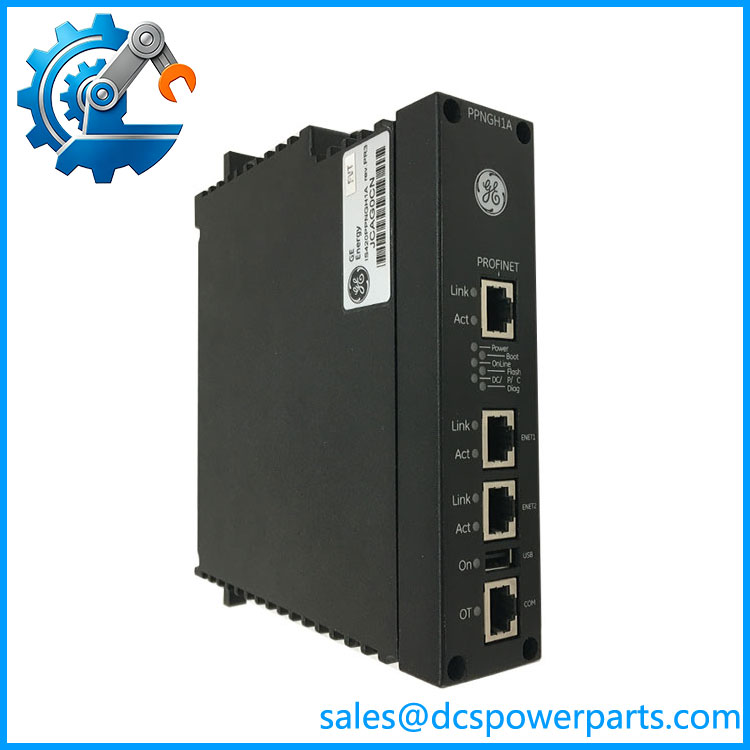
IS420PPNGH1A
Key Features and Advantages
PROFINET RT Version 2.2 I/O controller class: the gateway holds the protocol role of a controller, so third-party devices are handled in their own terms rather than through a translator layer.
Update rates from 1 ms to 512 ms: each device segment can be refreshed on the cycle it needs, and the PROFINET cycle runs asynchronous to the Mark VIe scan so a slow device cannot stretch a fast loop.
GSDML-driven configuration: device behaviour comes from the vendor’s own description file, which keeps engineering honest when a device is replaced by a different type.
Physical network separation from ControlST V07.04 onward: IONet and PROFINET occupy separate ports on the embedded implementation, and the standalone module keeps the same principle — the private I/O network is not exposed to the plant’s PROFINET segment.
MRP ring support: a ring can be configured rather than a star, which is how a PROFINET segment keeps working when one cable is cut.
Correct in the protocol’s terms: Record Data, IO Data and Alarm CRs mean diagnostics and events arrive as PROFINET diagnostics rather than as a polled status word.
Controller-class hardware, no terminal board: the gateway is a module on the panel, not a card in an I/O assembly, so it is replaced without touching field terminations.
Embedded or standalone: the function can live inside a quad-core UCSC controller or as this separate module, so an existing cabinet does not have to add hardware it already owns.
Applications
Third-party I/O on turbine controls: PROFINET valve, actuator and remote I/O hardware brought into a Mark VIe controller that otherwise speaks only IONet.
Balance-of-plant integration: BoP skids supplied with PROFINET interfaces, mapped into the Mark VIe database instead of being wired point to point.
RSTi-EP Slice I/O expansions: distributed slices added where a cabinet has no room for a GE I/O assembly, with the gateway owning the slice network.
Combined cycle and steam plant retrofits: existing PROFINET segments reused when the turbine control is renewed, avoiding a wholesale re-instrumentation of the plant.
Water and auxiliary systems: pump and treatment packages offered with PROFINET connectivity, integrated without a second control system.
Remote and packaged equipment: skid-mounted devices whose vendor supports PROFINET, connected over a single network drop rather than a marshalling cabinet.
Plants separating control and device networks: the gateway keeps the PROFINET LAN on its own port, so the turbine’s private I/O network stays closed.
Related Products
IS420UCSBH1A — Mark VIe compact controller in the same certified model block and the same 28 V DC / 1.1 A input class; the controller this gateway typically serves. IS420UCSBH3A — the UCSB variant certified at 0 to +65 °C, worth noting where a cabinet’s ambient exceeds the standard range. IS420UCSBH4A — higher-specification UCSB controller, same family and same gateway pairing. IS421UCSBH1A — IS421-prefix controller, a distinct catalog prefix in the same family. IS421UCSBH4A — the second IS421 member, differing in specification rather than role. IS420UCSBS1A — the S-variant (safety) controller in the same certificate; note that no equivalent S variant exists for PPNG. IS421UCSBS1A — the IS421-prefix safety controller, same relationship. IS420UCSCH1A — quad-core controller that carries the gateway as an embedded function rather than as a separate module. IS220UCSAH1A — earlier IS220-prefix controller; a cabinet at this generation is where a separate gateway module is most likely to be the practical route. IS220YPROS1A — Mark VIeS protection pack with IS200TREAS1A; the trip function some listings wrongly attribute to PPNG.
Installation and Maintenance
Before installation: confirm whether the cabinet’s controller already provides the gateway function — a quad-core UCSCH1A does, and adding a standalone IS420PPNGH1A beside it buys nothing. Verify the supply is 28 V DC at the module’s terminals and that the 1.1 A figure is available within the panel’s budget rather than assumed. Collect the GSDML files for every PROFINET device on the segment before work starts; a gateway commissioned without them stops at the first device. Note that the 0 field in the part number means no conformal coating, so confirm the enclosure’s ingress protection is doing its job in a humid or dusty location.
Installation: mount the module on the panel as a controller-class device, and keep the PROFINET segment on its own port and its own cable — shielded twisted pair, and a distinct colour from the IONet cables so a technician cannot mistake one network for the other. Import the GSDML files in ToolboxST, assign the device names and IP addresses the segment expects, set each device’s update rate from its process requirement rather than from the fastest available value, and configure MRP parameters only if a ring is actually wired. Map the PROFINET I/O data onto Mark VIe variables and verify each point against the device’s own reading before the loop is closed with it.
Maintenance: treat the gateway as a network asset with a configuration record — device names, IP addresses, update rates, ring parameters and the GSDML revision for every device — because a device replaced with a different firmware or a different GSDML will appear on the network and fail to map. Read the PROFINET device diagnostics and the gateway diagnostics before replacing hardware; a device that has dropped out of the ring and a gateway that has failed report differently. Keep the configuration archived in the ToolboxST project rather than in a laptop folder, and keep a spare only where a cabinet has no embedded gateway to fall back on. Where the installation is in a classified area, verify the certificate issue that names this model before energising, and remember the ambient limit is −30 to +65 °C rather than the wider figures some listings quote.
Warranty and Quality
Every unit is supplied as the Mark VIe PROFINET gateway module, decoded from GE’s own nomenclature legend as IS4 RoHS-compliant, 2 module containing PWAs, 0 standard operating environment, function PPNG, revision string H1A, and is described from GE-issued material for the gateway function and the hazardous-location certificate: listed in the annex to IECEx UL 21.0073X Issue 6 (issued 2 July 2025, certificate holder Nexus Controls LLC, Longmont, Colorado) under I/O Pack / Controller Modules in the same block as IS420UCSBH1A, IS420UCSBH3A, IS420UCSBH4A, IS421UCSBH1A and IS421UCSBH4A, with no accessory terminal board, at 28 V DC 1.1 A max input, marking Ex ec IIC T4 Gc against IEC 60079-0:2017, IEC 60079-7:2017 and IEC 60079-11:2011, and an ambient range of −30 to +65 °C; a PROFINET RT Version 2.2 I/O controller function supporting third-party PROFINET I/O including RSTi-EP Slice I/O, with device update rates of 1 ms to 512 ms, GSDML import, MRP ring configuration, Record Data / IO Data / Alarm CRs, diagnostics through the controller, and — from ControlST V07.04 — physical separation of the IONet and PROFINET networks. Units are inspected for port and connector condition, housing and label integrity, marking legibility, and for evidence of heat damage or prior repair. Two limits are stated rather than smoothed over: the standalone module’s own port count, enclosure dimensions and processor are not published in any document retrieved here, so they are not asserted; and the certified model list carries S variants for the controllers but none for PPNG, so a safety-rated PROFINET gateway is not within the scope this certificate supports. A 12-month repair, replacement or refund commitment applies. Technical support covers what this part actually raises: deciding between the embedded gateway in a UCSCH1A and a standalone module, identifying the eight fields of the part number before a substitute is offered, setting device update rates that do not overload the controller, and reconstructing a PROFINET segment’s device names, addresses and GSDML revisions when the configuration record has been lost.
免费
今天 15:49