Description
Product Overview
IS420UCSCH1A-F-V0.1-A is a Mark VIe UCSC controller of the H1 generation, quoted with a three-part order suffix. The controller itself is well documented: a compact, stand-alone module that runs application-specific control logic for wind turbines, gas and steam turbines and combined-cycle plants, mounts in a panel, and reaches its I/O across an on-board IONet rather than a backplane. The suffix is a different matter, and it is the part of this quotation that deserves attention before anything is ordered.
The certified identity stops at IS420UCSCH1A. GE’s hazardous-location and conformity documentation identifies models by their base catalogue number; the UCSC family’s trailing characters are decoded by GE’s own nomenclature legend, where the prefix position distinguishes non-RoHS from RoHS construction, the next position distinguishes a printed wiring assembly from PWAs on a base and from a module containing PWAs, and the third position distinguishes the standard operating environment from conformal coating. Everything after that — the -F-V0.1-A in this quotation — falls outside the certified model string. It appears in trade listings in several forms across the family: IS420UCSCH1A-B, IS420UCSCH1A-F-V0.1-A, IS420UCSCH1B-B-V0.1-A, IS420UCSCH2A-E-V0.1-A. The visible pattern is a build or revision letter, a software-version token, and a final grouping letter, but no GE document retrieved here names those fields, and the one trade explanation on offer — that the leading letter denotes a “revised edition” and the trailing letter “product grouping information” — is a seller’s reconstruction rather than GE text. The practical consequence is worth stating plainly: a quotation that differs only in these trailing fields may be the same hardware with different loaded software, or a different assembly revision, and the decision cannot be made from the base model alone. The unit’s label and GE’s order record settle it.
Inside the enclosure the architecture is the interesting part. The H1A is a quad-core controller running a real-time hypervisor over QNX Neutrino, and it divides the hardware into separate virtual machines: one running the Mark VIe control application, one running the Embedded PPNG PROFINET gateway, and one running the Embedded Field Agent on Linux for cloud and edge connectivity. The isolation is functional rather than cosmetic — a fault or a software problem in the field-agent partition does not stop the control partition, which continues to execute its loops on QNX. That is a materially different reliability argument from a single operating system running several services, and it is why this controller can host a gateway and a cloud agent without the turbine control inheriting their risk.
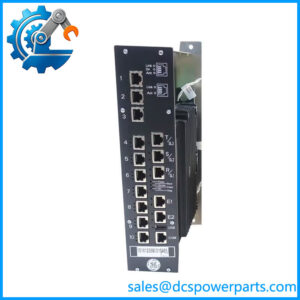
The port layout follows the same logic. Three IONet ports carry the private I/O network — R/SL1, S/SL2 and T/SL3 for the redundant legs — with IEEE 1588 synchronising controller and I/O clocks to within about ±100 microseconds. ENET1 is the primary plant interface carrying ToolboxST, alarms and Modbus TCP, OPC UA or EGD data to the HMI. On the H1A, ENET2 is the PROFINET port, so the third-party device network has a physical connector of its own rather than sharing the plant LAN. The controller also exposes ten independent serial links once the seven-port expansion board is fitted, which is how a UCECH1A assembly is built for applications such as excitation control that need many dedicated connections.
A detail that surprises people who come from rack-based systems: this controller hosts no application I/O at all. All process data arrives over the IONet interfaces, and in a redundant set every I/O network is attached to each controller, so no single point of application input is lost when one controller is powered down for maintenance. That is the architectural claim the UCSC family is built on, and it holds whether the set is Dual or TMR.
Two figures in circulation for this family are worth separating from verified content: processor and memory are reported in trade documentation as a quad-core AMD G-Series part at 1.2 GHz with 4 GB of DDR3-1333 SDRAM, and physical data as roughly 6.61 × 5.90 × 2.17 inches at about 1.3 kg, with storage to −40 to +85 °C. None of those appear in a GE-issued datasheet retrieved here, and earlier generations of this controller are described with different processors in different listings, so they are presented as reported rather than confirmed.
Technical Specifications
| Parameter | Value |
|---|---|
| Model | IS420UCSCH1A-F-V0.1-A — certified base model IS420UCSCH1A plus order suffix -F-V0.1-A |
| Manufacturer | Nexus Controls LLC (GE Mark VIe product line), 1800 Nelson Rd., Longmont, CO 80501, USA |
| Product type | Mark VIe UCSC compact stand-alone controller, H1 generation, quad-core |
| Construction fields | IS4 RoHS-compliant; 2 module containing PWAs; 0 standard operating environment (no conformal coating), per GE’s nomenclature legend |
| Architecture | Quad-core processor with real-time hypervisor running QNX Neutrino; separate virtual machines for the control application, the Embedded PPNG gateway and the Embedded Field Agent |
| IONet | 3 ports — R/SL1, S/SL2, T/SL3; IEEE 1588 clock synchronisation to approximately ±100 µs |
| Plant interface | ENET1 primary LAN carrying ToolboxST, alarm communication and Modbus TCP / OPC UA / EGD |
| PROFINET interface | ENET2, twisted pair 10Base-T/100Base-TX, RJ-45 (H1A configuration) |
| Serial links | 10 independent links — R/SL1, S/SL2, T/SL3 plus expansion ports 1–7, GE proprietary high-speed serial link |
| Local ports | 2 × USB (initial UDH IP setup and controller restore); COM port RJ-45 at 115200 bit/s, 8N1, no flow control; Display port disabled after start-up; microSD slot not supported |
| Supply | 18–30 V DC, nominal 24/28 V DC; 3-pin Phoenix Contact plug, pin 1 GND, pin 2 −, pin 3 +; 28–16 AWG |
| Redundancy | Simplex, Dual or TMR; bumpless switchover in Dual, 2-out-of-3 voting in TMR; mixed controller platforms permitted in a redundant set from ControlST V07.04 |
| Non-volatile capacity | ControlST V07.04 and below: 3067 non-volatile variables, 338 arrays, 64 totalizers; V07.05 and above: 6139 variables, 338 arrays, 128 totalizers |
| Security | 8-character access password supported from controller firmware V06.00.00C; SecurityST secure mode with encrypted and authenticated communications |
| Diagnostics | ONL, Diag, OT, VDC, Boot and FAOK indicators |
| Software baseline | Available beginning with ControlST V07.01; configuration in ToolboxST (GEH-6700 / GEH-6703) |
| Reported physical data | Approximately 6.61 × 5.90 × 2.17 in, about 1.3 kg, convection cooled, storage −40 to +85 °C — trade documentation, unconfirmed by GE datasheet |
| Processor and memory | Reported as quad-core AMD G-Series 1.2 GHz with 4 GB DDR3-1333 — trade documentation, unconfirmed |
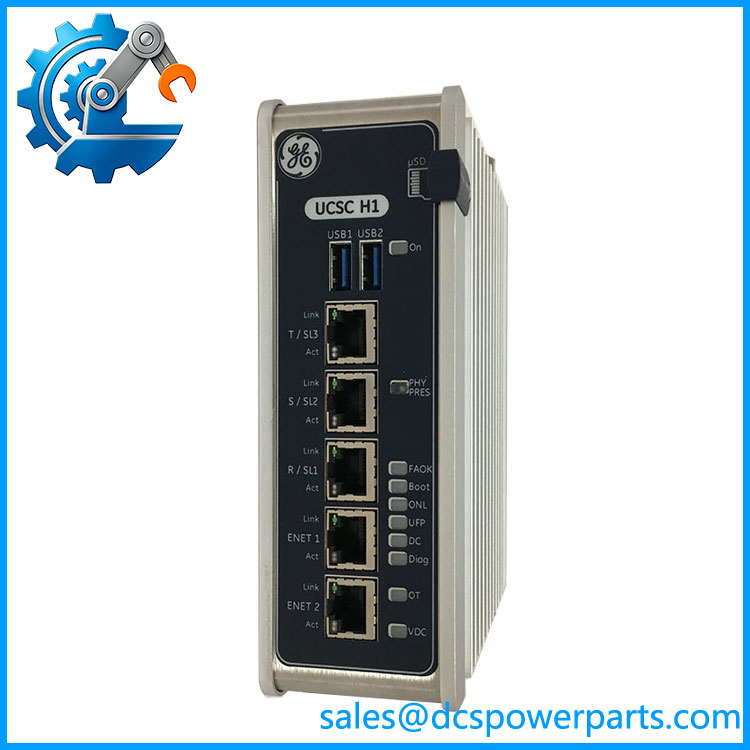
IS420UCSCH1A-F-V0.1-A
Key Features and Advantages
Virtual machines, not just multiple services: the control application, the PROFINET gateway and the field agent run in separate partitions, so a problem in the cloud-facing side does not reach the loops.
No hosted application I/O: every process input arrives over IONet, and every controller in a redundant set sees every I/O network, so maintenance on one controller does not remove a single input from the logic.
Ten serial links with one expansion board: three ports standard, ten with the seven-port board, which covers applications that need many dedicated connections without adding a second controller.
IEEE 1588 synchronisation: controller and I/O clocks held to roughly ±100 µs, which is what makes sequence-of-events and cross-controller comparison meaningful.
PROFINET on its own port: third-party devices sit on ENET2 while the plant LAN sits on ENET1 and the I/O network on IONet’s three ports — three networks, three purposes, no shared cable.
Bumpless switchover and 2-out-of-3 voting: Dual and TMR are supported configurations rather than options added later, and platform mixing within a redundant set is permitted from ControlST V07.04.
Configuration portability: the controller holds no unique configuration to preserve — the project file carries it, and a USB recovery file rebuilds the unit, which makes spares practical.
Security that can be switched on: an eight-character access password from firmware V06.00.00C and SecurityST secure mode for encrypted, authenticated communications.
Applications
Gas and steam turbine control: the controller that runs the turbine application where a compact, panel-mounted unit replaces a rack-mount processor.
Combined-cycle balance of plant: BoP loops on the same platform as the turbine, with the plant LAN and the I/O network kept apart.
Wind turbine control: the family’s declared application set includes wind, where a fanless, battery-free module suits a nacelle or tower cabinet.
Excitation control: a UCECH1A assembly with the seven-port expansion, used where excitation needs many dedicated serial connections.
PROFINET-connected plant equipment: the embedded gateway brings third-party PROFINET devices into the controller without a separate gateway box.
Edge and cloud monitoring: the Embedded Field Agent partition collects and transmits machine data while the control partition runs independently of it.
Redundant and TMR architectures: Dual sets for availability and TMR sets for voting, with every I/O network attached to each controller.
Legacy Mark VIe cabinets being renewed: sites moving from UCSB or UCSA hardware onto the quad-core platform, where the order suffix determines what software the unit arrives with.
Related Products
IS420UCSCH1B — the same H1 controller without the embedded PROFINET gateway; the variant to specify when only the field agent is needed. IS420UCSCH1C — H1 controller with the embedded EtherCAT master instead of the PROFINET gateway; a different device network, a different choice. IS420UCSCH2A — dual-core UCSC controller, three-port, available from ControlST V07.04. IS420UCSCS2A — the Mark VIeS safety version of the same compact controller, for SIL 2 and 3 safety loops. IS420UCECH1A — controller plus seven-port expansion board, turning three serial links into ten; the excitation-control configuration. IS420UCSBH1A — previous-generation UCSB controller, the hardware this platform replaced. IS420UCSBH4A — higher-specification UCSB member, still the fallback where a cabinet’s spares strategy is built on that generation. IS420PPNGH1A — the PROFINET gateway as a standalone module, for cabinets that need the function without the quad-core controller. IS420UCSBS1A — UCSB safety controller; a different prefix and a different certification path from the UCSC safety unit. IS220UCSAH1A — the earliest IS220-prefix controller, the generation before UCSB.
Installation and Maintenance
Before installation: read the unit’s label rather than the quote, and confirm which order suffix actually shipped — the -F-V0.1-A field decides what software the controller arrives with, and a mismatch found at commissioning is a mismatch the project has to absorb. Confirm the supply is 18–30 V DC at the terminals and wire the three-pin Phoenix plug correctly: pin 1 ground, pin 2 negative, pin 3 positive, with 28–16 AWG conductors. Because the construction field reads 0 — standard operating environment with no conformal coating — verify the enclosure’s protection rather than assuming it.
Installation: mount the controller in the panel with clearance for convection cooling, and keep the three networks physically distinct — IONet on the R/SL1, S/SL2, T/SL3 ports, the plant LAN on ENET1, PROFINET on ENET2 — using shielded Cat 5e or better and a cable colour that stops a technician from confusing them. Set the UDH address through the USB port or the COM port before the controller is placed online, then download the project and confirm the ONL lamp is solid with no Diag alarm. Where a Dual or TMR set is being built, verify that each controller is attached to every I/O network before the redundant group is formed, and test the switchover deliberately — pull the designated controller’s power or network and watch for a bumpless transfer.
Maintenance: read the indicators in order — Boot during start-up, ONL for application running, OT for an over-temperature condition that will shut the unit down if it escalates, VDC for supply health, FAOK for the field agent’s cloud connection. A controller that boots but does not reach ONL is usually a download or configuration problem rather than a hardware one, and the Boot lamp’s flash pattern narrows a failure to memory or firmware. Keep the ToolboxST project archived as the authoritative configuration, take a USB recovery file before any replacement, and confirm the replacement carries the same order suffix — a unit with a different suffix may load different software into a validated control scheme. Set the access password where the plant standard requires it, and enable SecurityST only as part of a planned roll-out, since secure mode changes how the controller communicates.
Warranty and Quality
Every unit is supplied as a Mark VIe UCSC H1 quad-core controller, with its certified base model decoded from GE’s own nomenclature legend as RoHS-compliant, module containing PWAs, standard operating environment, and is described from GE system-manual material for this generation: a compact stand-alone controller running a real-time hypervisor over QNX Neutrino with separate virtual machines for the control application, the Embedded PPNG PROFINET gateway and the Embedded Field Agent; three IONet ports R/SL1, S/SL2, T/SL3 with IEEE 1588 synchronisation to approximately ±100 µs; ENET1 as the primary plant LAN carrying Modbus TCP, OPC UA or EGD; ENET2 as the PROFINET twisted-pair port on the H1A; ten independent serial links once the seven-port expansion board is fitted; 18–30 V DC nominal 24/28 V DC supply through a three-pin Phoenix Contact plug with 28–16 AWG conductors; Simplex, Dual and TMR configurations with bumpless switchover and 2-out-of-3 voting; controller-platform mixing in redundant sets from ControlST V07.04; non-volatile capacity of 3067 variables, 338 arrays and 64 totalizers through V07.04 and 6139 variables, 338 arrays and 128 totalizers from V07.05; an eight-character access password from firmware V06.00.00C and SecurityST secure mode; ONL, Diag, OT, VDC, Boot and FAOK indicators; and availability from ControlST V07.01. Units are inspected for connector and pin condition, housing and label integrity, port latch condition, revision and suffix marking legibility, and for evidence of heat damage or prior repair. Two boundaries are declared rather than blurred: the -F-V0.1-A suffix is not decoded in any GE document retrieved, so it is treated as an order configuration field whose meaning is confirmed from the label and GE’s order record — not from the base model; and processor, memory and physical figures for this platform are quoted as trade-reported because no GE datasheet confirming them was obtained. A 12-month repair, replacement or refund commitment applies. Technical support covers what this controller actually raises: reconciling a quotation’s order suffix with the label on the unit, deciding between the H1A, H1B and H1C embedded functions, setting up UDH addressing and the three separate networks, planning a Dual or TMR set so every I/O network reaches every controller, and archiving the ToolboxST project and USB recovery file before a controller is replaced.
免费
今天 15:57