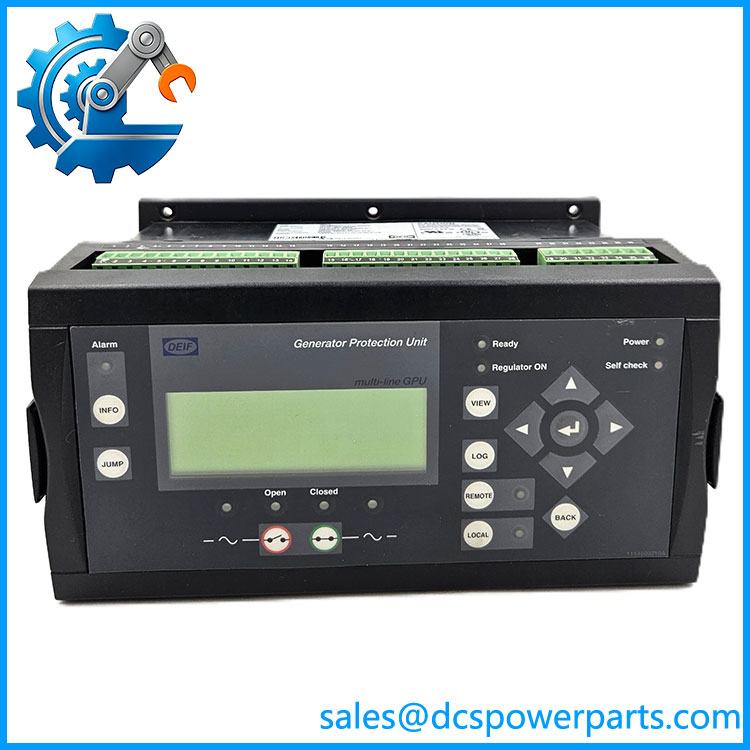
Description
Product Introduction
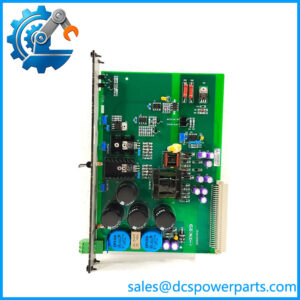
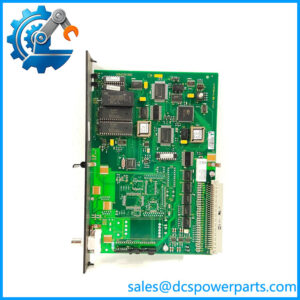
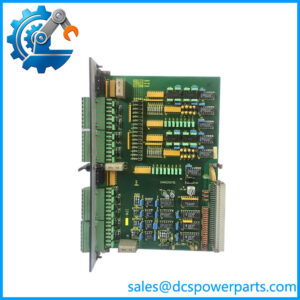
Generator control becomes difficult when protection, synchronization, measurement, and PLC communication are split across several independent devices. The DEIF GPU-3 was designed around that problem. It combines generator and busbar protection with synchronization and three-phase measurement, while its serial communication interfaces allow integration with PLC-based power-management and SCADA systems. DEIF also provides a local LCD for displaying operating values and alarms.
The DEIF GPU-3 can be configured beyond basic generator protection through optional interface hardware. DEIF describes an engine interface card with its own power supply and independent microprocessor; this adds start/stop and engine protection functions and provides backup engine supervision if the main GPU-3 processor fails. That architecture matters in generator installations where a controller failure should not automatically mean loss of engine shutdown supervision.
Key Technical Specifications
| Parameter | Specification |
|---|---|
| Product Model | GPU-3 |
| Manufacturer | DEIF |
| Product Family | Multi-Line 2 |
| Product Type | Generator Protection Unit |
| Primary Function | Generator and busbar protection |
| Synchronization | Integrated generator synchronization |
| Measurement | Three-phase measurement circuits |
| Local Display | LCD display for operating values and alarms |
| Communication | Serial communication for PLC/SCADA integration |
| PLC Integration | Designed for PLC-based power-management systems |
| Engine Control | Available through optional engine interface card |
| Engine Protection | Supported with optional engine interface |
| Backup Supervision | Independent processor on optional engine interface card |
| Mounting Options | Rear mount / DIN-rail mounting |
| Application | Gensets, power-management systems, marine and land power applications |
| Configuration | Application logic and functions configurable through DEIF software |
DEIF specifically lists generator/busbar protection, synchronization, multiple display/operator-panel capability, engine protection with backup on shutdown channels, and engine control/communication among the GPU-3 feature set.
Application Scenarios & Pain Points
The practical issue with generator controllers is rarely just voltage or frequency measurement. The difficult part is getting protection, breaker control, synchronization, engine sequencing, and supervisory communication to behave correctly as one system.
- Generator protection: GPU-3 provides protection functions for generators and busbars while continuously handling three-phase electrical measurements.
- Generator synchronization: Suitable for applications where a generator must be synchronized with a busbar or other generation before connection.

DEIF GPU-3
- PLC-based power management: Serial communication allows the controller to exchange information with PLC and SCADA equipment rather than operating as an isolated relay.
- Marine generator systems: DEIF documentation specifically presents for marine and offshore generator applications, including multiple gensets and power-management arrangements.
- Engine supervision: With the optional engine interface card, the controller can provide start/stop and engine protection functions with an independent processor for backup supervision.
Field note: In a multi-generator system, synchronization settings and breaker logic deserve more attention than the controller’s front-panel display. A replacement unit may power up perfectly while still having incorrect CT/VT ratios, nominal frequency, protection thresholds, or synchronization parameters.
Related Products
- DEIF gas — Generator protection variant intended for gas-engine applications, with generator protection, synchronization, and engine-control functions.
- DEIF hydro — Variant intended for hydroelectric applications, with turbine-control functionality available through its turbine interface option.
- DEIF PPU-3 — Paralleling and protection unit from the same Multi-Line 2 generation, suited to applications requiring combined paralleling and protection functionality.
- DEIF GPU 300 — Earlier generator protection unit; DEIF identifies it as being phased out and replaced by the iE 250.
- DEIF iE 250 — Current replacement direction referenced by DEIF for the GPU 300 rather than a direct assumption of interchangeability.
These are related products, not automatic drop-in substitutes. The actual replacement decision depends on the required protection functions, communications, I/O, generator configuration, approvals, and existing control logic.
Engineer’s Guide — Field Pitfalls to Avoid
1. Do not confuse with gas or hydro
The product names are close, but their intended control applications differ. DEIF maintains separate documentation for , gas, and hydro.
Avoidance: Match the complete controller designation and option configuration before ordering a replacement.
2. Do not assume the base includes every engine-control function
The standard provides generator protection and synchronization. DEIF describes the engine-control functions as being provided through an optional engine interface card.
Avoidance: Check the installed option cards, not just the name on the front panel.
3. Back up the configuration before replacing the controller
A physically identical controller can still have different protection settings, I/O assignments, synchronization parameters, or application logic.
Avoidance: Save the existing configuration and record CT/VT ratios, nominal voltage, frequency, breaker logic, protection thresholds, and communication parameters before removal.
4. Check the communication architecture
is intended to communicate with PLC and SCADA systems through serial communication.
Avoidance: Document the existing protocol, addressing, baud-rate configuration, termination, and PLC data mapping before commissioning a replacement.
5. Do not treat “powers up” as a functional test
For a generator protection controller, successful booting proves very little. Measurement scaling, synchronization, trip logic, breaker commands, alarms, and shutdown channels all need verification.
Avoidance: Test the controller against the actual generator protection and synchronization sequence before returning the genset to automatic operation.
FAQ
What is the DEIF ?
The is a generator protection unit from the Multi-Line 2 family. It combines generator/busbar protection, synchronization, three-phase measurement, local display, and communication functions for PLC-based power-management systems.
Can the control a generator engine?
It can, when equipped with the appropriate optional engine interface card. DEIF states that this card adds start/stop and protection functionality and has its own power supply and independent microprocessor.
Can DEIF communicate with a PLC or SCADA system?
Yes. Serial communication is provided for interfacing the with PLCs, SCADA systems, and other supervisory equipment. The exact communication configuration should be verified against the installed hardware and application.
Is suitable for marine generator applications?
Yes. DEIF’s marine/offshore application documentation specifically presents as a generator protection and control solution for marine power-management systems.
What should I check before buying a replacement ?
Check the complete model designation, hardware revision, installed option cards, communication configuration, mounting arrangement, and application settings. For an existing genset installation, also compare the CT/VT configuration and protection parameters with the original controller.
Is the same as gas?
No. DEIF lists and gas as separate controller variants. gas is specifically intended for gas-engine generator applications.
Is still a suitable choice for a new control-system design?
That depends on the project requirements and lifecycle status of the specific configuration. For an existing installation, compatibility with the installed system is the primary consideration. For a new design, the current DEIF product portfolio should be evaluated rather than assuming an older Multi-Line 2 controller is the intended platform.