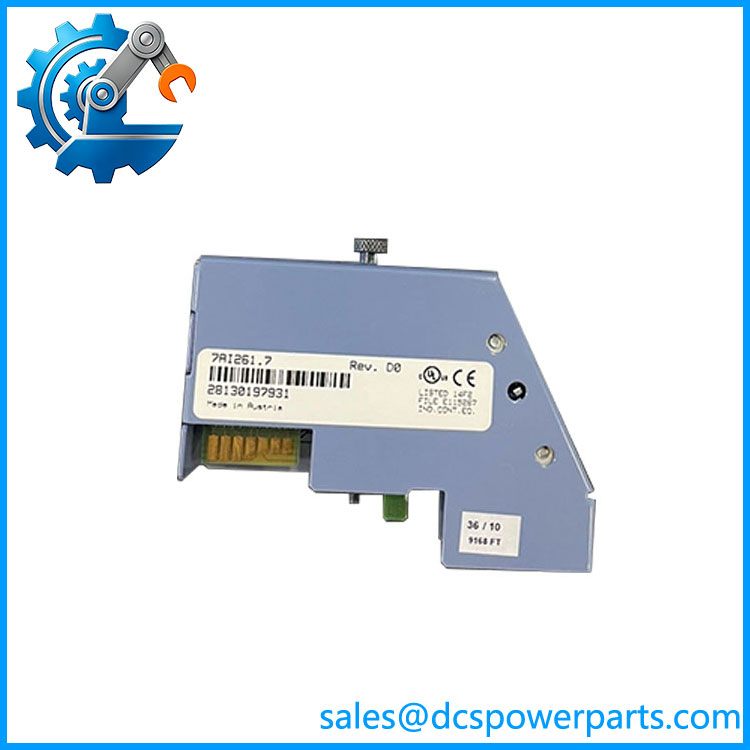
Description
Key Technical Specifications
| Parameter | Specification |
|---|---|
| Product Model | 7AI261.7 |
| Manufacturer | B&R Industrial Automation |
| Module ID | AI261 |
| Product Family | B&R System 2003 |
| Product Type | Analog Input / Strain Gauge Module |
| Number of Inputs | 1 |
| Input Type | Full-bridge strain gauge |
| A/D Converter Resolution | 24 bit |
| Measurement Range | ±1 to ±16 mV/V, software configurable |
| Input Current | <140 nA |
| Operating / Measuring Range | 75 to 5000 Ω |
| Bridge Excitation | 4.5 VDC ±3% |
| Maximum Bridge Current | 60 mA |
| Sensor Connection | 4-wire |
| Calibration | Software-based, including during operation |
| Linearization | y = k × x + d |
| Internal Power Consumption | Maximum 0.6 W |
| Protection | Short-circuit and overload protection |
| Module Construction | B&R 2003 screw-in module |
| Adapter / Interface | AF101 Adapter Module / CP Interface |
| Typical Applications | Load cells, force, pressure, strain, torque measurement |
The OEM B&R material identifies 7AI261.7 as a System 2003 analog input module with one full-bridge strain-gauge input and 24-bit conversion. The documented bridge excitation is 4.5 VDC ±3%, with a maximum current of 60 mA.
One specification deserves particular attention during procurement: the module is not an eight-channel general-purpose analog input. Some third-party product pages incorrectly describe this part as an 8-channel, 16-bit voltage/current module. That conflicts with B&R’s own product identification and technical documentation, which specify one full-bridge strain-gauge input and 24-bit resolution.
Application Scenarios & Pain Points
A weighing system can become unreliable from a surprisingly small wiring problem. With millivolt-per-volt bridge signals, a loose terminal or incorrect excitation arrangement can produce a measurement that looks plausible but is materially wrong.
- Industrial weighing: The single full-bridge input is suited to load-cell applications where weight must be converted into a control-system value.
- Force measurement: Presses, tension systems, and mechanical test equipment can use strain-gauge bridges to measure applied force. The 24-bit conversion provides considerably more measurement granularity than the older 12-bit analog modules in the same System 2003 family.
- Pressure measurement: Bridge-type pressure transducers can be connected where their electrical characteristics fall within the documented ±1 to ±16 mV/V range.
- Torque and strain monitoring: A suitable bridge sensor can provide the input for torque, bending, or mechanical strain measurement. B&R documentation specifically lists force, bending elasticity, weighing cells, pressure, strain, and torsion measurement as applications.
Field note: For a four-wire load cell, verify excitation and signal polarity before blaming the AI module. A swapped signal pair can produce an inverted reading; an excitation problem can create drift that looks like calibration failure.

- 7AI261.7
Related Products
- B&R 7AI294.7 — System 2003 analog input module with four inputs for potentiometric displacement measurement. It belongs to the same general screw-in module family but is intended for potentiometers rather than full-bridge strain gauges.
- B&R 7AI351.70 — One-channel analog input supporting ±10 V or 0–20 mA signals. It is a better fit for conventional voltage/current transmitters, but it is not a substitute for a millivolt strain-gauge bridge.
- B&R 7AI354.70 — Four-channel ±10 V analog input module. Use it for voltage measurement rather than load-cell bridge acquisition.
- B&R 7AI774.70 — Four-channel 0–20 mA analog input module. Appropriate for current-output transmitters, not direct full-bridge load-cell signals.
- B&R 7AT352.70 — Two-channel PT100 input module with three-wire connections. It handles resistance-temperature measurement and serves a completely different sensor type.
- B&R 7AT664.70 — Four-channel thermocouple input module. Suitable for temperature measurement using thermocouples rather than strain-gauge bridges.
- B&R 7AO352.70 — Two-channel analog output module supporting ±10 V or 0–20 mA. It complements input modules when an analog control output is required but cannot replace 7AI261.7.
- B&R AF101 — Adapter/interface component associated with the CP interface for System 2003 screw-in modules. The 7AI261.7 documentation identifies AF101 in its interface arrangement.
The Engineer’s Guide: Field Pitfalls to Avoid
⚠️ Do not replace it with a standard 4–20 mA analog input.
The 7AI261.7 is designed for a full-bridge strain-gauge signal, with a specified ±1 to ±16 mV/V measurement range. A conventional current-input module cannot directly perform the same bridge excitation and measurement function.
⚠️ Check the bridge excitation before commissioning.
The documented excitation is 4.5 VDC ±3%, maximum 60 mA. Verify the load cell’s excitation requirements and wiring before connecting it. An incorrect bridge arrangement can make a good module appear defective.
⚠️ Do not confuse 7AI261.7 with similarly numbered System 2003 modules.
7AI351.70, 7AI354.70, and 7AI774.70 are voltage/current input modules with entirely different electrical functions. The suffix and complete part number matter.
Practical check: Before removing the existing card, record the load-cell excitation voltage, bridge resistance, signal polarity, configured mV/V range, zero offset, and scaling coefficients. The module supports software calibration and linearization, so configuration is part of the replacement—not an afterthought.
Frequently Asked Questions (FAQ)
What is B&R 7AI261.7 used for?
The B&R 7AI261.7 is a one-channel System 2003 analog input module for full-bridge strain-gauge measurement. Typical applications include load cells, force measurement, pressure measurement, strain measurement, bending measurement, weighing, and torque measurement.
How many channels does the B&R 7AI261.7 have?
It has one input channel. This is an important distinction because several inaccurate online descriptions identify the part as an 8-channel general-purpose analog module. B&R’s technical documentation specifies one full-bridge input.
What is the resolution of 7AI261.7?
The A/D converter provides 24-bit resolution. The measurement range is software configurable from ±1 to ±16 mV/V, allowing the module to accommodate different bridge-output levels.
Can I connect a 4–20 mA pressure transmitter to 7AI261.7?
No—not directly as a normal 4–20 mA transmitter input. The 7AI261.7 is designed for a full-bridge strain-gauge signal. If the pressure transmitter provides 4–20 mA, a suitable current-input module such as the System 2003 7AI774.70 is the more appropriate architecture.
What load-cell wiring does 7AI261.7 use?
The documented connection is four-wire, with bridge excitation supplied by the module. The specified bridge operating voltage is 4.5 VDC ±3%, with maximum current of 60 mA. Verify the sensor’s bridge resistance and wiring before commissioning.
Is 7AI261.7 compatible with B&R System 2003?
Yes. B&R identifies it specifically as a B&R 2003 screw-in module, and its documentation references the AF101 adapter/CP interface arrangement. It is also listed among the screw-in modules supported by B&R Power Panel interfaces.