Description
Bently Nevada TK3 177313-01-01
Product Overview
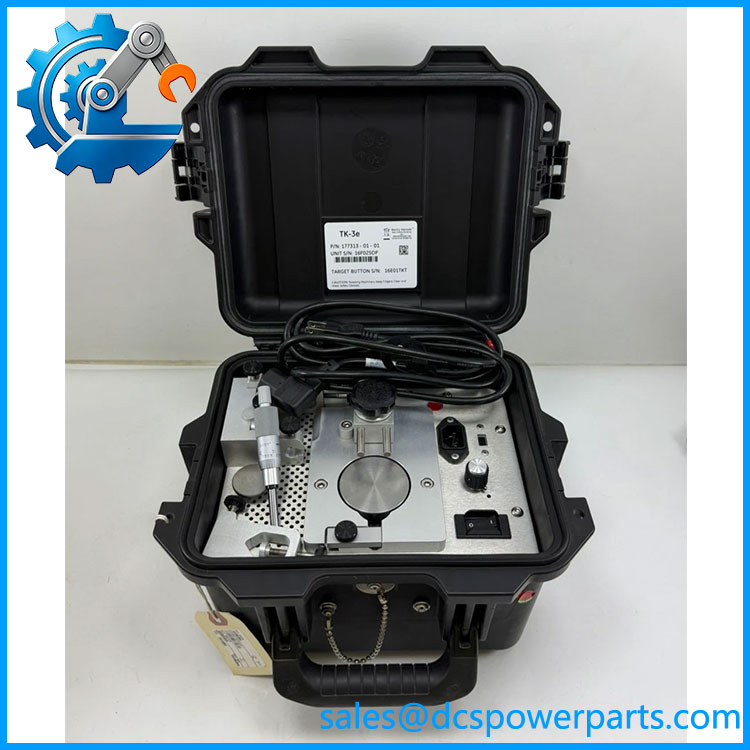
The Bently Nevada TK3 177313-01-01 is an electric-driven TK-3e Proximity System Test Kit used to check and calibrate Bently Nevada eddy-current proximity transducer systems. Its job is very specific: provide controlled mechanical movement and vibration so a technician can evaluate the relationship between a proximity probe, target, Proximitor Sensor, and the receiving machinery-monitoring channel. It is therefore a maintenance and commissioning instrument rather than a permanent component installed in a PLC, DCS, or machinery protection rack. Baker Hughes identifies the electric-driven TK-3e under the 177313 ordering family.
The 177313-01-01 configuration combines an English measurement scale with an American power cord. The test kit provides both a wobulator for simulated shaft vibration and a spindle micrometer for static probe-position testing. The documented wobulator amplitude range is 50 to 254 μm peak-to-peak, while the spindle mechanism provides 0 to 25.4 mm of controlled target movement. This allows field personnel to evaluate both dynamic vibration response and the DC gap/position relationship of compatible eddy-current probe systems.
For engineers maintaining legacy Bently Nevada machinery-monitoring systems, the value of the Bently Nevada TK3 177313-01-01 is its ability to test the complete measurement chain without relying solely on a running machine. A technician can mount a probe in the supplied universal arrangement, change the target position in known increments, and observe the resulting Proximitor output. That makes it useful during commissioning, troubleshooting, calibration checks, and maintenance of machinery protection channels. It should not, however, be confused with an electronic calibrator that can automatically characterize every monitor configuration.
Product Introduction
A vibration monitor can report a perfectly plausible number while the actual probe gap, cable, Proximitor, or mechanical target condition is wrong. The TK3 177313-01-01 addresses that problem by creating a controlled mechanical reference for the proximity measurement chain.
Its electric-driven wobulator provides 50–254 μm peak-to-peak vibration, while the spindle micrometer provides 0–25.4 mm of controlled position movement. For a Bently Nevada proximity system calibration or legacy machinery-monitoring maintenance job, those mechanical references are often more useful than simply forcing a signal into the monitor input.
Key Technical Specifications
| Parameter | Specification |
|---|---|
| Product Model | TK-3e |
| Part Number | 177313-01-01 |
| Manufacturer / Brand | Bently Nevada |
| Product Type | Proximity System Test Kit |
| Drive Type | Electric-driven |
| Scale Units | English |
| Power Cord | American |
| Electric Supply | 95–125 VAC, 50/60 Hz, 1 A minimum |
| Alternate Electric Supply | 190–250 VAC, 50/60 Hz, 1 A minimum |
| Pneumatic Version | TK-3g uses air drive; not applicable to this electric configuration |
| Wobulator Vibration Amplitude | 50–254 μm (2–10 mils) peak-to-peak |
| Maximum Wobulator Speed | 0–5000 cpm, ±1000 cpm |
| Spindle Micrometer Range | 0–25.4 mm (0–1000 mils) |
| Universal Probe Mount Range | 5–19 mm (0.197–0.75 in) probe diameter |
| Operating Temperature | 0 to 50°C (32 to 122°F) |
| Storage Temperature | -18 to 65°C (0 to 150°F) |
| Humidity | Up to 95% non-condensing |
| Environmental Design | IP54 for dust/water exposure when closed |
| Approx. Dimensions | 195 × 299 × 248 mm |
| Approx. Weight | 5.22 kg |
| Primary Application | Proximity probe and machinery-monitoring system testing |
The above values are taken from the TK-3 technical documentation and ordering information. Some commercial listings report different shipping weights and operating-temperature figures, so the manufacturer’s published TK-3 documentation should take precedence when preparing a calibration procedure or equipment specification.
TK3 177313-01-01
Major Features / Practical Advantages
Dynamic Proximity-System Testing
The TK-3e does more than provide a convenient mechanical fixture. Its wobulator creates controlled shaft-like motion that allows a technician to examine the dynamic response of an eddy-current proximity system. The documented vibration amplitude range is 50 to 254 μm peak-to-peak, equivalent to 2–10 mils.
This is particularly useful when troubleshooting a vibration channel that appears electrically healthy but produces questionable amplitude readings during operation.
Controlled Static Probe-Gap Verification
The spindle micrometer provides 0–25.4 mm of calibrated mechanical movement. That gives the technician a controlled way to vary the distance between the probe and target and observe the corresponding Proximitor output.
For field work, this distinction matters. A monitor can only process the signal it receives. The TK-3 helps determine whether the sensor chain itself is behaving correctly.
Universal Probe Mount
The documented universal probe mount accommodates probe diameters from approximately 5 to 19 mm. That gives the test kit useful flexibility across a range of compatible proximity-probe arrangements rather than limiting it to a single probe diameter.
The actual probe, extension cable, target material, and Proximitor combination still need to match the test procedure. The test kit does not automatically compensate for an incorrectly selected sensor system.
Electric-Driven Configuration
The 177313 model family represents the electric-driven TK-3e. The -01-01 configuration specifies English scale units and an American power cord. The separate air-driven TK-3g belongs to the 177314 family and should not be substituted merely because both instruments are called TK-3.
Field-Oriented Mechanical Design
The TK-3 is intended for maintenance and calibration work rather than permanent panel installation. The published enclosure/environmental information specifies indoor use, a 0–50°C operating range, 95% non-condensing humidity, and an IP54 design when closed.
That makes transportation and field use practical, but it does not make the unit suitable for permanent outdoor installation.
Useful for Complete Measurement-Chain Troubleshooting
A proper proximity-system check should consider the probe, extension cable, Proximitor Sensor, mechanical target, monitor input, and configuration as one measurement chain. The TK-3 provides the mechanical stimulus needed to separate mechanical/sensor problems from monitor-processing problems.
That is the real reason to keep one available in a machinery-maintenance program.
Related Products
- 177313-02-01 — TK-3e electric-driven configuration with metric scale units and American power cord; useful when metric mechanical measurements are preferred.
- 177313-01-02 — TK-3e configuration using English scale units with the European power-cord option; verify exact ordering availability and approvals.
- 177313-02-02 — Electric-driven TK-3e with metric scale units and European power cord.
- 177314-01 — Air-driven TK-3g family configuration with English scale units; pneumatic drive rather than the electric drive used by 177313.
- 168836 — MDS 100 Data Acquisition CBT module listed as an accessory in the TK-3 documentation.
- 330180 Series Proximitor Sensors — Eddy-current signal-conditioning devices commonly associated with Bently Nevada proximity measurement systems; exact sensor must match the probe/cable system being tested.
- 3300 XL Proximity Probes — Common Bently Nevada eddy-current probe family; probe diameter, thread, case length, and system configuration must be matched before testing.
- 3300 Series Monitoring Systems — Legacy Bently Nevada machinery-monitoring platform for which proximity-system calibration and verification procedures are applicable.
- 3500 Series Machinery Protection System — Bently Nevada machinery protection platform using proximity-based vibration and position measurements; the TK-3 is a test instrument, not a 3500 rack module.
FAQ
What is the Bently Nevada TK3 177313-01-01 used for?
It is used to test and calibrate proximity transducer systems by providing controlled mechanical movement and vibration. It can be used to evaluate probe gap/position response and dynamic vibration response.
Is 177313-01-01 a vibration monitor?
No. It does not replace a Bently Nevada 3500, 3300, or similar machinery-monitoring module. It is a portable test and calibration instrument used to stimulate the proximity measurement system.
What does 177313-01-01 mean?
The base 177313 identifies the electric-driven TK-3e. The first 01 specifies English scale units, while the second 01 specifies an American power cord. The Baker Hughes datasheet lists the ordering structure as 177313-AA-BB-CC in its current revision, with agency approval represented by the third field.
Can I use this kit with any proximity probe?
Not automatically. The universal mount accommodates approximately 5–19 mm probe diameters, but the probe, extension cable, Proximitor Sensor, target material, and electrical characteristics still need to form a compatible Bently Nevada measurement system.
What vibration range does the TK-3e provide?
The documented wobulator range is 50–254 μm peak-to-peak, or approximately 2–10 mils peak-to-peak. Maximum speed is specified as 0–5000 cpm with a ±1000 cpm tolerance.
Does the TK3 require compressed air?
Not this model. 177313-01-01 is the electric-driven TK-3e. The air-driven version is the separate 177314 TK-3g family.
Can I hot-swap the TK3?
There is no hot-swap concept comparable to a PLC or machinery-protection rack module. The TK-3 is a portable test instrument. Disconnect the electrical supply before servicing the equipment and follow the applicable calibration and electrical-safety procedure.
Does the TK3 retain a firmware configuration?
It should not be treated like a programmable PLC or digital protection relay. Its principal function is mechanical stimulation and measurement-system verification. The important calibration variables are the mechanical setup, probe/Proximitor combination, test target, measurement instrument, and documented procedure.
What should I verify when buying a used or New Surplus TK3?
Verify the complete 177313-01-01 identification, electric-drive operation, spindle condition, wobulator operation, probe mounting hardware, power-cord configuration, physical target condition, and calibration status. A unit can look excellent externally while its mechanical calibration has drifted.
Calibration evidence is especially important. A third-party listing may describe a unit as available or tested, but that does not establish current calibration traceability. The manufacturer’s documentation should be used for the required test limits and calibration procedure.
Procurement Note
The Bently Nevada TK3 177313-01-01 should be purchased as a precision maintenance/test instrument, not simply as another Bently Nevada spare part. Its usefulness depends heavily on mechanical condition and calibration status.
For used or surplus equipment, inspect the wobulator drive, spindle micrometer, magnetic base, universal probe mount, target surfaces, power cord, and any supplied accessories. Request calibration records when the instrument will be used for formal machinery-protection commissioning or acceptance testing.
One important procurement distinction: 177313-01-01 is English scale + American cord. Metric or European-cord versions use different ordering suffixes. The electric-driven TK-3e also belongs to the 177313 family, while the pneumatic TK-3g is 177314. These are configuration differences worth checking before issuing a purchase order.