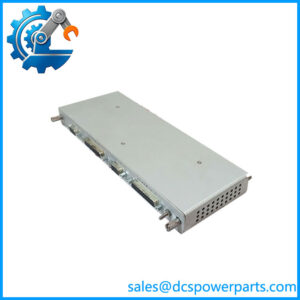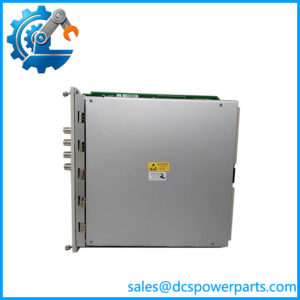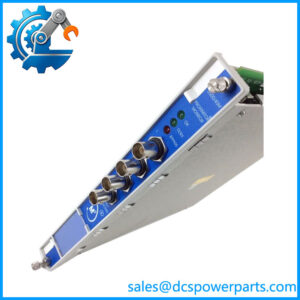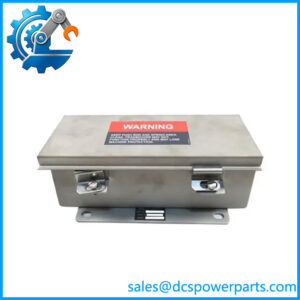
Description
Key Technical Specifications
| Parameter | Specification |
|---|---|
| Product Model | 3300/16-13-01-01-00-01-02 |
| Manufacturer | Bently Nevada |
| Product Type | Dual Vibration Monitor |
| Monitoring Channels | 2 independent channels |
| Measurement | Radial vibration / shaft position (gap) |
| Frequency Response | Programmable: 4–4,000 Hz or 1–600 Hz, −3 dB |
| Recorder Outputs | +4 to +20 mA, 0 to −10 VDC, or +1 to +5 VDC |
| Current Output Load | 0–600 Ω |
| Voltage Output Load | Minimum 10 kΩ |
| Power | Supplied through 3300 rack |
| Rack Compatibility | Bently Nevada 3300 Monitoring System |
| Installation | 3300 rack plug-in monitor position |
The 3300/16 architecture monitors two independent radial vibration channels and associated average shaft position using proximity-probe systems. The published technical information also identifies programmable frequency-response options of 4–4,000 Hz and 1–600 Hz.
For recorder outputs, the 3300/16 provides independently available channel outputs and supports selectable current or voltage formats. At 25°C, published recorder-output accuracy is approximately 0.7% of signal plus 0.09 mA offset for the 4–20 mA configuration, with separate specifications for the voltage-output options.
Product Introduction
The Bently Nevada 3300/16-13-01-01-00-01-02 is a two-channel vibration monitor used within the 3300 machinery protection system. It continuously processes vibration signals from rotating equipment and provides monitoring outputs for machine protection, alarm handling, and plant instrumentation. The 3300/16 family was designed for applications requiring radial vibration and shaft-position information from proximity-probe systems.
Its practical value is in maintaining an existing 3300 installation without changing the entire monitoring architecture. The catch is configuration. Different 3300/16 suffixes represent different measurement and output arrangements, so replacing a card by family number alone is risky. Match the complete part number, rack configuration, probe system, and existing alarm/output requirements before installation.
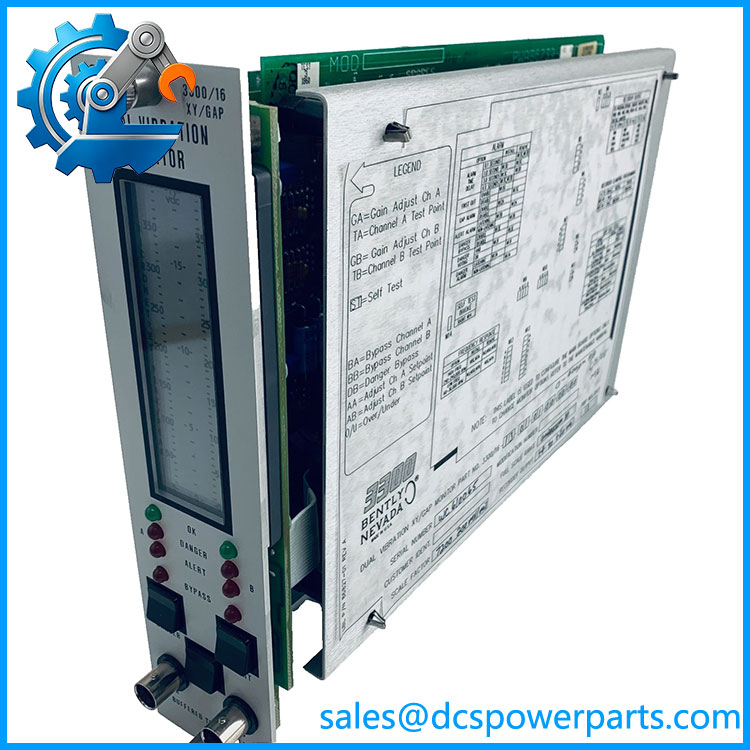
3300/16-13-01-01-00-01-02
Application Scenarios & Field Pitfalls
Engineering Pain Point
A common maintenance problem with legacy machinery-protection systems is a failed monitor appearing to be a simple card swap. It rarely is. A plant may have a turbine, compressor, pump, or gearbox tied into shutdown logic through a specific 3300/16 configuration. Installing another 3300/16 variant that looks physically identical can produce incorrect scaling, output behavior, or alarm characteristics. The machine may run, yet the protection system is no longer configured as originally engineered.
Typical Applications
- Power Generation — Radial vibration monitoring on steam-turbine and generator auxiliary machinery.
- Petrochemical — Compressor and pump vibration monitoring where continuous machine protection is required.
- Oil & Gas — Rotating equipment condition monitoring tied into plant alarm and shutdown systems.
- Industrial Process Plants — Legacy 3300 machinery-protection installations requiring replacement monitoring cards.
Technical Pitfalls to Avoid
- Do not match only “3300/16.”
The complete suffix is important. The 3300/16 family contains multiple configuration variants, including different measurement ranges, frequency-response arrangements, and output configurations. Treat 3300/16-13-01-01-00-01-02 as the actual procurement identifier. - Check the recorder-output configuration.
The monitor supports programmable current and voltage recorder outputs. A downstream PLC, DCS, recorder, or panel meter may have been engineered around one specific signal format. Verify the existing wiring and receiving-device input before commissioning. - Verify the frequency-response requirement.
The 3300/16 documentation identifies 4–4,000 Hz and 1–600 Hz response options. The lower-frequency configuration is not appropriate for every machine, particularly applications involving rapid acceleration or deceleration. Do not change this setting casually during replacement.
Related Products
- Bently Nevada 3300/16-13-01-01-00-00-00 — Closely related dual vibration XY/GAP configuration. Useful when comparing an existing 3300/16 installation, but the final suffix must be matched before substitution.
- Bently Nevada 3300/16-12-01-01-00-00-00 — Another 3300/16 configuration used for dual vibration monitoring. It should be treated as a configuration alternative rather than an automatic drop-in replacement.
- Bently Nevada 3300/16-11-01-01-00-00-00 — Earlier 3300/16 configuration for dual vibration monitoring. Useful when identifying legacy rack installations and comparing card configurations.
- Bently Nevada 3300/16-15-01-01-00-00-00 — Another member of the 3300/16 family. Its presence in the same family does not establish interchangeability with the -13 configuration.
- Bently Nevada 3300/20 — Dual thrust monitoring platform within the 3300 system. It serves a different measurement purpose and should be selected for thrust-position applications rather than radial-vibration replacement.
- Bently Nevada 3300/12 — 3300-system power-supply family. It supports the rack power architecture rather than replacing the 3300/16 monitoring function.
- Bently Nevada 3300/14 — DC power-supply option for the 3300 system. Relevant when diagnosing a complete rack-level power problem rather than an individual vibration-monitor failure.
- Bently Nevada 3300 XL 8 mm Proximity Transducer System — Modern proximity measurement hardware used with compatible machinery-monitoring architectures. It is a sensor system, not a direct functional replacement for the 3300/16 monitor.
- Bently Nevada 3500/40M — A later-generation machinery-monitoring I/O module used in the 3500 platform. It belongs to a different monitoring architecture, so migration requires system-level engineering rather than a simple card substitution.