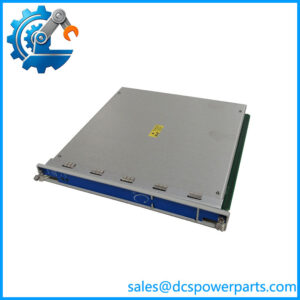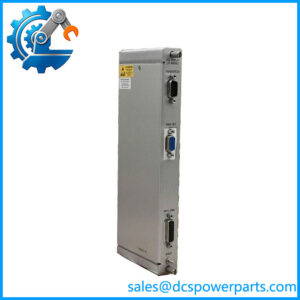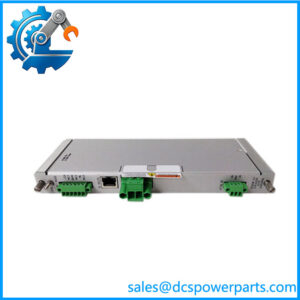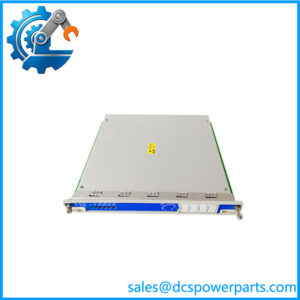
Description
Bently Nevada 1900/27 | Single-Channel Vibration Monitor | Machinery Protection
Key Technical Specifications
| Parameter | Specification |
|---|---|
| Manufacturer | Bently Nevada |
| Model | 1900/27 |
| Part number | 190127-01 |
| Product family | 1900 Series |
| Monitor type | Single-channel vibration monitor |
| Input | Compatible 200150 / 190520 accelerometer |
| Measurement | Peak vibration velocity |
| Display | Local LCD |
| Analog interface | 4–20 mA |
| Alarm relays | Alert and Danger |
| Relay contact type | SPDT / Form C |
| Relay behavior | Latching/non-latching selectable |
| Relay state | Normally energized/de-energized selectable |
| Relay delay | 3, 5, 10 or 15 seconds |
| Bypass | Relay bypass function |
| Reset | Local and remote reset |
| Signal output | Buffered transducer output |
| Power options | 110/220 VAC & HVDC, or +24 VDC versions |
| Application | General-purpose rotating machinery |
| Trendmaster integration | Possible through optional TIM interface |
| Installation | Locally mounted |
| Manufacturer status | Legacy/obsolete |
The Bently Nevada manual specifies that the 1900/27 accepts a vibration signal from a compatible accelerometer, integrates it to velocity, and displays the peak vibration amplitude. It provides two alarm levels and a built-in 4–20 mA interface for plant control and automation systems.
Product Introduction
The Bently Nevada 1900/27 is a single-channel, locally mounted vibration monitor designed for rotating machinery where a significant portion of rotor vibration is transmitted through the machine bearing and casing. It accepts a compatible accelerometer signal, processes the vibration into peak velocity units, and presents the result on its local LCD.
For plant integration, the monitor provides a 4–20 mA interface and separate Alert and Danger relay contacts. The Alert relay can be used for annunciation or supervisory control, while the Danger relay is associated with the higher vibration shutdown threshold. The monitor can also provide a buffered transducer signal for external diagnostic equipment.
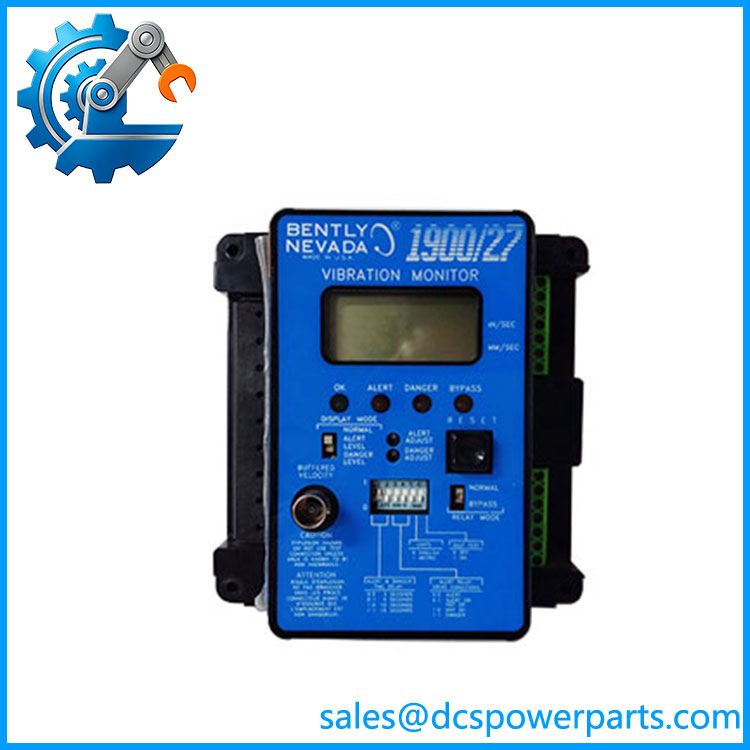
1900/27
Application Scenarios & Field Pitfalls — Engineer’s Perspective
Engineering Pain Point
The 1900/27 is often incorrectly entered into spare-parts databases as a generic analog input or vibration sensor. It is neither. It is a complete signal-conditioning and machinery-protection monitor positioned between the accelerometer and the plant control/protection system.
Typical Applications
- Fans and blowers — monitoring casing vibration on rolling-element-bearing machines.
- Pumps and motors — providing local vibration indication and alarm contacts.
- General rotating machinery — continuous vibration trending through the 4–20 mA interface.
- Legacy Trendmaster installations — selected 1900/27 channels can interface with Trendmaster 2000 through an optional TIM arrangement.
Technical Pitfalls to Avoid
- Do not confuse the monitor with the accelerometer. The 1900/27 receives the transducer signal; it is not the vibration sensor itself.
- Verify the power version. The manual documents high-voltage AC/HVDC and +24 VDC power options. Do not apply a generic 24 VDC assumption to every 1900/27 unit.
- Preserve relay configuration. Alert and Danger relays can be configured for latching/non-latching and normally energized/de-energized operation. These settings can affect the plant shutdown philosophy.
- Check the 4–20 mA loop during bypass. A configurable bypass behavior can cause the current output to indicate a NOT OK condition below 3 mA. This needs to be accounted for in the receiving DCS/PLC logic.
- Do not substitute a newer monitor solely by signal range. The accelerometer characteristics, velocity conversion, alarm logic, relay wiring and plant scaling should all be checked.
Related Products
- Bently Nevada 1900/25 — earlier 1900 Series vibration monitor with a similar general-purpose machinery-monitoring role.
- Bently Nevada 1900/55 — four-channel fan monitor for applications requiring multiple vibration channels.
- Bently Nevada 1900/65A — later general-purpose machinery monitor that can serve as an upgrade/replacement path for the 1900/55 family.
- Bently Nevada 200150 accelerometer — compatible accelerometer referenced by the 1900/27 documentation.
- Bently Nevada 190520 accelerometer — another compatible accelerometer identified in the 1900/27 manual.
- Bently Nevada TIM — Rack Buffered Output Transducer Interface Module used to integrate selected 1900/27 applications with Trendmaster 2000.
- Bently Nevada Trendmaster 2000 — machinery condition-monitoring platform that can work with the 1900/27 through the appropriate interface arrangement.
- Bently Nevada 3500/42M — more advanced multi-channel Proximitor/Seismic Monitor family; not a direct form-fit replacement for a 1900/27.
Procurement Note
For Bently Nevada 1900/27, specify the complete identification:
1900/27 — Part Number 190127-01 — Single-Channel Vibration Monitor
Before replacement, verify the power variant, accelerometer type, 4–20 mA loop scaling, Alert/Danger relay wiring, relay time delays, latching configuration, bypass behavior and installed enclosure.
The key database classification should be:
Bently Nevada 1900/27 = single-channel standalone vibration monitor with accelerometer input, peak velocity measurement, 4–20 mA output, and Alert/Danger relay protection.