Description
Key Technical Specifications
| Parameter | Specification |
|---|---|
| Product Model | UAC389AE02 |
| Part Number | HIEE300888R0002 |
| Manufacturer | ABB |
| Product Type | Pulse Amplifier Interface Module / Control Board |
| Primary Application | Excitation Control |
| System Association | ABB UNITROL / Universal Control Unit |
| Board Function | Pulse amplifier interface |
| Hardware Form | PCB / Control Board |
| Application | Generator excitation and industrial power control |
| Installation | Compatible ABB excitation-system assembly |
| Condition | New Surplus / Used / Tested Refurbished |
There is conflicting third-party identification of this part in current web records, with some listings incorrectly labeling HIEE300888R0002 as a generic AC500 digital-input module. That description conflicts with other records specifically identifying UAC389AE02 HIEE300888R0002 as a Pulse Amplifier Interface module and associating it with ABB excitation equipment.
For procurement purposes, I would use the UAC389AE02 / HIEE300888R0002 pairing and the physical board label as the primary identification. Do not use generic specifications such as “16 digital inputs” unless the actual installed hardware documentation confirms them.
Application Scenarios & Pain Points
Generator excitation systems are unforgiving about incorrect board substitutions. A control cabinet may power up normally while the excitation path remains unable to produce the expected firing or pulse signals.
- Generator excitation systems: The UAC389AE02 is associated with ABB excitation-control hardware where pulse-interface functions connect control electronics with the power-control stage.
- ABB UNITROL equipment: Suitable for maintenance of compatible ABB excitation assemblies where the installed board carries the exact UAC389AE02 designation.
- Legacy power-generation control: Particularly relevant when an older excitation cabinet must remain in service and an exact PCB-level spare is required.
- Control-system refurbishment: Useful as a replacement board after component aging, connector deterioration, or electronic failure, provided the complete excitation architecture is matched.
Field note: If the excitation system reports a firing or pulse-related fault, do not condemn this board immediately. Check the upstream controller command, gate/pulse wiring, power stage, connectors, and associated interface circuitry first. A missing pulse at the power device is not proof that the interface PCB itself failed.
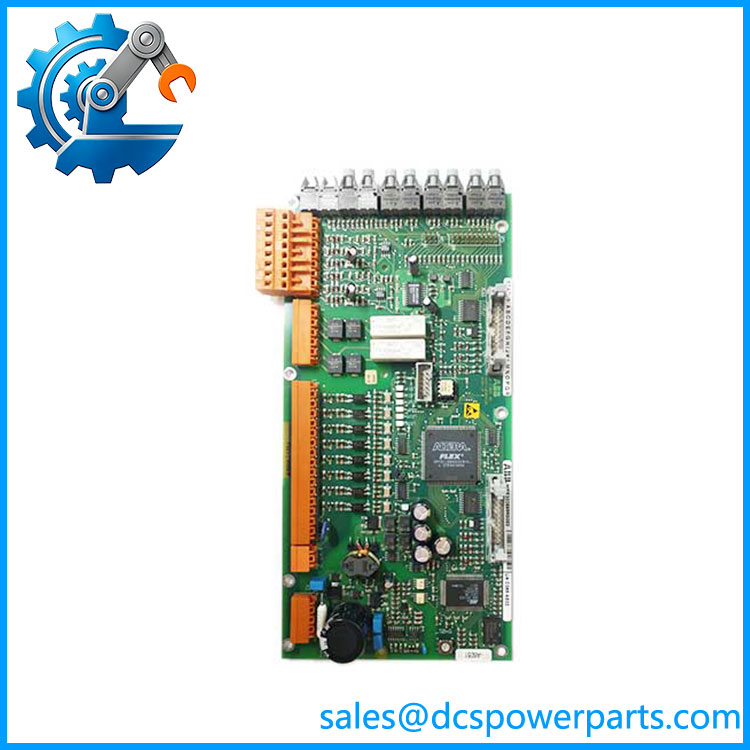
UAC389AE02 HIEE300888R0002
Related Products
- ABB UAC389AE02 HIEE300888R0002 — Exact part specified here. It is associated with Pulse Amplifier Interface functionality in compatible ABB excitation hardware.
- ABB Universal Control Unit (GCU) — The broader control architecture identified in connection with the UAC389AE02. The PAI board works as part of this control arrangement rather than operating as an independent PLC.
- ABB UNITROL excitation systems — The broader application family for generator voltage/excitation control. Exact compatibility depends on the installed UNITROL generation and hardware configuration.
- ABB excitation controller boards — These execute excitation regulation and control functions; they should be distinguished from the pulse-interface role associated with UAC389AE02.
- ABB thyristor firing/pulse electronics — Power-stage interface hardware receiving controlled firing commands. These components are complementary to the PAI function and are not direct substitutes.
- ABB INFI 90 / Symphony hardware — Some secondary listings associate the same part number with legacy ABB control architectures, but the available evidence is inconsistent. Verify the actual cabinet and board documentation before treating an INFI 90 application as equivalent.
The Engineer’s Guide: Field Pitfalls to Avoid
⚠️ Do not classify HIEE300888R0002 from a generic online parameter sheet.
Current references contain contradictory descriptions for this part. One source calls it a 16-channel digital-input module, while another specifically identifies it as a Pulse Amplifier Interface module.
How to avoid it: Use the physical nameplate, PCB markings, complete ABB ordering code, cabinet documentation, and installed system type as the identification baseline.
⚠️ Do not substitute a similar-looking excitation PCB.
Excitation boards often have similar dimensions and connectors while performing very different functions.
How to avoid it: Match , board revision, connector arrangement, and system position before installation.
⚠️ Check the pulse path before replacing the board.
A failure anywhere between the controller command and the power semiconductor stage can appear as a pulse-amplifier fault.
How to avoid it: Trace the signal chain systematically: controller output → interface board → pulse wiring → gate/power stage. Use appropriate test equipment and the approved excitation-system procedure rather than probing live power electronics casually.
Frequently Asked Questions (FAQ)
What is ABB ?
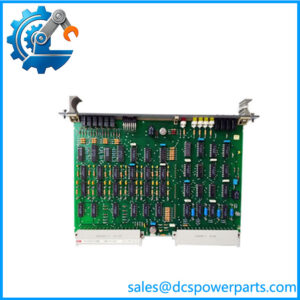
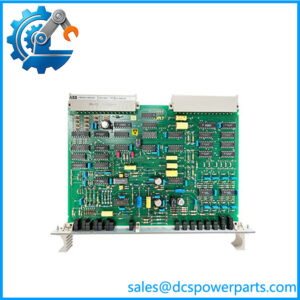
It is an ABB control PCB identified in available references as a Pulse Amplifier Interface (PAI) module, associated with ABB Universal Control Unit and excitation-system hardware.
Is an analog or digital I/O module?
It should not automatically be classified as a conventional PLC I/O module. The stronger identification for this exact / pairing is Pulse Amplifier Interface hardware used in excitation control. Some secondary sources provide conflicting generic I/O descriptions, so the actual board label and system documentation should take precedence.
Is used in ABB UNITROL systems?
Available equipment references associate with ABB excitation hardware and identify it as a Pulse Amplifier Interface module.
Can I replace with another ABB control board?
Not based on physical similarity alone. Verify the exact part number, revision, connector configuration, cabinet location, excitation-system model, and associated control electronics. A different ABB board can have completely different pulse timing or interface requirements.
What should I verify when buying a replacement ?
Request confirmation of:
- Exact marking.
- ordering code.
- PCB revision.
- Connector condition.
- Component condition and evidence of overheating.
- Functional test results.
- Compatible excitation-system model.
- Test evidence for the pulse/interface function.
How should a refurbished be tested?
A meaningful test should reproduce the appropriate control/interface environment rather than simply applying power to the PCB. Check initialization, diagnostics, connector signals, interface response, and pulse-path behavior using a suitable ABB test arrangement or approved maintenance procedure.