Description
Product Overview
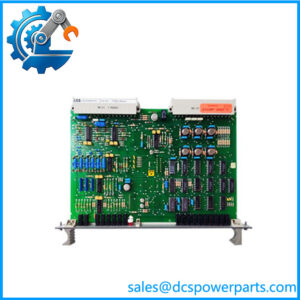
The ABB SPBRC400 is an HR Series Harmony Rack controller designed for ABB Symphony Plus distributed control systems and legacy Bailey INFI 90 installations. ABB identifies the SPBRC400 as part of the HR Series BRC controller family, alongside the SPBRC300 and SPBRC410. These controllers provide simultaneous support for HR Series I/O and earlier rack generations, as well as SD Series I/O, PROFIBUS, HART I/O, block I/O, and S800 I/O through the appropriate interface architecture.
For ABB SPBRC400, the controller architecture centers on an industrial-grade RISC processor with 8 MB DRAM and 2 MB NVRAM. The documented communication arrangement includes INFI-Net exception reporting, controller peer-to-peer communication, Controlway, and interfaces for HR Series I/O, SD Series I/O, HN800, S800, and H-Net architectures through the applicable interface modules. It provides two RS-232-C ports, or one RS-232-C combined with one RS-485 interface, plus an IISAC01 channel.
The ABB SPBRC400 is particularly relevant when maintaining an installed Harmony/INFI 90 control system rather than replacing the entire DCS architecture. ABB’s own material describes the BRC family as the latest version of the Harmony Rack controller family at the time of the documented lifecycle presentation, with support extending across multiple generations of I/O.This makes the controller useful for controlled modernization where existing field I/O and control strategies still have service value.
Product Introduction
Legacy INFI 90 installations often have years of validated control logic tied to existing Harmony Rack I/O. SPBRC400 provides a controller path for retaining that architecture while supporting multiple generations of ABB I/O through the appropriate interfaces.
With 8 MB DRAM and 2 MB NVRAM, plus dual serial communication capability, the controller is suited to existing Symphony Plus HR Series installations where replacing the complete control layer would create unnecessary engineering and commissioning work.
Key Technical Specifications
| Parameter | Value |
|---|---|
| Manufacturer | ABB |
| Model | SPBRC400 |
| Product Type | Controller with Expanded Memory |
| Controller Family | HR Series / Harmony Rack |
| DCS Platform | ABB Symphony Plus |
| Legacy Architecture | Bailey INFI 90 / Harmony |
| Processor | Industrial-grade RISC processor |
| DRAM | 8 MB |
| NVRAM | 2 MB |
| Programming | Function Codes, C, Batch 90, UDF |
| INFI-Net | Exception reporting |
| Controller Communication | Peer-to-peer |
| I/O Bus | Controlway |
| HR Series I/O | Supported |
| SD Series I/O | Supported through applicable architecture |
| S800 I/O | Supported through applicable interface |
| HN800 | Supported through PBA800 |
| H-Net | Supported through PBA200 |
| Serial Ports | 2 × RS-232-C, or 1 × RS-232-C + 1 × RS-485 |
| Additional Interface | 1 × IISAC01 channel |
| Operating Temperature | 0 to 70°C / 32 to 158°F |
| Controller Power | Approx. 2 A at 5 VDC / 10 W |
| Redundant Controller Data | Approx. 4 MB/s normal operation |
| Controller Dimensions | 35.56 × 177.80 × 298.45 mm |
| Product Category | Central Unit / Controller |
| Battery | Lithium button cell |
| Status | Legacy Harmony/Symphony Plus controller |
The controller memory, processor type, programming environment, communication interfaces, temperature range, power requirement, and dimensions are documented in the HR Series technical data.ABB’s product record separately identifies as a “Controller with Expanded Memory” and classifies the product type as Central_Unit.
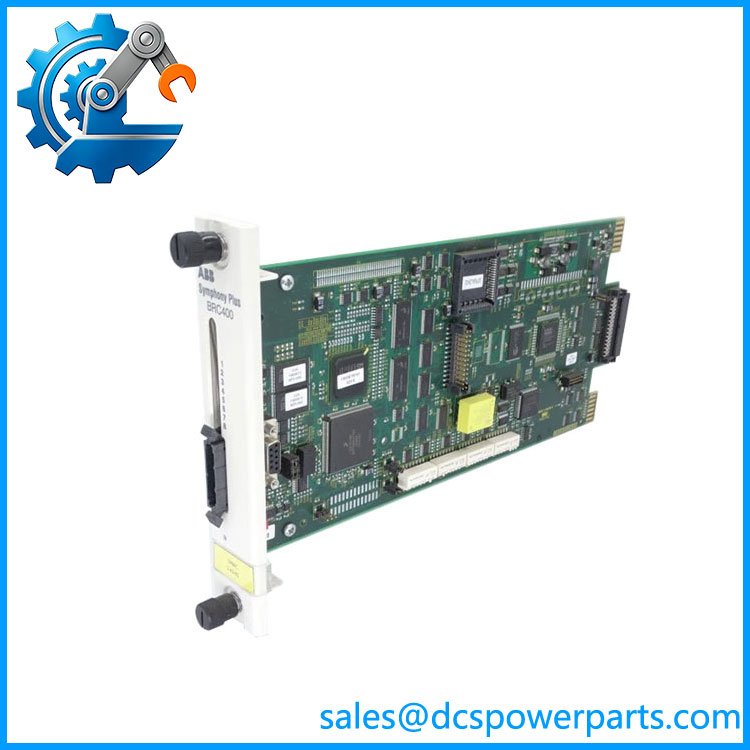
SPBRC400
Related Products
- SPBRC300 — Earlier HR Series BRC controller. It belongs to the same Harmony Rack controller family and is relevant when assessing an upgrade from an older controller generation.
- SPBRC410 — Higher-generation BRC controller in the same HR Series family. It adds capabilities beyond the , including support for MODBUS TCP devices according to ABB’s documented family overview.
- BRC400 — The underlying BRC400 controller designation associated with the Symphony Plus naming. The hardware family has been rebranded within the Symphony Plus product structure.
- BRC300 — Previous BRC generation. Useful when evaluating controller replacement in an existing Harmony Rack installation.
- SPASI23 — HR Series analog input module used with the corresponding Harmony Rack controller architecture.
- SPASO11 — HR Series analog output module that complements the controller for analog control loops.
- PBA800 — Interface architecture used to connect HN800-based I/O to BRC controllers. The documentation identifies HN800 support through PBA800.
- PBA200 — Interface used for H-Net and related Block I/O architectures.
- PDP800 — PROFIBUS interface that can be used with an /410 architecture; ABB documents support for up to four redundant PDP800 pairs per /410 controller.
Frequently Asked Questions
What is ABB used for?
The is a Harmony Rack controller for ABB Symphony Plus DCS installations.
Its job extends beyond simple communication. It executes configured control strategies and manages communication with supported I/O and controller networks. The documented architecture includes HR Series I/O, Controlway, INFI-Net, SD Series I/O, HN800, S800, and H-Net through the appropriate interface modules.
It is particularly useful in plants retaining an established Bailey INFI 90/Harmony control architecture.
Is compatible with legacy INFI 90 systems?
Yes, but compatibility depends on the specific I/O and network architecture.
ABB’s own Harmony lifecycle material states that the BRC family supports HR Series I/O and previous rack generations, as well as SD Series, block, and S800 I/O.
Before approving a replacement, map the actual installed controller, I/O processors, communication interfaces, and firmware. A BRC controller should be evaluated as part of the complete DCS architecture.
What is the difference between and SPBRC410?
Both belong to the HR Series BRC controller family, but the SPBRC410 provides expanded communication capabilities.
One clear distinction documented by ABB is that MODBUS TCP devices are supported via the BRC410, while the BRC300 and BRC400 are described with the broader HR/SD/block/S800 I/O support.
For a replacement, do not assume that moving from to SPBRC410 is just a hardware swap. Check the engineering database, firmware, communication configuration, and connected I/O.
Can I hot-swap the ?
Do not assume live replacement is permissible merely because the module is physically replaceable.
The controller is an active DCS processor containing the running control strategy and communications state. A live replacement should only be performed where the installed architecture and approved maintenance procedure explicitly support it.
For a production plant, confirm controller redundancy, control strategy state, I/O dependencies, and database backup before removing the processor.
Will I lose my control logic when replacing ?
The safest answer is: not if the replacement is managed as a controlled controller-replacement procedure and the existing application is properly backed up.
Before removing the existing controller:
- Back up the complete control configuration.
- Record firmware and hardware revision.
- Document controller address/configuration.
- Record installed I/O interfaces.
- Verify redundancy status if applicable.
- Confirm the replacement controller’s memory and firmware compatibility.
- Validate the restored configuration before returning the process to automatic control.
The uses 2 MB NVRAM, so memory retention is an important maintenance consideration.
Does support PROFIBUS?
The can participate in PROFIBUS architectures through the appropriate PROFIBUS interface rather than providing PROFIBUS directly through its native controller ports.
ABB documents the PDP800 as a Symphony Plus SD Series PROFIBUS interface and specifies support for up to four redundant PDP800 pairs per /410 controller.
So if a plant’s requirement is PROFIBUS integration, specify the controller and the appropriate interface module.
How should I verify a New Surplus?
For a DCS controller, a successful power-up test is only the first checkpoint.
Recommended acceptance procedure:
- Verify the nameplate and serial information.
- Record hardware and firmware revisions.
- Inspect the backplane connector and module housing.
- Check the lithium battery condition.
- Install it in a compatible Harmony Rack test environment.
- Verify controller initialization and diagnostics.
- Establish engineering-station communication.
- Load a controlled test configuration.
- Test the required communication interfaces.
- Verify representative HR/SD/ I/O communication where applicable.
- Check controller peer-to-peer communication.
- Test redundancy if the target system uses redundant controllers.
- Document all alarms, diagnostics, and test results.
To be completely transparent, “new surplus” does not automatically mean field-ready for a controller of this age. Battery condition, firmware revision, storage history, and compatibility with the existing Harmony configuration should be verified before the unit is accepted as a production replacement.