Description
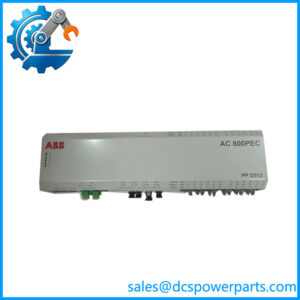
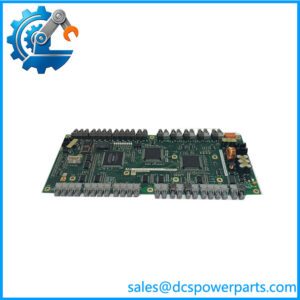
ABB REM543CG216AAAA Machine Terminal
Product Introduction
Protection of a large motor or generator is not just about detecting an overcurrent. The relay has to acquire phase currents and voltages, supervise operating conditions, execute protection logic, provide control functions and communicate those events to the plant automation system. The ABB REM543CG216AAAA belongs to ABB’s REM 543 rotating-machine terminal family, a multiprocessor protection and control platform designed for rotating-machine applications. ABB documentation describes REM 543 as a machine terminal combining protection, monitoring and control functions with local HMI and distributed I/O processing.
The ABB REM543CG216AAAA is a specific hardware configuration rather than a generic REM543 replacement. Ordering documentation for the REM543C_216 family identifies nine analog sensor channels, 1/5 A current-transformer inputs, 100 V voltage-transformer inputs, digital I/O, an RTD/analog module and graphic HMI. A project specification for the exact CG216AAAA designation further identifies 80–265 VDC auxiliary power and IEC 61850 communication for motor-feeder service. That combination makes the complete order code important during replacement; a different REM543 suffix can change the I/O and power configuration.
Key Technical Specifications
| Parameter | Specification |
|---|---|
| Product Model | REM543CG216AAAA |
| Manufacturer | ABB |
| Product Family | REM 543 / REM 54_ |
| Product Type | Rotating Machine Protection and Control Terminal |
| Primary Application | Motor / rotating-machine protection |
| Hardware Family | REM543C_216 |
| Analog Sensor Channels | 9 |
| Current Transformer Inputs | 7 × 1/5 A CT channels in the documented C_216 configuration |
| Voltage Transformer Inputs | 2 × 100 V VT channels in the documented C_216 configuration |
| Digital Input Threshold | 18 VDC configuration |
| RTD / Analog Module | Included in documented C_216 configuration |
| Display | Fixed graphic HMI |
| Auxiliary Supply | 80–265 VDC identified for CG216AAAA in project documentation |
| Communication | IEC 61850 identified for the exact CG216AAAA installation |
| Protection Functions | Motor / rotating-machine protection functions; exact enabled functions depend on software configuration |
| Installation | Panel-mounted machine terminal |
| Condition | Verify actual unit condition and configuration before procurement |
ABB’s REM543 documentation emphasizes that the different hardware versions are defined by their I/O and auxiliary-power arrangements. The C_216 configuration table lists nine analog measurement channels, seven 1/5 A CT channels, two 100 V VT channels, one CPU, one power supply, digital I/O, one RTD/analog module and a fixed graphic display.
Important configuration note: the general REM543 documentation includes multiple auxiliary-power options, including 110/120/220/240 VAC-class and 110/125/220 VDC supplies as well as 24/48/60 VDC variants. Therefore, do not infer the supply from “REM543” alone. The 80–265 VDC figure above comes specifically from a project specification identifying the complete REM543CG216AAAA order code.
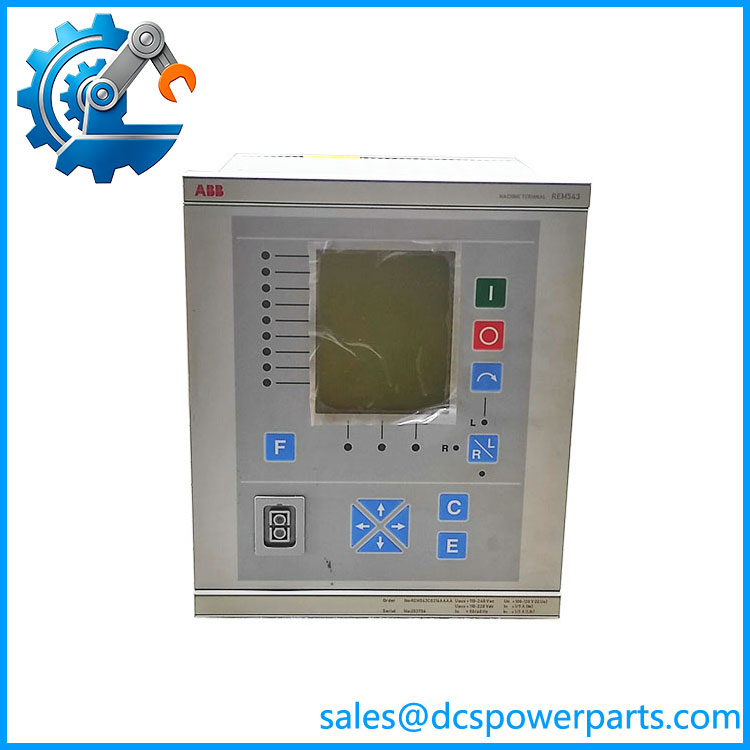
REM543CG216AAAA
Application Scenarios & Pain Points
A motor protection relay failure is rarely convenient. If the relay is part of a critical motor feeder, the immediate problem can involve both protection availability and SCADA visibility. With an older REM543 installation, the bigger procurement risk is ordering a with a superficially similar designation but the wrong hardware configuration.
- Medium-voltage motor protection: The exact CG216AAAA configuration is documented in a motor-feeder application, with 6 CT + 3 VT channels specified in the project documentation.
- Rotating-machine protection: combines protection, measurement, monitoring and control functions within a single machine terminal.
- Plant SCADA integration: IEC 61850 communication is identified for the exact CG216AAAA configuration in the referenced project specification.
- Legacy motor-protection replacement: Suitable for projects maintaining an installed architecture where the original terminal needs replacement rather than a complete protection-system redesign.
One practical issue deserves attention: the general C_216 hardware table and the project description use slightly different ways of describing the measurement configuration. That is a good reason to verify the physical terminal markings and project drawings rather than translating the suffix into channel counts from memory.
Related Products
- REM543C_216AAAA — Same core REM543C 216 hardware family designation; the complete suffix should be compared before treating it as equivalent.
- REM543C_216AABA — Another C_216 configuration with a different hardware allocation.
- REM543C_216AAAB — Related C_216 variant; I/O and option differences must be checked.
- REM543C_216AABB — Another C_216 hardware configuration.
- REM543C_216CAAA — Related REM543C configuration with a different ordering combination.
- REM543C_216CABA — Another C_216 configuration; not automatically interchangeable.
- REM543B_217AAAA — Earlier/different hardware configuration; useful for legacy system identification but not a direct substitute without engineering verification.
- REM545 — Higher-I/O member of the REM 54_ family. ABB documentation distinguishes and REM545 by available I/O configuration.
The related part numbers are configuration variants, not a list of guaranteed drop-in replacements. ABB’s ordering tables show that power supply, digital I/O, analog interface, display and mechanical configuration can change between order codes.
Engineer’s Guide — Field Pitfalls to Avoid
1. Never buy against “” alone
has multiple hardware configurations. The ordering tables distinguish variants by analog inputs, power supply, digital I/O, RTD/analog hardware, display and mechanical configuration.
Avoidance: Put the complete REM543CG216AAAA order number on the RFQ and photograph the front-panel identification strip.
2. Check the auxiliary supply before energizing
documentation covers several power-supply variants. The exact CG216AAAA project specification identifies 80–265 VDC, but that should not be generalized to every .
Avoidance: Verify the nameplate, wiring diagram and installed supply before applying power.
3. Do not assume the CT/VT configuration from the suffix alone
The C_216 ordering table documents a particular analog-interface allocation, while the project specification for describes its field application as 6 CT + 3 VT channels.
Avoidance: Match the actual terminal wiring and project drawings. CT and VT inputs are protection circuits; a mistaken connection is not a commissioning detail.
4. Verify the IEC 61850 configuration
The exact designation has been documented in a motor-feeder project with IEC 61850 communication. That does not mean every in the field has the same communication configuration.
Avoidance: Check the communication hardware, station configuration and engineering files before assuming an old relay can be swapped and immediately recognized by the substation network.
5. Preserve the old relay configuration
supports configurable protection, control, measurement and communication functions. A replacement with correct hardware can still require restoration of the application configuration.
Avoidance: Extract and document settings, logic, communication parameters and protection curves before removing a functioning unit whenever possible.
6. Do not diagnose the relay without checking the measurement circuit
CT wiring, VT fuses, test switches and terminal connections can create symptoms that resemble an internal relay fault.
Avoidance: Verify the secondary circuits and protection test interface first. Pay particular attention to CT circuits before disconnecting anything.
7. Confirm software revision
The REM54 documentation associates software revisions with the order-number/revision identification of the machine terminal.
Avoidance: Record the software identification shown on the existing terminal and compare it with the proposed replacement. For a legacy protection system, software compatibility is part of the hardware specification.
FAQ
What is ABB ?
It is a configured ABB REM 543 rotating-machine protection, monitoring and control terminal. The family was designed for rotating-machine applications and combines protection functions with measurement, control, monitoring, communication and local HMI capabilities.
Is a motor protection relay?
Yes. The exact designation appears in a current project specification under a motor-feeder application, where it is specified with CT/VT measurement and IEC 61850 communication.
What CT and VT inputs does the REM543C_216 configuration have?
The REM543C_216 ordering documentation identifies nine analog sensor channels, with seven 1/5 A CT channels and two 100 V VT channels in the documented configuration table. A specific project specification for describes its installed application as 6 CT + 3 VT channels, so the actual terminal wiring should be checked against the project documentation rather than relying on a simplified channel count.
What auxiliary voltage does use?
A project specification for the exact identifies 80–265 VDC auxiliary voltage. The broader family has multiple power-supply versions, so this value should not be generalized to every .
Does support IEC 61850?
The exact designation is documented with IEC 61850 communication in a motor-feeder project specification. For a replacement unit, the actual communication hardware and configured station parameters should still be verified before commissioning.
Is still a current-generation ABB relay?
is a legacy ABB machine-terminal family. Current secondary documentation describes the specific as discontinued, while the unit still appears in recent project documentation as installed legacy equipment.
Can another replace ?
Not automatically. The ordering system includes multiple combinations of analog interfaces, auxiliary supplies, digital I/O, RTD/analog hardware and display configurations. The complete order code must be matched, followed by verification of software, protection settings and communication configuration.
What should procurement verify before buying this relay?
Request the complete designation, front-panel identification, hardware revision, software revision, auxiliary-voltage requirement, CT/VT wiring configuration and communication interface. For an IEC 61850 installation, retain the existing station configuration and protection settings as part of the replacement record.