Description
Key Technical Specifications
| Parameter | Specification |
|---|---|
| Manufacturer | ABB |
| Model | PDP800 |
| Product Type | PROFIBUS DP Master Communication Module |
| System | ABB Symphony Plus / S+ Control |
| Controller Interface | HN800 |
| PROFIBUS Protocol | DP V0, V1, V2 |
| Communication Role | Master |
| PROFIBUS Speed | 9.6 kbps to 12 Mbps |
| Maximum Slave Capacity | Up to 125 devices |
| Line Redundancy | Yes |
| Module Redundancy | Yes |
| PROFIBUS Media | Electrical; fiber-optic extension supported |
| Maximum Fiber Distance | Up to 15 km using appropriate repeaters |
| Diagnostics Port | Mini-USB |
| Hot Swap | Yes |
| Mounting | Horizontal row |
| Form Factor | xA style |
| Operating Temperature | 0 to +55°C |
| Typical Power Requirement | 24 VDC ±10%, approximately 150 mA / 3.6 W |
| HN800 Bus Length | 175 mm |
ABB’s product catalog specifies 24 VDC ±10% at 150 mA, an industrial-grade RISC processor, 128 MB memory plus 4 MB ROM, redundant PROFIBUS connections, and support for PROFIBUS DP at rates from 9.6 kbps through 12 Mbps.
The newer ABB hardware-selector data lists up to 125 slaves, module and line redundancy, hot swap, a front-panel mini-USB diagnostics interface, and a 1-hour stated MTTR for the PDP800.
Product Introduction
The ABB PDP800 is a PROFIBUS DP master communication interface for ABB Symphony Plus SD Series control systems. It provides the communication path between Symphony Plus controllers and intelligent PROFIBUS field devices such as transmitters, actuators, motor-control equipment, and intelligent electronic devices.
The important engineering feature is its redundancy architecture. PDP800 supports both module redundancy and PROFIBUS DP line redundancy, allowing the communication layer to be designed for higher availability in applications where loss of a fieldbus interface could affect plant operation. PROFIBUS PA devices can also be integrated through suitable DP/PA linking equipment.
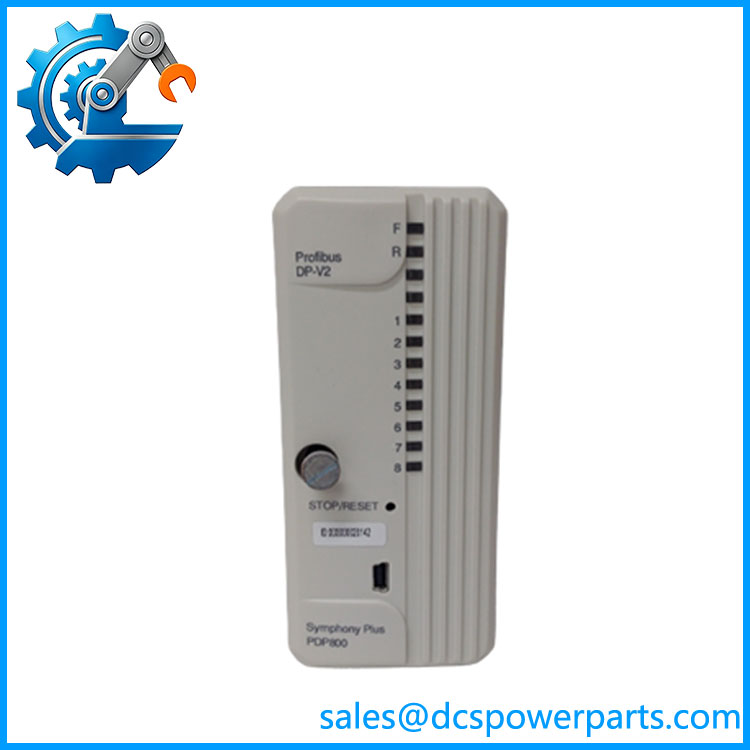
PDP800
Application Scenarios & Field Pitfalls — Engineer’s Perspective
Engineering Pain Point
A PDP800 failure is usually a communication-architecture problem rather than an I/O-channel problem. If multiple PROFIBUS devices disappear simultaneously, check the PDP800 pair, HN800 connection, PROFIBUS line redundancy arrangement, bus termination, slave configuration, and controller engineering database before replacing individual field devices.
Typical Applications
- ABB Symphony Plus power-generation DCS
- PROFIBUS DP networks connecting intelligent field instruments
- Motor control centers, drives, actuators, and intelligent electrical devices
- PROFIBUS PA device integration through DP/PA linking equipment
ABB specifically describes as the interface between Symphony Plus controllers and PROFIBUS DP channels, supporting intelligent devices such as smart transmitters, actuators, and IEDs.
Technical Pitfalls to Avoid
- Do not confuse with a PROFIBUS slave module.
is a PROFIBUS DP master interface. Its job is to manage communication with the PROFIBUS slave devices connected to the Symphony Plus controller architecture. - Do not assume every PROFIBUS redundancy arrangement is identical.
supports module and line redundancy, but the actual redundancy design depends on the controller, mounting arrangement, bus components, connectors, termination, and engineering configuration. Replacing a single module without checking the redundant pair can leave the system in a degraded state. - Check the slave count and network topology.
Current ABB documentation specifies up to 125 PROFIBUS slave devices and data rates up to 12 Mbps. Fiber-optic extensions can reach much longer distances, but that requires appropriate external optical hardware. - Verify the controller generation.
belongs to the Symphony Plus / SD Series architecture. It should not be treated as a generic PROFIBUS PCI card or assumed to work as a standalone PROFIBUS master outside the ABB control-system architecture.
Related Products
- ABB PIO800K02 — Current PROFIBUS communication module kit designation; includes the module and associated mounting hardware.
- ABB PTU810 — Mounting base associated with configurations.
- ABB SPC600 — Symphony Plus SD Series controller capable of using PROFIBUS master interfaces.
- ABB SPC810 — Higher-capacity Symphony Plus controller supporting -based PROFIBUS architectures.
- ABB HPC800 — Symphony Plus controller platform used with the broader SD Series communication architecture.
- ABB RFO810 — Fiber-optic repeater used for extending Symphony Plus communication networks.
- ABB CI850 — Symphony Plus communication interface for IEC 61850 MMS/GOOSE applications; different protocol and function from .
- ABB SCI200 — Symphony Plus serial communication interface used for protocols such as IEC 60870-5-104 and DNP3; not a PROFIBUS replacement.
ABB’s current Symphony Plus documentation shows alongside other protocol interfaces including CI850 and SCI200, reinforcing that is the dedicated PROFIBUS communication component rather than a general-purpose controller interface.
Procurement Check
Before approving an replacement, verify:
- Exact designation:
- Current kit/article number where applicable: PIO800K02
- Symphony Plus / SD Series system generation
- Controller model
- Single or redundant arrangement
- PROFIBUS DP line redundancy configuration
- PROFIBUS slave count
- DP baud rate
- Electrical versus fiber-optic network architecture
- PROFIBUS termination and connector arrangement
- HN800 bus arrangement
- Existing engineering/database configuration
- Hardware revision
- Firmware compatibility
- Mounting base and physical module arrangement
Recommended procurement description:
ABB PROFIBUS DP V0/V1/V2 Master Module, Symphony Plus SD Series Communication Interface, Redundant PROFIBUS DP Line and Module Support, Up to 125 Slaves, Up to 12 Mbps.
The key distinction is straightforward: is an ABB Symphony Plus PROFIBUS DP master communication interface, not an analog/digital I/O module. For replacement work, match the Symphony Plus controller architecture, redundancy arrangement, PROFIBUS topology, and engineering configuration, not just the physical module.