Description
Product Overview
The ABB NBRA-663 is an external braking chopper designed for use with compatible ABB ACS 600 frequency converters. During rapid motor deceleration, a motor can return energy to the drive’s DC intermediate circuit, causing the DC bus voltage to rise. The NBRA-663 monitors this voltage and switches a compatible braking resistor into the circuit when the operating threshold is reached. The resistor converts the returned electrical energy into heat, allowing the drive to achieve shorter deceleration times and helping control DC bus overvoltage.
The NBRA-663 is used in applications where the motor or driven load has significant stored kinetic energy, including material-handling equipment, conveyors, and other machinery with demanding stopping cycles. ABB’s ACS 600 documentation lists the NBRA-663 for selected 690 V-class drive models. The chopper must be matched to the exact drive rating and braking-resistor specification; it is not suitable for every drive in the ACS 600 family. The documented combination for an ACS 600 model determines the permitted resistance, braking power, and resistor energy capacity.
From a maintenance standpoint, the NBRA-663 should be treated as part of a complete braking circuit rather than an independent replacement component. The chopper, resistor, cable sizing, voltage-selection setting, and drive parameters all affect operation. ABB’s installation guide also describes fault monitoring for conditions such as a shorted braking resistor or cable, a shorted chopper IGBT, and control-board failure. Before commissioning a replacement, confirm the chopper’s voltage selection and the compatible resistor combination using the original ACS 600 documentation.
Product Introduction
The NBRA-663 provides resistor-based dynamic braking for compatible ABB ACS 600 drive systems. It is useful when the application requires more rapid deceleration than the drive can provide through normal ramp control alone.
For a replacement installation, record the existing chopper’s type and voltage-selection setting, identify the exact ACS 600 model, and confirm the installed resistor part number. A similar-looking NBRA model may have a different voltage class or braking capability. Electrical work must be performed by qualified personnel after isolating the drive and verifying that the DC intermediate circuit has discharged.
Key Technical Specifications
| Parameter | Specification |
|---|---|
| Manufacturer | ABB |
| Model | |
| Product Type | External braking chopper |
| Compatible Drive Family | ABB ACS 600, for specified models |
| Voltage Class | Applicable 525–690 V drive class; verify the exact selection |
| Main Function | Switches the braking resistor into the DC intermediate circuit |
| Braking Method | Dynamic resistor braking |
| Braking Resistor | Selected according to the ACS 600/chopper combination |
| Control Board | NBRC family |
| Fault Monitoring | Chopper and braking-circuit fault detection |
| Enable Input | Available |
| Fault Relay Output | Available |
| Fiber-Optic Synchronization | Supported for synchronized multiple-chopper arrangements |
| Enclosure Protection | IP54 for the NBRA-653/663 mechanical variant |
| Dimensions (H × W × D) | Approximately 198.5 × 157 × 149 mm |
| Weight | Approximately 2.9 kg net; 3.5 kg gross |
| Installation | External mounting with required ventilation clearances |
| Manufacturer Documentation | ACS 600 NBRA-6xx Installation and Start-up Guide |
Dimensions and weight are listed in ABB’s ACS 600 catalog. Confirm the exact voltage-selection setting, resistor combination, and ratings against the drive-specific documentation before installation.
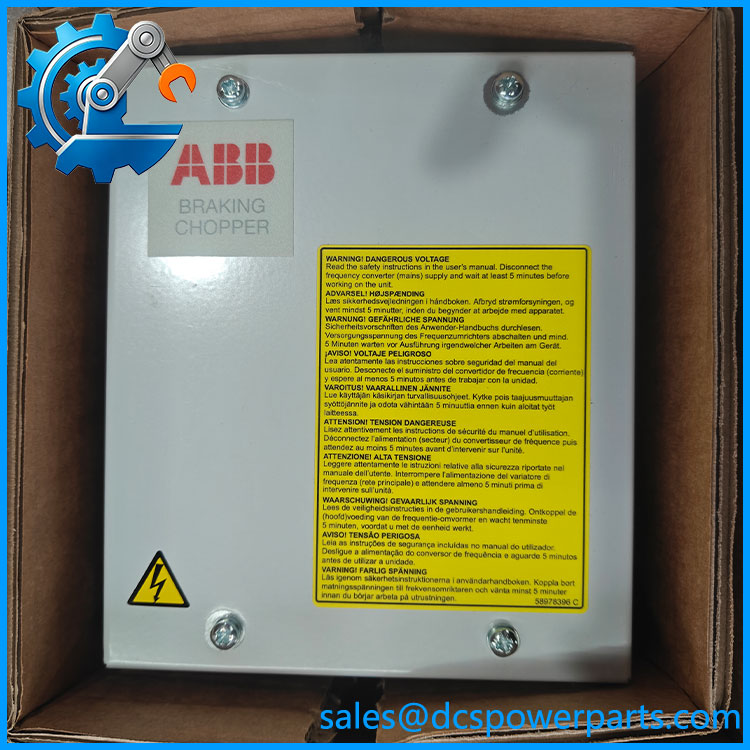
NBRA-663
Related Products
- ABB NBRA-653: Braking chopper for applicable 400 V-class ACS 600 drives.
- ABB NBRA-664: Higher-capacity chopper variant for specified ACS 600 models.
- ABB NBRA-666: Braking chopper used with selected higher-power drive configurations.
- ABB NBRA-667: Higher-capacity braking chopper for designated ACS 600 drive ratings.
- ABB NBRA-669: High-capacity braking chopper used in larger braking arrangements.
- ABB SACE08RE44: Braking resistor specified for certain combinations.
- ABB SACE15RE22: Braking resistor used in selected drive/chopper configurations.
- ABB ACS 600: Compatible drive family; the precise drive type determines braking-component selection.
These parts belong to the same braking-system ecosystem, but they are not interchangeable based on model similarity alone.
Frequently Asked Questions
Q1: What is the ABB used for?
It is an external braking chopper for compatible ABB ACS 600 frequency converters. It switches a braking resistor into the drive’s DC intermediate circuit when voltage rises during regenerative braking.
Q2: Does the include the braking resistor?
No. The chopper and braking resistor are separate components. The resistor must meet the minimum resistance and energy-handling requirements specified for the particular drive and chopper combination.
Q3: Can the be used with any ACS 600 drive?
No. Compatibility depends on the exact ACS 600 model, voltage class, braking demand, and resistor selection. Check ABB’s rating tables before selecting a replacement.
Q4: What happens if the braking resistor has the wrong resistance?
A resistance below the permitted minimum can cause excessive current and damage the chopper or drive. Resistance and thermal capacity must both be checked; matching the physical size of the old resistor is not sufficient.
Q5: Does the have fault monitoring?
Yes. ABB’s installation guide describes detection of faults including braking-resistor or cable short circuits, chopper IGBT short circuits, and control-board failures. A fault relay output is also provided.
Q6: What should I check before purchasing a replacement?
Verify the model marking, voltage-selection configuration, enclosure condition, terminal condition, and compatibility with the installed drive. Confirm the braking resistor’s part number and resistance, and request functional test evidence for used or refurbished equipment.
Q7: What safety precautions apply during replacement?
The drive’s DC intermediate circuit and braking terminals can retain hazardous voltage. ABB’s guide instructs qualified personnel to isolate the supply, wait at least five minutes for DC-bus capacitors to discharge, and verify the absence of voltage before work begins. Follow the complete site and manufacturer isolation procedure.