Description
Product Overview
The ABB Bailey INICT13A is an INFI-NET-to-computer transfer module used in legacy Bailey INFI 90 distributed control systems. Its purpose is to provide the communication path between the control network and a host computer or supervisory interface. In a properly configured system, this connection lets host-side applications access control-system data for functions such as monitoring, operator supervision, and data collection. The INICT13A is a communication component, not a field I/O module and not a standalone PLC controller. Its operation depends on the associated network hardware, host connection, and software driver configuration.
The INICT13A is used with the INNIS21 network interface slave module in the documented ICI13 arrangement. The modules communicate over a dedicated I/O expander bus, with the INICT13A acting as the master for this interface arrangement. Host-side connection options include RS-232-C through an appropriate termination unit or a SCSI connection on the module’s front plate. The correct wiring and connection method depend on the installed system architecture; they should be checked against the original system drawings and relevant instruction manuals rather than inferred from the module name alone.
For maintenance and procurement teams, the important issue is preserving the existing communication path without introducing an unplanned system migration. ABB’s evolution-planning documentation states that the INICT13A arrangement does not require the separate IMMPI01 module used with the earlier INICT03A design, but it does require the INNIS21 in the ICT13-based ICI03 configuration. ABB also lists SPICT13A as the later product to use, making compatibility checks especially important when repairing an older rack. Before ordering, verify the full model suffix, host connection type, installed firmware or revision where applicable, termination hardware, and the associated INNIS21. Confirm whether the replacement is new or used and what functional tests have actually been completed.
Product Introduction
The ABB Bailey INICT13A provides a computer communication path for legacy INFI 90 DCS installations. It connects the INFI-NET network to host-side systems through supported serial or SCSI interfaces, depending on the installed configuration.
When replacing this module, verify the associated INNIS21, termination unit, cabling, and firmware requirements. An incorrect interface arrangement can prevent host communication even when the replacement module powers up normally.
Key Technical Specifications
| Parameter | Specification |
|---|---|
| Manufacturer | ABB Bailey Controls |
| Model | |
| Product Type | INFI-NET-to-computer transfer module |
| Product Family | INFI 90 / Harmony rack hardware |
| Network Interface | INFI-NET through the associated network interface arrangement |
| Host Communication | RS-232-C or SCSI |
| Serial Communication Rate | 50–19,200 baud |
| SCSI Transfer Rate | Up to 4 MB/s |
| ROM | 512 KB |
| RAM | 2 MB |
| Power Supply | +5 V DC |
| Typical Power Consumption | 5.1 W |
| Maximum Power Consumption | 7 W |
| Typical Current | 1.1 A at +5 V DC |
| Maximum Current | 1.4 A at +5 V DC |
| Mounting | Standard module mounting unit (MMU) |
| Rack Occupancy | One module slot; adjacent-slot and expander-bus arrangement must be checked |
| Associated Network Module | INNIS21 |
| Serial Termination Unit | NTMP01, when used with the documented serial arrangement |
| SCSI Connector | 50-pin front-panel connection |
| Operating Temperature | 0 to 70 °C |
| Relative Humidity | 20–95% up to 55 °C, non-condensing |
| Lifecycle Status | Legacy; ABB lists SPICT13A as the later product to use |
Specifications are based on the instruction manual and ABB product information. The exact interface setup and rack installation must be confirmed against the site’s documentation.
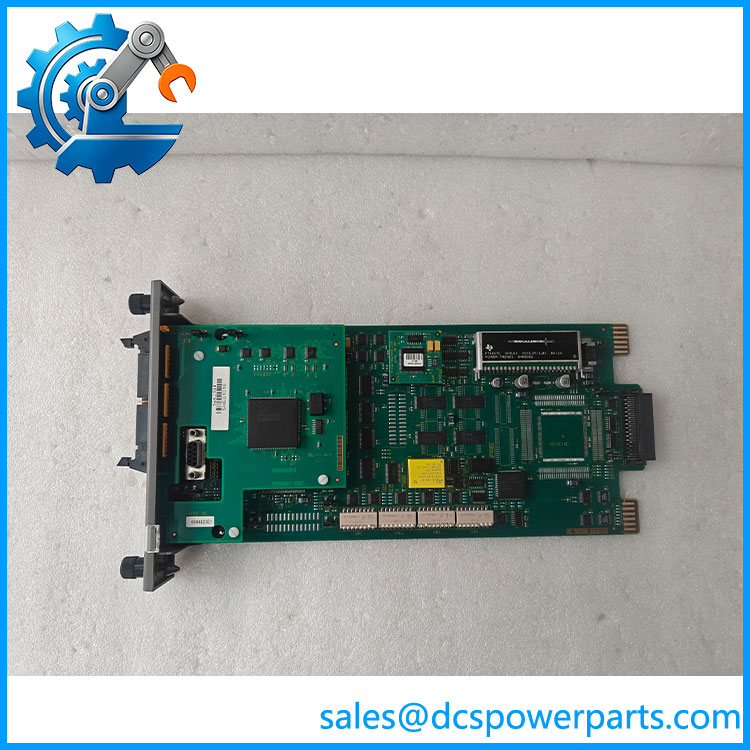
INICT13A
Related Products
- INNIS21 — Network interface slave module used with the in the documented ICI13 arrangement.
- INICT03A — Earlier computer transfer module; its architecture used the separate IMMPI01 in the referenced migration arrangement.
- IMMPI01 — Earlier interface module associated with the INICT03A arrangement; ABB’s evolution guidance states it is not required in the design.
- SPICT13A — Later product identified by ABB for use in place of ; verify system-specific migration requirements.
- NTMP01 — Termination unit for supported serial communication configurations.
- NKTU01 — Cable used to connect the to the NTMP01 in the documented arrangement.
- NKTU11 — Alternative cable for the same termination-unit connection, specified for a different cable construction.
- 1948720_60 — SCSI ribbon cable listed in the instruction documentation.
- INNIS11 — Earlier INFI-NET interface module family; not a direct substitute for without a system compatibility review.
Frequently Asked Questions
Q1: What is the ABB used for?
It transfers data between the INFI-NET control network and a host computer interface in a Bailey INFI 90 or related Harmony DCS configuration.
Q2: Does the require an ?
The documented ICT13-based ICI13 arrangement uses the as its network interface slave module. Confirm the actual rack architecture and wiring before ordering a replacement.
Q3: What host interfaces does the support?
The instruction documentation describes RS-232-C communication through an NTMP01 termination unit and SCSI communication through the module’s front-panel connector. The selected interface affects cabling and switch configuration.
Q4: Can the replace an INICT03A directly?
Not necessarily as a one-for-one module swap. ABB’s evolution guidance identifies the as a replacement path for the earlier INICT03A arrangement, but the associated IMMPI01 and requirements differ. Review the complete interface assembly before making the change.
Q5: What is the difference between and SPICT13A?
SPICT13A is identified by ABB as the later product to use. Do not assume identical installation, cabling, or configuration requirements; verify the approved migration path for the installed DCS version.
Q6: What should be checked before installing a replacement?
Verify the exact part number and revision, rack slot arrangement, I/O expander-bus connections, termination unit, host cabling, and communication settings. The instruction manual specifically warns that incorrect module placement or backplane connections can cause compatibility problems.
Q7: What should procurement confirm for a legacy ?
Request the module’s condition, revision and firmware details where applicable, test scope, warranty terms, and return policy. For a used unit, ask whether communication was tested with the relevant interface hardware; a visual inspection or power-up test alone does not establish full system compatibility.