Description
Technical Specifications
| Parameter | Specification |
|---|---|
| Model | IDM-96 |
| Manufacturer | ABB |
| Product category | Digital multivariable electrical meter |
| Display | Three 3-digit LED displays |
| Nominal frequency | 50/60 Hz, depending on ordering configuration |
| Current input | 1 A or 5 A, depending on version |
| Voltage measurement | Up to 500 VAC line-to-line for documented configurations |
| Auxiliary supply | 85–265 VAC or 90–300 VDC, according to the documented variant |
| Communication interface | Optional RS-485 |
| Communication protocol | Modbus RTU when the RS-485 option is fitted |
| Measurement accuracy | Standard documentation specifies Class 0.5; confirm the exact ordered version |
| Mounting | Panel mounting with retaining clamps |
| Harmonic measurement | Available in documented versions, up to the 63rd harmonic |
| Exact catalog code | Must be confirmed from the instrument label |
Specifications above are based on available IDM-96 documentation and may vary by catalog code, including N00392 and N00407 configurations.
Product Overview
The ABB IDM-96 consolidates multiple electrical measurements into a single panel instrument. It is intended for switchboards, power distribution assemblies, motor control centers, and industrial electrical systems where operators need local visibility into load and supply conditions.
Depending on its configuration, the meter can display phase voltages and currents, active and reactive power, apparent power, power factor, frequency, and energy-related values. This makes it useful for routine electrical monitoring and troubleshooting without installing separate meters for every measurement. Documented versions also support total harmonic distortion and harmonic analysis through compatible software.
The optional RS-485 interface allows a suitably equipped IDM-96 to exchange measurement data with a supervisory system using Modbus RTU. Before integrating it into a PLC, SCADA, or energy-monitoring application, verify that the unit actually has the communications option installed and confirm the required addressing and serial settings.
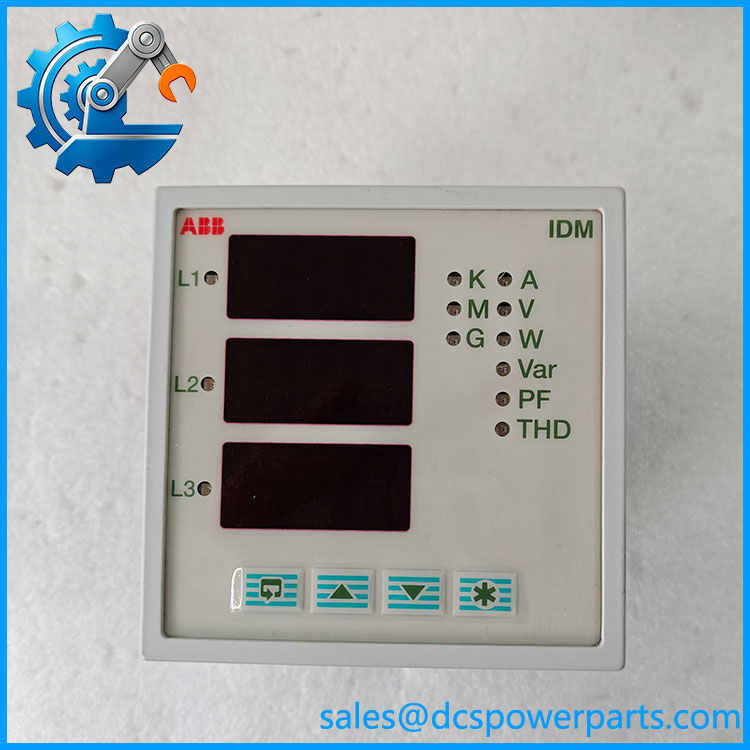
IDM-96
Major Features and Advantages
Multifunction electrical measurement
The IDM-96 combines several electrical variables in one instrument. Depending on the configuration, users can monitor voltage, current, active power, reactive power, apparent power, frequency, power factor, and energy values. This provides a consolidated view of electrical loading and can help maintenance personnel identify abnormal operating conditions.
Single-phase and three-phase support
The documented product configurations support single-phase and different three-phase connection arrangements. The correct configuration must match the site’s wiring arrangement, including whether the network uses three or four wires and whether the load is balanced or unbalanced.
Optional Modbus RTU communications
Versions fitted with RS-485 can communicate with compatible monitoring systems through Modbus RTU. This can support centralized data collection and energy monitoring, but the communications option should be verified from the actual unit’s catalog code and terminal arrangement.
Harmonic analysis on supported versions
Documented IDM-96 versions can measure harmonics up to the 63rd order and provide total harmonic distortion information. Confirm the exact variant and available software functions before relying on these capabilities for power-quality assessments.
Configurable measurement settings
Configuration options allow the instrument to be adapted to the intended electrical network. Current-transformer ratios, voltage-transformer ratios where applicable, network type, and communications parameters must be set correctly to avoid misleading readings.
Typical Applications
- Industrial switchboards and power distribution panels
- Motor control centers
- Electrical load monitoring
- Energy consumption tracking
- Three-phase power measurement
- Supervisory energy monitoring using optional Modbus RTU communications
Installation and Maintenance
- Verify the catalog code. Check the complete label, including any N00392 or N00407 identifier and the configuration suffix.
- Confirm the electrical inputs. Match the meter’s voltage and current ratings to the network and installed current transformers.
- Follow the wiring diagram. Check phase sequence, neutral connections where required, polarity, and terminal assignments.
- Configure scaling. Enter the correct transformer ratios and network settings.
- Check communications. If RS-485 is fitted, confirm the Modbus address, baud rate, parity, and wiring.
- Validate readings. Compare the meter’s measurements against a suitable reference instrument before using them for operational or energy reports.
Electrical connections must be made by qualified personnel using the manufacturer’s instructions and the site’s isolation procedures.
Product Assurance and Procurement Notes
When sourcing an ABB , confirm the complete catalog code rather than relying on the family name alone. Current-input rating, network configuration, auxiliary supply, and RS-485 availability can differ between versions.
Ask the supplier to identify the unit’s condition, provide photographs of its label and terminals, and state what inspection or functional testing has actually been performed. If the instrument is replacing a unit connected to an existing energy-monitoring system, verify that its measurement configuration and communication options match the original.
Procurement note: The is an electrical measurement instrument, not a general-purpose PLC module. Selecting the correct catalog variant is essential for accurate readings and correct system integration.