Description
Product Overview
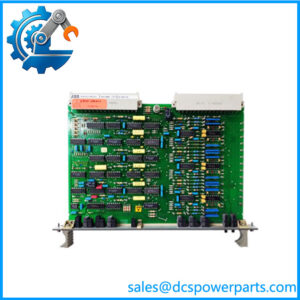
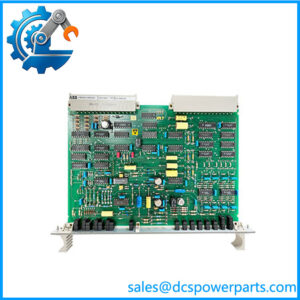
Ordering 500CSP04 1MRB150051R2 puts the shared-base structure under examination from the opposite side, and that is where it becomes interesting rather than merely symmetrical. HE401314-0002 and release R2 belong to this module exactly as HE401314-0001 and R1 belong to 500CMP04. Two catalogue entries, describing the two members separately, reproduce the same lockstep: index -0001 with release 1, index -0002 with release 2. A coincidence would have to be manufactured twice, in the same direction, with the same arithmetic. The structural conclusion is that 1MRB150051 is one assembly base released as two builds, each carrying its own designation and its own reference index — a communication processor on one side, a control and system processor on the other.
That conclusion overturns the family’s release rule in the one place where it matters most. Everywhere else in the block, a release increment means a revision of one product: 500AIM02 at R001 and the later R0002, 500BIM01 and 500BOM01 both at R0002, 500TRM02 at R1 which is R0001 spelled short. Here, on a single base, R1 and R2 do not mark an older and a newer version of one card; they select between two roles. That inverts the practical meaning of the field, and the consequence is worse than a wrong part number: 500CSP04 and its sibling share a base, almost certainly share the board outline, and plug into the same socket. A substitution made in either direction fits, energises, and then performs the wrong function — a rack that expects to be spoken to over a network finds a control processor instead, or a rack expecting control processing finds a gateway. Nothing fails loudly; the plant simply does not work, and the reason is a digit that everyone agreed was a revision number.
The functional reading follows the naming and the architecture together. CMP and CSP share their first letter and their last — both are processors in the family’s own vocabulary, which also gives 500CPU05 its name at 150081. Read against the block’s division of labour, one processor faces outward and one faces inward: the communication processor carries data to and from the plant, the system processor works inside the rack. That is the coherent pairing, and it explains why both exist rather than one replacing the other. What it does not explain, and what no accessible source settles, is the exact boundary between 500CSP04 and 500CPU05: whether the system processor handles scanning and sequencing while the CPU handles program execution, whether it is a partner to the CPU or an element of a different configuration of the same rack, is not documented. Two readings remain open, and a buyer should not treat either as settled.
The identities the market attaches to this code are three, and only one survives scrutiny. A control-and-system-processing module is the convergent description and matches the naming. A power module comes from a catalogue page that files 500CSP04, 500CMP04 and 500AIM02 all under that single heading — three unrelated functions under one label is a category, not a description. A high-performance safety controller module is the claim that deserves the firmest answer: functional safety is a certified property, established per module by approval and documented safety data, and this family has neither. Assigning “safety controller” to a legacy card that no approval covers is precisely how a plant acquires an unverified safety assumption, and it should be rejected on principle rather than on price.
Everything else offered about the card is filler. “High-performance industrial processor” and “integrated support for digital and analog signal processing” are statements that could be made about any processor ever built. Processor type, clock, memory, firmware, bus interface, ports and any power figures are unpublished at module level, and no ABB product page for this family exists to consult. What can be established with confidence is the identity — three strings that must agree — and the fact that a wrong choice among the two builds will not report itself.
Technical Specifications
| Parameter | Value |
|---|---|
| Module designation | 500CSP04 |
| Reference code | HE401314-0002 — base HE401314, index -0002; the counterpart of 500CMP04 at -0001 |
| Order code | 1MRB150051R2 — base 1MRB150051, release R2 |
| Shared base | 1MRB150051 carries both this module and 500CMP04; the release field selects the build rather than a revision of one product |
| Release semantics here | Inverted relative to the block: elsewhere R increments mark revisions, on this base they mark roles |
| Identity layers | Designation, reference code with index, ordering code — all three required |
| Family | 500xxx rack modules; ordering block includes 150003, 150005, 150011, 150022–150024, 150051, 150077, 150081, 178009 |
| Function category | Control and system processing module — rack-side processing |
| Relationship to the central processor | 500CPU05 at 150081 is the block’s central processor; the boundary between it and this module is undocumented |
| Manufacturer | ABB, Sweden |
| Platform compatibility as stated | Procontrol P13 |
| Processor type, clock, memory, firmware | Not published; circulating descriptions are generic |
| Certified functional safety | None documented; the “safety controller” label has no approval basis |
| Mounting | Rack plug-in module; slot per the rack’s layout |
| Lifecycle status | No end-of-life notice located; supply is dismantled and surplus stock |
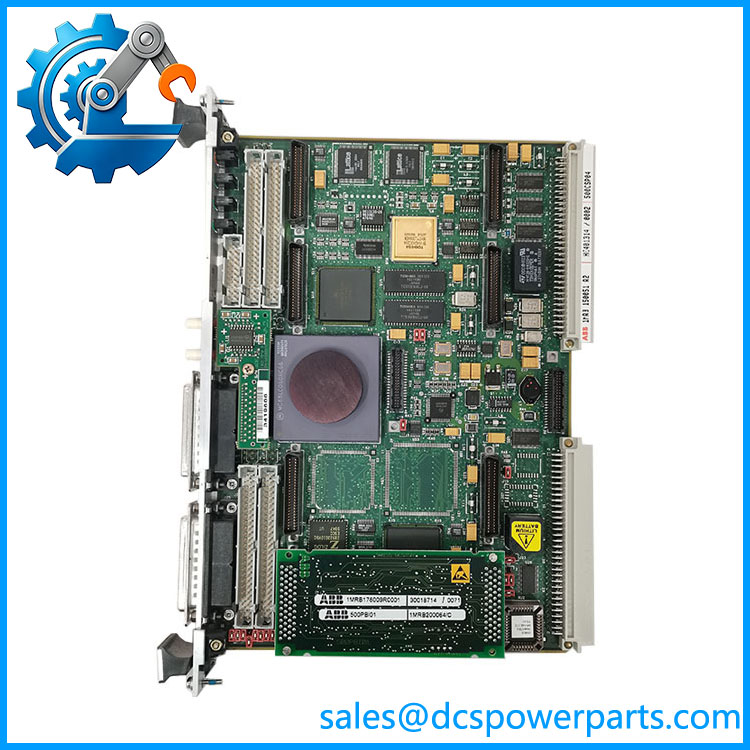
500CSP04 1MRB150051R2
Key Features and Advantages
A pair confirmed twice: -0002 with R2 here, -0001 with R1 on 500CMP04, reproduced independently on both members. The arithmetic is too consistent to be an accident, which is what establishes 1MRB150051 as one assembly base built in two forms.
The release field inverted: on this base, R1 and R2 select roles, not revisions. Elsewhere in the block an increment means a newer version of the same card; here it means a different card — and one that fits the same socket.
Substitution that cannot be detected by fitting: shared base means shared outline and shared connector. A wrong choice between the two builds energises cleanly and fails only at the level of plant function, which is the most expensive kind of failure this family can produce.
Naming that explains the block: CMP and CSP both end in the family’s processor vocabulary, alongside 500CPU05. One processor faces the plant, one works inside the rack — a division of labour rather than a duplicate.
A safety claim refused on principle: “high-performance safety controller module” is a certification, not a description, and no approval or safety data exists for this family. Rejecting that label protects the plant from an assumption nobody can audit.
An open question stated as open: whether this module partners 500CPU05 or serves a different configuration is not documented, and it is the one thing a buyer should confirm from the cabinet’s own arrangement rather than from a catalogue.
Applications
Rack-side control and sequencing: a processor of this class carries the work that belongs inside the cabinet — coordinating I/O cards, sequencing rack-level tasks — rather than the work that belongs on the network.
Partner element in legacy station configurations: plants of this vintage were built in several arrangements around the same card set, and a system processor can appear where a modern design would place a single controller, which is why the cabinet’s arrangement must be read before a spare is chosen.
Retrofit where the slot is fixed and the function is not: an existing cabinet with an empty or failed processor position needs the build that was there, and shared-base siblings make visual identification useless — the reference index and release field are the only discriminators.
Spares rationalisation: a store holding both builds must label them by all three strings, because a bin marked “150051 processor” contains two different products with one socket between them.
Where it does not fit: the communication slot. If a rack has lost its network link, the card required is 500CMP04 at -0001 and R1, and this order is the wrong one — physically correct, functionally useless.
Where the label does not belong: safety-related duty. A module without documented approval and safety data is not a safety controller regardless of how a catalogue files it, and using it as one is an assumption rather than an engineering decision.
Related Products
500CMP04 (HE401314-0001, 1MRB150051R1) — the communication processor sharing this module’s assembly base; the sibling whose existence defines the release field’s role-selecting behaviour. 500CPU05 (1MRB150081R1E) — the block’s central processor at 150081; the card whose relationship to this module is undocumented and must be confirmed from the cabinet. 500MBA01 / 500MBA02 (1MRB150003R0002 / R0003) — module bus adapters at the head of the block; the internal-bus pair that this processor’s I/O cards hang from. 500CIM06 (1MRB150077R0111) — industrial communication module on a different base; evidence that the family separates communication hardware across more than one ordering range. 500BIM01 / 500BOM01 / 500AIM02 (150024 / 150023 / 150022) — the I/O cluster whose data this processor handles. 500TRM02 (1MRB150011R1) — terminal module of the same block; the marshalling element between the rack and field wiring. 500SCM01 (1MRB200059/C, order code 1MRB15004R0001) — further member of the block, listed with its assembly code in the family’s layered form. 07KT98-H2 (GJR order code) — the older 07KT9x/GJR pattern of the same power-plant control lineage.
Installation and Maintenance
Before installation: settle the build before the card is touched. HE401314-0002 with 1MRB150051R2 is this control and system processor; HE401314-0001 with 1MRB150051R1 is 500CMP04, the communication card, and the two share an outline and a socket. Confirm all three strings against the cabinet’s record and against the failed card’s own label, then establish from the rack’s arrangement whether the missing processor was this module or 500CPU05 — the boundary between them is documented nowhere, and the cabinet is the only authority.
Installation: with the rack de-energised, seat the card to full backplane engagement and secure it, restore any address or configuration settings the rack expects, and bring the system up in the plant’s normal sequence. Because a wrong build is electrically harmless, the proof of a correct installation is functional, not electrical: the rack’s processing tasks must run as before, and any data path the rack exposes must behave as before. Where the rack depends on this processor for sequencing, verify the sequence end to end rather than at the card.
Maintenance: keep the failure record together with the three identity strings, so that a replacement is chosen by build rather than by resemblance. When a rack behaves incorrectly after a card change, test the build before testing the card — a shared-base substitution is the likeliest cause and the hardest to see. Store 500CSP04 in packaging marked with designation, reference index and release field, separately from 500CMP04, and confirm configuration retention on any replacement before the plant is returned to service.
Warranty and Quality
Every 500CSP04 1MRB150051R2 module is supplied as a control and system processing card of ABB’s 500xxx rack family, documented by designation, reference code with index -0002, and full ordering code, so that the build can be distinguished from the communication processor sharing its base, 500CMP04 at -0001 and R1. Units are inspected for backplane-interface and connector condition, PCB and assembly damage, rework evidence, corrosion and label legibility including the index and release field; verification covers power-up presence and, where a compatible rack is available, functional operation of the rack’s processing tasks. No processor type, clock rate, memory size, firmware revision or bus interface is asserted, because none is published and the circulating descriptions are generic. The “high-performance safety controller module” label is declined: functional safety is a certified property and no approval or safety data exists for this family. The “Power Module” heading that files this card alongside 500CMP04 and 500AIM02 is noted as a catalogue category rather than a description. A 12-month repair, replacement or refund commitment applies. Technical support covers what this part actually requires: distinguishing the two builds sharing 1MRB150051 by reference index and release field, confirming whether the rack’s missing processor is this module or 500CPU05, and reading the cabinet’s arrangement rather than a catalogue where the two overlap.
免费
今天 10:27