Description
Product Overview
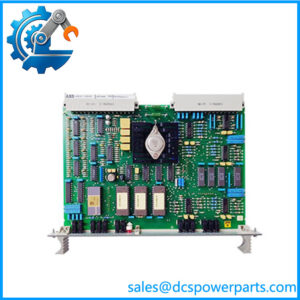
500CMP04 HE401314-0001 1MRB150051R1 carries three identities where the family’s other members carry two, and the third one changes what a mistake costs. Until now this block’s codes failed in the familiar way: a 160024 block that belongs to no module, an R000B where R0003 belongs — errors that produce non-existent parts and therefore announce themselves as “unavailable”. This module breaks that pattern. HE401314 is a shared reference base, and the trailing field selects the product: -0001 is 500CMP04, a communication processor; -0002 is 500CSP04, a control and system processing module. The ordering codes track the same split, 1MRB150051R1 against 1MRB150051R2. One character in the reference code or one digit in the release field moves the order from a communication card to a control card — and both are real, in stock, and will fit the same slot. That is a far more expensive class of error than a dead part number, because nothing fails until the rack is commissioned and the function is missing.
Reading the reference layer properly is therefore the first job. The format is HE plus a six-digit base plus a four-digit index, and sellers write the index either with a hyphen or a slash — HE401314-0001 and HE401314/0001 are the same string with different punctuation, and both appear for this module. Since the base 401314 is shared with the control module, the index is not decoration: it is the field that decides which of two products is in the box. Anyone who quotes the base alone, or quotes the base with the wrong index, has described a family rather than a part.
The function itself is the one point where the market converges, and the architecture explains why it must. CMP reads as communication processor, and four catalogues say the same thing in different words: communication motherboard, communication processor and interface board, multi-protocol interface module, high-performance communication processor module. The block’s structure supports it, because this family already contains a module whose job is the internal bus — 500MBA01 and 500MBA02 at 150003 — and a rack that couples its internal module bus still needs a second, different element to talk to the plant. Internal coupling and external communication are two jobs, and this block assigns them to two different cards. That also disposes of the motherboard reading in one step: a motherboard is the backplane, the backplane role is already owned at 150003, and a rack does not have two.
The remaining competing identity is the weakest and the most revealing. One seller’s category page lists 500CMP04, 500AIM02 and 500CSP04 all as “Power Module” — three modules with a communication function, an analog acquisition function and a control function, all filed under one label. That is not a description of anything; it is a category heading applied indiscriminately across a catalogue, and it is worth recognising because the same page also carries correct ordering codes. A source can be right about numbers and meaningless about nouns, and the numbers are what a purchase runs on.
The ordering block itself turns out to reach further than the plant-rack I/O set this family has been documented through. Alongside 150003, 150005, 150011, 150022, 150023, 150024 and 150081, the trade now shows 150051 for this base, 150077 for 500CIM06 — an industrial communication module carrying 1MRB150077R0111, a release field with letters inside it — and 178009 for 500PB101. So the 500xxx names cover modules beyond any single cabinet’s complement, and the 1MRB15 block is not one continuous series but several overlapping ranges assigned across a product family’s life. For a buyer the consequence is practical: the module’s name and its ordering code must both be checked, because “same family” no longer implies “same rack”.
What the card’s electrical and protocol content actually is, no accessible source states. “Supports extensive analog and digital I/O” is as specific as the market gets, and it describes what a communication processor passes through rather than what it is. Whether this module speaks a fieldbus, a plant network protocol or a proprietary link, how many ports it presents, and what medium it drives are all unpublished — and on a communication card those are precisely the numbers a retrofit needs. The cabinet’s own network documentation, the existing card’s port arrangement and the plant’s communication schedule are the only reliable sources, and unlike the I/O cards in this family, a communication card cannot be validated by injecting a signal: it either establishes its link and exchanges data, or it does not, and the test happens against the plant rather than on a bench.
Technical Specifications
| Parameter | Value |
|---|---|
| Module designation | 500CMP04 |
| Reference code | HE401314-0001 — base HE401314, index -0001; also printed HE401314/0001 |
| Order code | 1MRB150051R1 — base 1MRB150051, release R1 |
| Sibling on the same base | 500CSP04 at -0002, order code 1MRB150051R2 — a different module, not a revision of this one |
| Identity layers | Name, reference code, ordering code — three, unlike the two-layer I/O modules |
| Family | 500xxx rack modules; ordering block spans 150003–150081 plus 150051, 150077, 178009 |
| Function category | Communication processor / interface module — rack-to-plant communication |
| Distinction from the bus module | 500MBA01 / 500MBA02 couple the internal module bus; this card handles external communication |
| Manufacturer | ABB, Sweden |
| Platform compatibility as stated | Procontrol P13 |
| Protocols, ports, medium, data rate | Not published in accessible sources |
| Mounting | Rack plug-in module; slot per the rack’s layout |
| Published documentation | None located at module level |
| Lifecycle status | No end-of-life notice located; supply is dismantled and surplus stock |
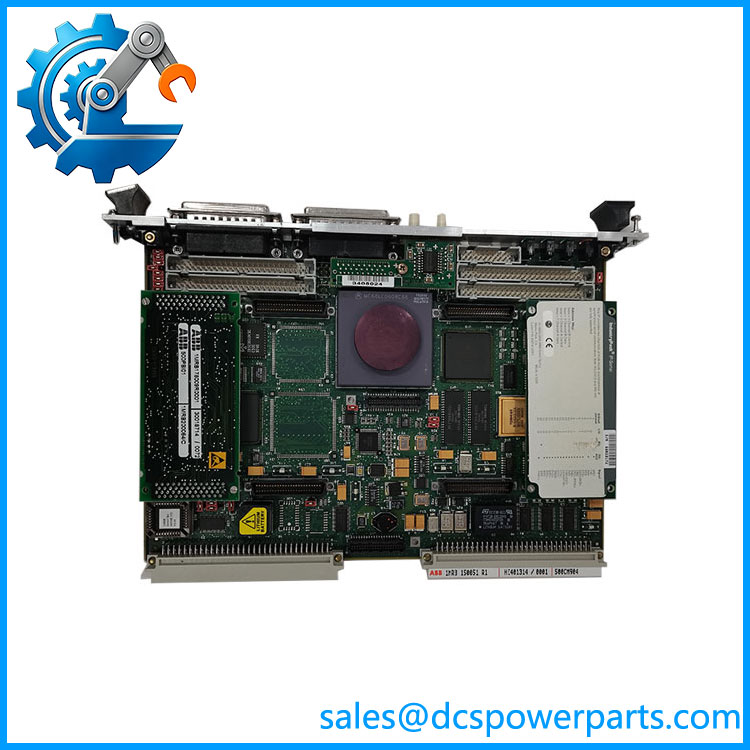
500CMP04-HE401314-0001
Key Features and Advantages
The dash decides: -0001 is this module, -0002 is 500CSP04. Both are real products that fit the same slot, so a one-character error does not fail — it silently delivers the wrong function. This is the family’s most expensive trap and the easiest to avoid.
Three layers to match, not two: name 500CMP04, reference -0001, ordering code 1MRB150051R1. All three move together, and a quotation carrying only two of them is incomplete.
Punctuation is not information: -0001 and /0001 are one string written two ways, and both appear for this module. The index is the load-bearing part; the separator is not.
A role confirmed by what the block already has: the internal bus is owned by 500MBA01 and 500MBA02 at 150003, so this card’s job must be external communication — which is what four catalogues independently state, and what rules out the “motherboard” reading on structural grounds.
Category labels are not descriptions: one page files this module, an analog input card and a control card all under “Power Module”. The ordering numbers on the same page are correct, which is the point — a source can be accurate about codes and meaningless about nouns.
A family wider than one cabinet: 150051, 150077 and 178009 appear alongside the I/O numbers, showing the 1MRB15 block as overlapping ranges across a product family’s life rather than a single continuous series. Same name family, different racks.
Applications
Rack-to-plant communication: the module is the point where a cabinet stops being an isolated controller and joins the station’s network, carrying process data upward and commands downward.
Protocol boundary in legacy stations: where an older plant control system must be integrated with newer supervisory layers, the communication processor is the element that has to be matched to both ends — and the least forgiving part of such a retrofit, because protocol and port expectations are rarely documented.
Telemetry and remote supervision: plants with outstations and unmanned sites depend on cards of this class to move data across a link rather than across a cabinet, which makes the communication processor the single point whose failure is visible to the whole network.
District heating, hydro and auxiliary plant control: installations of this vintage are common in exactly those areas, and their control racks stay in service long after the vendor’s support has moved to later platforms.
Retrofit spares where function matters more than fit: because the sibling 500CSP04 plugs into the same slot, a spare chosen by name or by slot alone can be physically perfect and functionally wrong — the reference index is what prevents it.
Where it does not fit: motherboard or backplane duty, power supply duty, analog acquisition, or binary I/O. The first is excluded by 500MBA01‘s occupancy, the second and third by the module’s own convergence of evidence, and the fourth by the presence of 500BIM01, 500BOM01 and 500AIM02 in the same block.
Related Products
500CSP04 (-0002, 1MRB150051R2) — the control and system processing module sharing this module’s reference base; the card a one-digit error buys instead, and the reason the index must be checked. 500MBA01 (1MRB150003R0002) — module bus adapter at the head of the block; the internal-bus counterpart that makes this card’s role unambiguous. 500MBA02 (1MRB150003R0003, 1MRB200053/M) — the second bus adapter variant of the same base. 500CIM06 (1MRB150077R0111) — industrial communication module of the same family, one block number beyond this one, with letters inside its release field. 500PB101 (1MRB178009R…) — a further family member outside the 15 block, evidence that the ordering ranges overlap rather than run continuously. 500CPU05 (1MRB150081R1E) — processor of the same family; the card whose data this module moves outward. 500BIM01 / 500BOM01 / 500AIM02 (150024 / 150023 / 150022) — the I/O cluster of the same block; the sources and sinks of the data this card transports. 07KT98-H2 (GJR order code) — the older 07KT9x/GJR pattern of the same power-plant control lineage.
Installation and Maintenance
Before installation: verify the index before anything else. -0001 with 1MRB150051R1 is this communication module; -0002 with 1MRB150051R2 is 500CSP04, a different product that fits the same slot. Confirm all three layers against the cabinet’s record, then read the plant’s communication documentation for the port arrangement, medium and protocol the rack expects — on this card those parameters are not published anywhere and cannot be inferred from the module’s appearance.
Installation: with the rack de-energised, seat the card to full backplane engagement and secure it, then connect the network side per the plant’s schedule. Bring the rack up and let the card establish its link before the plant is returned to service: a communication processor has no useful bench test, so the verification is end-to-end — data arriving at the supervisory layer, in the right form, from the right addresses. Record the configuration that was loaded and the addresses it was given, because those live in the plant, not in the module, and a replacement will not carry them.
Maintenance: treat communication faults as three-layer problems — physical link, configuration and card — and check them in that order, since most “failed communication module” reports end at a cable, a connector or a changed address. Archive the rack’s network configuration and the module’s three identity strings together, and store a spare 500CMP04 labelled with the reference index and the release field in full. A spare labelled only “500-series communication card” is the one most likely to be fitted in the wrong place.
Warranty and Quality
Every MP04 1MRB150051R1 module is supplied as a communication processor of ABB’s 500xxx rack family, documented by designation, reference code with its index, and full ordering code, so that all three layers can be checked against a cabinet record before dispatch. Units are inspected for connector and backplane-interface condition, port and connector condition, PCB and assembly damage, rework evidence, corrosion and label legibility including the reference index; verification covers power-up presence and, where a compatible rack and link are available, establishment of communication. No protocol, port count, medium or data rate is asserted, because none is published: the market’s most specific statement is “supports extensive analog and digital I/O”, which describes what the card passes rather than what it is, and the “Power Module” category applied to this module, to 500AIM02 and to 500CSP04 on one page is a heading rather than a description. The function is stated as the family’s convergent reading — communication processor — confirmed by the block’s structure, in which the internal bus role is already owned at 150003. A 12-month repair, replacement or refund commitment applies. Technical support covers what this part actually requires: separating -0001 from -0002 and R1 from R2 so that 500CSP04 is never substituted for a communication card, reading and /0001 as one string, and confirming the plant-side protocol expectations from the site’s own documentation.