Description
Product Overview
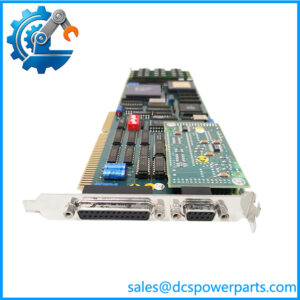
500ITM02 1MRB150021RO116 occupies the one-number gap in its family’s I/O region, and that position is the only fact about it that nothing contradicts. The block runs 150020 for 500MTM02, 150021 for this card, then 150022–150024 for the analog and binary I/O cluster. What that arrangement describes is a two-card front-end pair sitting immediately upstream of the acquisition and drive cards — MTM02 and ITM02 as partners, followed by 500AIM02, 500BOM01 and 500BIM01. A module that fills the last number before the I/O run belongs with the I/O run’s front end, not with the bus adapters at 150003 and not with the processors at 150051 and 150081.
The second code supports that placement more precisely than the block numbers do. 1HDF930712X010 is an engineering identifier in the same 1HDF930n series as the analog input card’s 1HDF930412X010 — the two differ in the four-digit middle of the string, not in the series. Whatever these 1HDF numbers denote, they are assigned from one hardware-engineering scheme, and a card sharing the scheme with an analog input module is a signal-side card rather than a supply or a network element. That is the argument that holds this module to the I/O front end when the trade’s descriptions would scatter it across the whole catalogue.
Those descriptions scatter it widely. A temperature or instrumentation module, and separately a temperature transmitter for DIN-rail mounting that accepts Pt100 and thermocouple inputs — the second is a genre error, because a field transmitter mounted on a DIN rail is a different product line entirely from a card in a 500-series rack, and no ordering-code structure supports the reading. A counter/timer module, from two sources. An interface controller, and separately an industrial communication interface controller belonging to the AC500 series — the AC500 attribution is the same platform error this family has attracted from the start, and AC500’s own ordering codes live in a different prefix system. And a power supply module, from two more. Five identities, four of them incompatible with each other, and one of them incompatible with the module being a rack card at all.
Among the survivors, the counter/timer reading is the one with the most support and the one the naming permits. ITM02 can be read as an intelligent or interval timer module, and the adjacent block 150020 carries 500MTM02 — a second …TM designation one number away, which is exactly the kind of paired naming a series produces when two cards share a function family. A dedicated counting and timing card is also a real thing in racks of this vintage: pulse counting for flow totalisation, speed and position inputs, and time-delay functions that a controller would otherwise have to implement in software. That reading is plausible, evidenced twice, and consistent with the card being positioned before the I/O run — but it is not confirmed, and the article treats it as a reading rather than a specification.
Two smaller observations belong with this order. The release string is printed everywhere as RO116, with a letter O where the family’s convention would put a zero; the competition between the two characters is unresolvable from catalogue text and the board label decides. And the four-digit tail of these release strings is not a sequence shared across the block: R0712 appears on 150020, R0111 on 150077, RO116 here, four digits that rise and fall independently of base number. On this evidence the field behaves like a per-base issue or edition identifier rather than a version counter running through the family — an observation from three data points, offered as a working model and not as a rule.
What the card’s channels, voltages and timing ranges are, nobody publishes. Not one accessible source states a count, a range, a resolution or a response time, and the pages that name a function name only the function. For a special-function card that is the hardest possible gap: unlike an input card, which announces its channels on its face, a timer’s usefulness depends on ranges and resolution that can only be read from the module’s own documentation or from the plant’s functional description of what it was timing.
Technical Specifications
| Parameter | Value |
|---|---|
| Module designation | 500ITM02 |
| Order code | 1MRB150021RO116 — block 1MRB150021; the release string is printed with a letter O, most likely R0116 |
| Second code | 1HDF930712X010 — engineering identifier sharing the 1HDF930n series with 500AIM02‘s 1HDF930412X010 |
| Family | 500xxx rack modules; block number 150021 |
| Block position | Between 500MTM02 at 150020 and the I/O cluster beginning at 150022 |
| Function category | Special-function rack module; counter/timer reading is the best-supported interpretation and remains unconfirmed |
| Platform compatibility as stated | Procontrol P13 |
| Manufacturer | ABB, Sweden |
| Channel count, input frequency, timing ranges, resolution | Not published in any accessible source |
| Mounting | Rack plug-in module; slot per the rack’s layout |
| Published documentation | None located at module level |
| Lifecycle status | No end-of-life notice located; supply is dismantled and surplus stock |
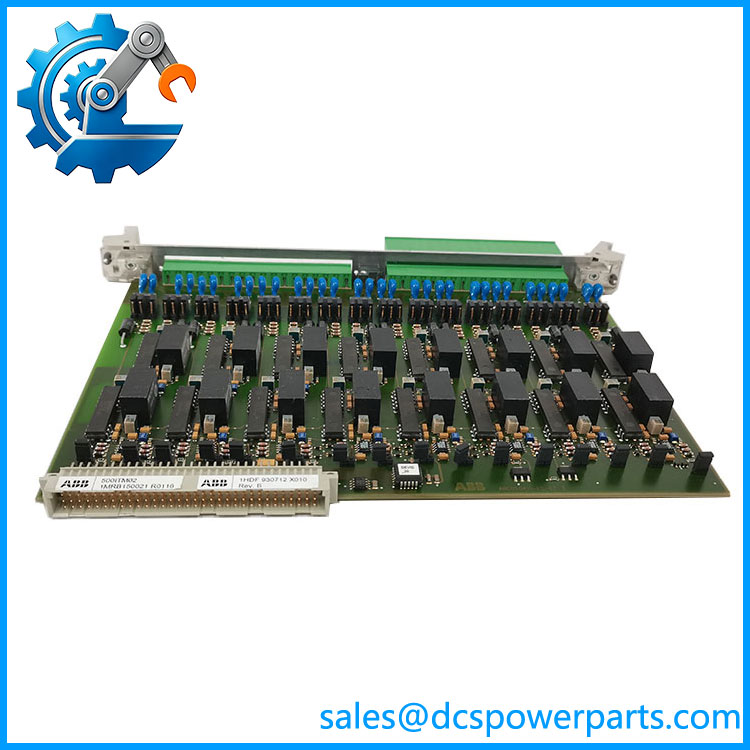
500ITM02 1MRB150021RO116
Key Features and Advantages
A position nobody disputes: 150021 fills the single number between 500MTM02 and the I/O cluster, which makes this card the second half of a front-end pair rather than a member of the acquisition run.
An engineering code that anchors it: 1HDF930712X010 sits one digit away from 500AIM02‘s 1HDF930412X010 in the same 1HDF930n series — a signal-side lineage, not a supply or network one.
Four identities excluded on grounds the buyer can check: a DIN-rail temperature transmitter is a different product line; an AC500-series controller uses a different ordering prefix; a communication interface duplicates roles held elsewhere; a power supply has no engineering code in common with an analog input card.
The surviving reading stated as a reading: counter/timer, supported by two catalogues and by the …TM pairing with 500MTM02 at the adjacent block — plausible, unconfirmed, and not turned into a specification.
A character that needs a decision: RO116 is printed with a letter O by every source seen; the family’s other releases use a zero. Copy the board label, not the catalogue.
Release fields that do not form a series: R0712, R0111 and RO116 on three different bases rise and fall independently, which reads as per-base edition numbering rather than a family-wide version counter.
Applications
Pulse and event counting in legacy racks: totalising flow meter pulses, counting shaft or machine cycles, and capturing events that a controller would otherwise have to poll — the work a dedicated counting card is bought to do.
Time-delay and sequencing functions: on-delay and off-delay duties in interlock chains, where a hardware timer keeps the function independent of program scan time and survives a controller restart.
Speed and position supervision: inputs from proximity probes and encoders converted into rate or position information for the control layer, in plants whose drives predate digital feedback.
Front-end pairing in retrofit planning: because 500MTM02 and 500ITM02 occupy adjacent numbers ahead of the I/O cluster, a cabinet’s complement is usually planned as a group — a store that holds one and not the other has half a front end.
Where it does not fit: DIN-rail temperature transmitters, AC500-series equipment, power supply duty, communication interface duty, or the analog input slot at 150022. Each of those has been attached to this number by at least one catalogue, and each is contradicted either by the ordering structure or by the function being claimed elsewhere in the same block.
Where the function must be confirmed before purchase: anywhere the card is counted on to measure something. Channel count, input frequency and timing range are unpublished, so the plant’s functional description of what this card was doing — not a catalogue — is the document that decides whether a spare will do the job.
Related Products
500MTM02 (1MRB150020R0712) — the module at the block number immediately before this one; the …TM partner that makes the pair reading coherent. 1HDF930712X010 — this module’s engineering identifier, one digit from 500AIM02‘s 1HDF930412X010; the layer that establishes the signal-side lineage. 500AIM02 (1MRB150022R001, 1HDF930412X010) — analog input module at the next number in the series; the first card of the I/O cluster this module precedes. 500BOM01 (1MRB150023R0002) — binary output module of the same cluster. 500BIM01 (1MRB150024R0002) — binary input module of the same cluster. 500TRM02 (1MRB150011R1) — terminal module of the same block; the marshalling element that carries field wiring toward these cards. 500MBA01 / 500MBA02 (1MRB150003R0002 / R0003) — module bus adapters at the head of the block, at the other end of the numbering from this card. 500CPU05 (1MRB150081R1E) — processor of the same family, the consumer of whatever this card produces.
Installation and Maintenance
Before installation: confirm the function from the plant, not from a catalogue. No accessible source states channel count, input frequency, timing range or resolution, and the trade’s five competing identities mean the spare has to be matched to what the card was doing in that cabinet — counting, timing, or something else. Check the ordering string against the board label character by character, since RO116 and R0116 differ in one stroke and every catalogue prints the letter. Verify the second code 1HDF930712X010 as well, then read the slot’s wiring schedule for the input sources and their signal form.
Installation: with the rack de-energised, seat the card to full backplane engagement and land terminations per the schedule. Signal-side cards of this vintage are sensitive to what arrives at their terminals rather than to what the program does with it, so verify the source devices’ signal levels and isolation before energising, and confirm that pulse or timing inputs are within whatever the plant’s functional description says the card was rated for. Bring the rack up and test the function against a known source — a pulse train with a known rate, or a timing interval that can be measured independently.
Maintenance: keep the cabinet’s functional description of this card with its ordering string, because that description is the only record of what the module does and the only basis on which a replacement can be judged correct. Watch terminals for oxidation and for signal degradation from long cable runs, check that suppression on nearby contactor circuits is still in place — counting inputs are easily disturbed by switching noise — and store 500ITM02 separately from the I/O cards, labelled by both codes and by the function recorded from the plant.
Warranty and Quality
Every 500ITM02 1MRB150021RO116 module is supplied as a special-function rack card of ABB’s 500xxx rack family, documented by designation, full ordering string and the second code 1HDF930712X010, with the release string reproduced exactly as printed rather than normalised to a guessed form. Units are inspected for terminal and backplane-interface condition, PCB and assembly damage, rework evidence, corrosion and label legibility including the letter-or-digit character in the release field; verification covers power-up presence and, where a compatible rack is available, operation of the card’s function against a known source. No channel count, input frequency, timing range or resolution is asserted, because none is published anywhere. The five identities in circulation are addressed rather than repeated: the DIN-rail temperature transmitter reading is a different product line, the AC500-series reading uses a foreign ordering prefix, and the power supply and communication interface readings are contradicted by the engineering-code lineage the card shares with 500AIM02. The counter/timer reading is offered as the best-supported interpretation, tied to the adjacent 500MTM02, and explicitly not as a confirmed specification. A 12-month repair, replacement or refund commitment applies. Technical support covers what this part actually requires: resolving RO116 against R0116 from the board label, matching the card to the function recorded in the plant’s documentation, and confirming that a spare chosen from a catalogue identity will actually perform the duty the cabinet expects.
免费
今天 10:34