Description
Fireye 95UVS2-1CEX InSight I UV Flame Scanner
Product Overview
The Fireye 95UVS2-1CEX is an InSight I ultraviolet flame scanner designed to detect the presence or absence of a target burner flame. Unlike a basic UV sensor that simply produces a raw detector signal, the Type 95 InSight architecture incorporates microprocessor-based flame processing and an internal flame relay. This allows the scanner to perform flame discrimination locally rather than requiring a separate remote flame amplifier. The S2 configuration also supports automatic selection of the flame modulation frequency during setup, with manual adjustment available when required.
The Fireye 95UVS2-1CEX is the explosion-protected variant of the 95UVS2 family. Available product records identify its housing as EExd IIC T6 and associate the CEX configuration with internal terminal blocks rather than the standard quick-disconnect arrangement. This distinction matters when replacing a scanner in a hazardous-area burner installation because the enclosure, cable entry, wiring method, and certification arrangement all form part of the installation approval.
The Fireye 95UVS2-1CEX is now a legacy component. Fireye states that the 95UVS2-1CEX, including E versions, is obsolete and identifies 95UVS4-1CEX as the recommended replacement. A replacement should not be treated as a simple sensor swap, however. Burner sighting, mounting, flame characteristics, wiring, hazardous-area certification, configuration parameters, and commissioning settings should all be checked before the existing scanner is removed.
Technical Specifications
| Parameter | Specification |
|---|---|
| Product Model | 95UVS2-1CEX |
| Manufacturer | Fireye |
| Series | InSight I / Type 95 |
| Product Type | Ultraviolet integrated flame scanner |
| Detection | Ultraviolet flame detection |
| Processing | Microprocessor-based |
| Supply Voltage | 24 VDC |
| Supply Current | Approx. 0.35 A |
| Analog Output | 4–20 mA DC |
| Flame Relay | Internal SPST, normally open |
| Fault Relay | Internal SPST, normally closed |
| Housing | EExd IIC T6 explosion-protected |
| Hazardous-Area Version | CEX |
| Display | 8-character alphanumeric LED |
| Operator Interface | Four pushbuttons |
| Environmental Protection | NEMA 4X / IP66 family specification |
| Ambient Temperature | -40°C to +65°C |
| Scanner Internal Temperature | Up to approximately +81°C |
| Purge Air | Approximately 4 SCFM minimum under specified conditions |
| Electrical Connection | Internal terminal blocks / CEX threaded cable-entry arrangement |
| Lifecycle | Obsolete |
| Listed Replacement | 95UVS4-1CEX |
The general Type 95 specifications above are based on available Fireye InSight documentation and technical records. Exact hazardous-area installation requirements should be checked against the applicable certification documentation and the physical scanner nameplate rather than assuming that a generic 95UVS2 specification applies to every CEX configuration.
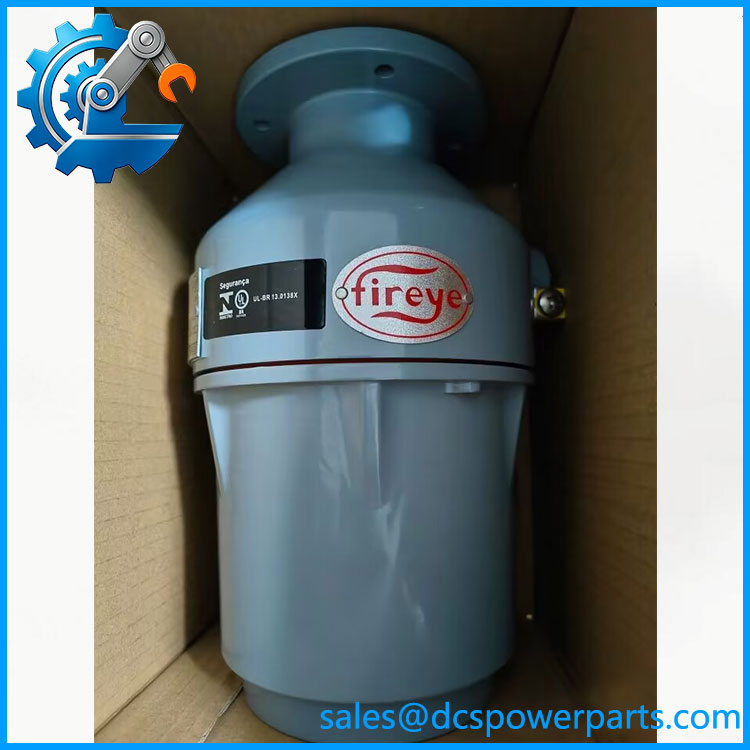
95UVS2-1CEX
Main Features and Engineering Considerations
The principal function of the 95UVS2-1CEX is reliable flame discrimination using ultraviolet radiation from the target flame. The scanner measures the modulation or “flicker” characteristics of the flame rather than simply treating any UV energy as proof of combustion. During setup, the S2 version can automatically determine a suitable modulation frequency, with operator adjustment available when the burner environment requires it. This is important where background radiation, ignition sources, adjacent burners, or unstable flame patterns can otherwise create nuisance flame signals.
The internal flame relay is another important architectural feature. The scanner can provide a discrete flame-status signal directly to the burner management or flame safeguard circuitry. A separate fault relay provides diagnostic status. The 4–20 mA output can also be used where the associated control system requires an analog representation of scanner signal information.
The CEX suffix should receive particular attention during replacement. It identifies a hazardous-area housing configuration, and available records specifically describe the housing as EExd IIC T6. The scanner should therefore be installed with the correct cable-entry hardware, sealing arrangement, grounding provisions, and enclosure assembly required by the approved installation. Substituting a standard 95UVS2 body into an existing CEX installation is not an acceptable assumption simply because the electronics appear similar.
Fireye has discontinued the 95UVS2-1CEX and lists the 95UVS4-1CEX as its replacement. That makes configuration preservation particularly important for legacy burner systems. Before replacement, document flame-on/flame-off thresholds, modulation frequency, gain, sighting position, relay wiring, analog-loop wiring, and any purge-air arrangement.
Application Scenarios
- Industrial gas and oil burner flame monitoring
- Boiler burner management systems
- Furnace combustion systems
- Process heaters
- Single- and multi-burner installations
- Hazardous-area combustion equipment
- Applications requiring UV flame discrimination
- Legacy Fireye InSight I installations
Engineer’s Guide: Field Pitfalls
Do not confuse UV and IR models.
95UVS2 is the ultraviolet configuration. 95IRS2 is the infrared equivalent, while 95DSS2 combines UV and IR detection. These are not interchangeable by part-number similarity.
CEX is not just a cosmetic suffix.
The CEX housing is associated with the explosion-protected installation. Verify the complete hazardous-area certification and cable-entry arrangement before replacement.
Do not assume the replacement is plug-and-play.
Fireye lists 95UVS4-1CEX as the replacement for 95UVS2-1CEX, but the burner installation should still be reviewed for configuration and commissioning requirements.
Check sighting before changing electronics.
A scanner can be electrically healthy while producing poor flame discrimination because the sighting angle, burner geometry, lens condition, or purge-air path has changed.
Keep the purge-air path clean.
Dust, oil deposits, combustion products, and inadequate cooling/purge flow can degrade optical performance or increase scanner temperature.
Preserve the old settings.
Record modulation frequency, gain, flame thresholds, relay behavior, and analog-loop scaling before removing the legacy scanner.
Frequently Asked Questions
What is Fireye 95UVS2-1CEX?
It is an InSight I ultraviolet integrated flame scanner with an EExd IIC T6 explosion-protected housing for hazardous-area combustion applications.
Is 95UVS2-1CEX still manufactured?
No. Fireye identifies the 95UVS2-1CEX as obsolete and lists 95UVS4-1CEX as the recommended replacement.
What does the UV scanner detect?
It detects ultraviolet radiation associated with the target burner flame and uses the InSight processing system to distinguish flame conditions.
Does it have an internal flame relay?
Yes. The Type 95 InSight architecture incorporates an internal flame relay, eliminating the need for a separate remote flame amplifier for the basic flame-relay function.
What power does the scanner use?
The Type 95 InSight scanner specification is 24 VDC, with approximately 0.35 A supply current reported for the family.
What is the recommended replacement?
Fireye specifically lists 95UVS4-1CEX as the replacement for 95UVS2-1CEX. The replacement should still be checked against the installed burner-management configuration and hazardous-area requirements.
Procurement Note
For a legacy 95UVS2-1CEX, verify the complete nameplate, hazardous-area marking, housing condition, cable-entry arrangement, and burner application before purchasing. Because the model is obsolete, preserving the original configuration data is often as important as obtaining a physically compatible scanner. Fireye’s documented replacement path is 95UVS4-1CEX, but site certification and commissioning requirements should be confirmed before making the change.