Description
Product Overview
500CPU03 1HDF700003R5122 is an oddity worth naming precisely: it is a module whose name identifies its family while its order-code prefix does not. 500CPU03 belongs to a 500xxx naming scheme that spans processor, binary-input and terminal modules — 500CPU05, 500BIM01, 500TRM02 all follow the same pattern — and those siblings carry order codes in the 1MRB block. This one carries 1HDF. So the prefix varies inside one named family, which means the family cannot be identified from the code prefix at all, only from the module name. That single observation dismantles most of what the market says about this part.
The market’s five identities are: an AC 500 PLC CPU, an AC500-eCo CPU, an RTU500 CPU, an REB500 busbar-protection CPU, and a BIVECTOR drive controller CPU — with one seller hedging across two of them in the same sentence, calling it a legacy unit used in earlier generations of the REB500 busbar protection system and specialised BIVECTOR drive controllers. Those five products do not share a module family, and their order-code prefixes differ: the AC500 and AC500-eCo ranges use 1SAP-style codes and PM5xx/TB5xx module names; the RTU500 range has its own naming; the REB500 protection range uses its own prefix block again. A 500CPU03 with an 1HDF code and siblings in 1MRB fits none of those descriptions. What it does fit is the family pattern that sits beside it in the trade’s own catalogues: a 500xxx module set with 1MRB codes, a Sweden origin field, a customs classification of 85389091 — parts of electrical apparatus — and a catalogue series field reading Procontrol.
That last point is the one worth taking seriously, because it is a real ABB lineage rather than a reseller’s guess. ABB’s Procontrol power-plant control systems are Swedish-origin equipment with rack-mounted processor and I/O modules carrying 07KT9x designations and GJR order codes — and one dealer’s catalogue places 07KT98-H2 (GJR…) in the same product run as 500CPU03 and 500CPU05. Two unrelated product lines do not get catalogued together by accident as often as a single vendor’s related rack equipment does. None of this is documentation, but the association is consistent: a rack processor module of ABB’s power-plant control lineage, later generation than the 07KT9x boards, carrying a 500xxx name and an order code from whichever block the factory assigned it.
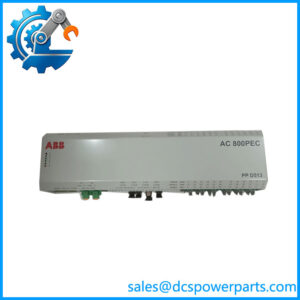
What the part physically is, the catalogued fields answer better than any prose: a rack module of roughly 73 mm by 233 mm by 212 mm at about 1.1 kg, which is the form factor of a plant control rack CPU rather than a DIN-rail PLC head or a drive control card. Those figures come from a reseller transcription of ABB catalogue data — the field set (article number, series, origin, dimension, weight, customs tariff) is the pattern ABB’s own catalogue export produces — so they are more trustworthy than any functional description in circulation, while still being worth verifying against the item in hand.
What is not trustworthy at all is the specifications. One listing gives 800 MHz, 1 GB RAM, 4 GB Flash, 24 VDC at ≤25 W and a −25 °C low limit. None of that appears in any catalogue field or manual, and a rack processor of this generation and form factor does not carry desktop-class memory figures; it is the same template that gets pasted onto every industrial module a certain tier of seller touches. The same goes for the “high-performance” framing: this is a legacy plant controller, and its value is continuity, not throughput.
The order code itself is being hand-copied badly in the market. One seller’s page carries 1HDF700003R5112 in the title and 1HDF700003R5122 in its own specification table — the same item, two different order codes, differing in a single digit of the R field. That is exactly how a wrong card gets bought: not through a wrong platform theory, but through a 1 typed where a 2 belongs. The R field is part of the identity, and it has to be checked character by character against the cabinet’s record.
Technical Specifications
| Parameter | Value |
|---|---|
| Module designation | 500CPU03 |
| Order code | 1HDF700003R5122 — prefix 1HDF, release field R5122 |
| Family pattern | 500xxx module naming, siblings 500CPU05, 500BIM01, 500TRM02 |
| Sibling order codes | 1MRB block (e.g. 500CPU05 = 1MRB150081R1E), showing the prefix varies within the family |
| Manufacturer | ABB, Sweden-origin power plant control lineage |
| Product type | Rack CPU / processor module |
| Series field as catalogued | Procontrol |
| Dimensions as catalogued | 73 × 233 × 212 mm |
| Mass as catalogued | 1.1 kg |
| Customs tariff as catalogued | 85389091 |
| Mounting | Rack plug-in module; slot assignment per the rack’s own layout |
| Supply, memory, performance | Not published — no manual or datasheet located; circulated figures are template text |
| Published documentation | None located at module level |
| Lifecycle status | No end-of-life notice located; supply is dismantled and surplus stock |
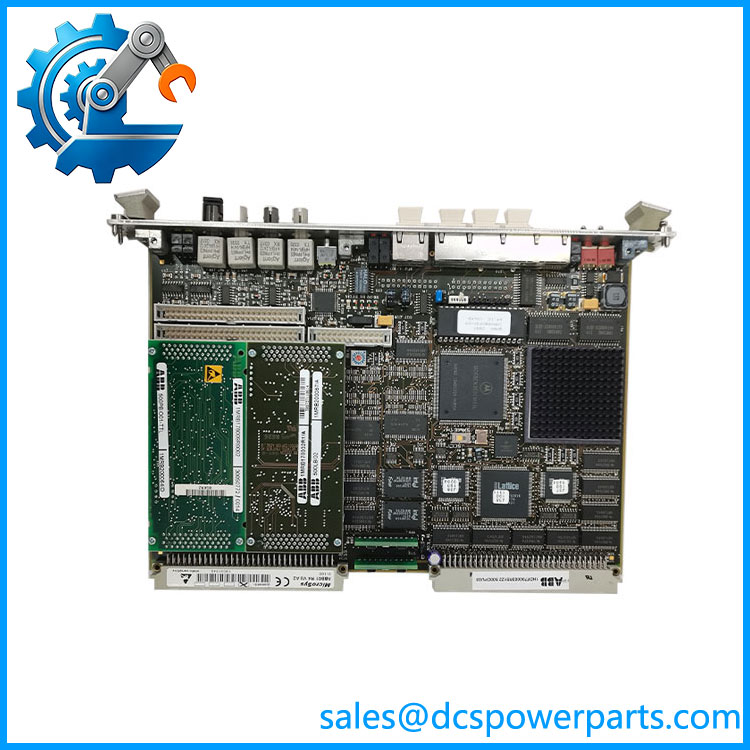
500CPU03 1HDF700003R5122
Key Features and Advantages
Read the name, not the prefix: 500CPU03 places the module in a family that includes processor, binary-input and terminal units. The order-code prefix does not, because siblings carry 1MRB while this one carries 1HDF. Naming discipline is what makes this part identifiable at all.
A code-family argument that eliminates four claims at once: AC500 and AC500-eCo use 1SAP codes and PM5xx names, RTU500 and REB500 use their own blocks. A 500xxx module with 1HDF/1MRB codes, a Sweden origin and a customs classification of 85389091 does not belong to any of them — and that is a stronger conclusion than any vote among listings.
Rack form factor that matches the function: 73 × 233 × 212 mm at 1.1 kg is plant-control rack geometry, not DIN-rail PLC geometry and not drive-card geometry. The physical description corroborates the family reading.
Catalog fields beat catalogue prose: article number, series, origin, dimension, weight and tariff appear as a transcribed set — the same field pattern ABB’s catalogue export produces — and they are usable where functional descriptions are not.
Order-code discipline as the actual risk: the R field distinguishes stock, and the trade is already mis-copying it, with one page carrying R5112 and R5122 for the same item. Checking all thirteen characters is the purchase.
Honest limits: no manual, no memory figure, no supply specification and no lifecycle statement exists for this module in accessible sources; the 1HDF prefix itself is not documentable to a named ABB product line, so the platform reading rests on the family, the origin field and the catalogue series — an association, not a datasheet.
Applications
Power plant control racks: as the processor of a 500xxx rack, the module sits at the top of a plant cabinet’s control hierarchy, with the binary-input and terminal modules of the same family around it — a configuration that matches boiler, turbine and balance-of-plant duty.
Hydro and thermal plant retrofit: legacy plant controllers in this lineage stay in service far past their design life, and a release-accurate CPU module is what keeps a cabinet running through another maintenance cycle.
Redundant controller pairs: where a plant cabinet runs duplicated processors, the pair must match in order code as well as in type, which is the strongest argument for recording the full R field rather than the family name.
Spares holding for obsolete racks: the module is the one card whose loss stops the whole rack, and with no factory supply the practical answer is one verified unit held against the full order code.
Cabinet identification: for a plant with drawings missing but racks populated, the 500xxx names on the neighbouring modules establish the family and the generation faster than any serial-number search.
Where it does not fit: AC500 or -eCo PLC duty, RTU500 telecontrol duty, REB500 busbar protection duty, BIVECTOR drive control duty, or any description carrying 800 MHz, 1 GB RAM and 4 GB Flash. Those are template texts attached to this number, not properties of the module.
Related Products
500CPU05 (1MRB150081R1E) — the sibling processor of the same 500xxx family; the module that proves the order-code prefix varies while the name family holds. 500BIM01 (1MRB150024R0002) — binary input module of the same family; the field-side partner of a 500xxx rack CPU. 500TRM02 (1MRB150011R1) — terminal module of the same family; the marshalling element that sits between field wiring and the rack. 07KT98-H2 (GJR order code) — the older 07KT9x/GJR module pattern of ABB’s power-plant control lineage, catalogued alongside this family by the same trade. 1HDF700003R5112 — not a relative but a transcription error: the same item with one digit of the R field changed, appearing on a seller’s own page beside the correct code. / -eCo PM5xx CPU modules — the products this module is most often mis-sold as; 1SAP order codes and a DIN-rail format separate them decisively. REB500 protection modules — the busbar-protection identity attributed to this part by one seller; a different product line with its own code block.
Installation and Maintenance
Before installation: verify all thirteen characters of 1HDF700003R5122, with particular attention to the R digit, since the market demonstrably circulates R5112 for this item. Confirm the module against the rack’s own record and against the neighbouring 500xxx modules, check the slot assignment and the backplane connector for bent or recessed pins, and establish what the rack expects of its processor before fitting anything — the application and configuration are the site’s asset, and a replacement processor with no compatible configuration is hardware only. Photograph the module in place with its cabling, and work at an ESD-protected bench.
Installation: with the rack de-energised, seat the module to full backplane engagement and secure it per the rack’s mechanical arrangement, then bring the cabinet up and let the self-test and diagnostics run before loading the application. Confirm that the neighbouring modules are recognised at their expected addresses and that the plant’s I/O is reporting plausibly — on a rack processor, a healthy start with wrong I/O is usually a configuration or addressing problem rather than a board fault.
Maintenance: keep the application, the parameter set and the full order codes of every module in the rack archived together, and update them when any module is replaced; this is what makes a spare meaningful on a legacy platform. Treat cabinet cooling and backplane cleanliness as part of the processor’s service life, inspect connectors for oxidation at planned outages, and do not re-seat working modules as routine practice. Store a spare 500CPU03 in dissipative packaging labelled with the complete order code and the rack it belongs to, because a 500xxx module from another cabinet may be the right family and the wrong release.
Warranty and Quality
Every 500CPU03 1HDF700003R5122 module is supplied as the processor of an ABB 500xxx control rack and is documented by module designation and full order code, including the R field, so that it can be matched against a cabinet record rather than against a description. Units are inspected for connector and backplane-interface condition, PCB and assembly damage, rework evidence, corrosion, label legibility and the legibility of the order code itself; verification covers power-up presence and self-test behaviour in a compatible rack where one is available. No processor speed, memory size, supply range or power figure is asserted, because those numbers appear only in template texts that describe several unrelated ABB product lines at once, and the catalogue fields transcribed for this module — 73 × 233 × 212 mm, 1.1 kg, tariff 85389091, series Procontrol — are offered as catalogue data rather than as measured specification. A 12-month repair, replacement or refund commitment applies. Technical support covers what this part actually requires: reading 500CPU03 as a member of a named 500xxx family whose order-code prefixes vary between 1HDF and 1MRB, rejecting the , RTU500, and BIVECTOR identities on code-family grounds, and checking every character of the R field before a spare is dispatched.