Description
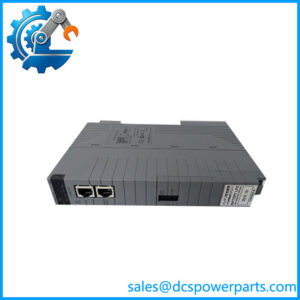
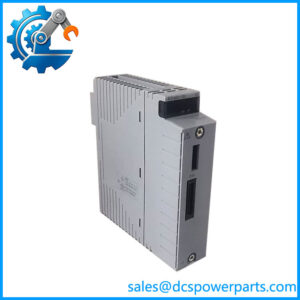
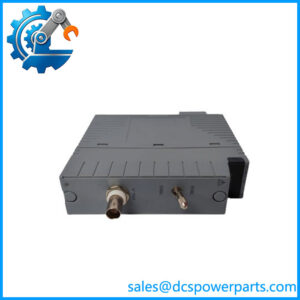
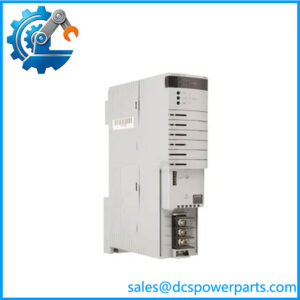
Yokogawa NFDV557-S00 Digital Output Module
Product Overview
The Yokogawa NFDV557-S00 is a high-density digital output module designed for Yokogawa’s FCN/STARDOM autonomous controller I/O architecture. Its basic job is straightforward: convert controller-generated discrete commands into 24 VDC field outputs for equipment such as solenoid interfaces, contactor control circuits, status devices, interlocks, and other on/off loads. Yokogawa documentation identifies the NFDV557 as a 32-channel, 24 VDC isolated digital output module and specifically distinguishes it from the NFDV551 by limiting the NFDV557 to pressure-clamp terminal connections.
From a maintenance standpoint, that termination detail matters more than it may appear. The NFDV557-S00 is not simply a generic 32-point PLC output card that can be dropped into any Yokogawa rack. Its electrical interface, terminal arrangement, module family, and controller hardware generation all need to match the existing installation. Yokogawa’s FCN documentation lists the NFDV557 together with the NFTC5S pressure-clamp terminal arrangement, while the module’s documented application is within the FCN autonomous-controller hardware ecosystem.
For legacy system maintenance, the Yokogawa NFDV557-S00 is most useful when the existing application already uses the same pressure-clamp termination architecture. Replacing it with a superficially similar 32-channel output module without checking the terminal interface is a common procurement mistake. The NFDV551, for example, is also a 32-channel 24 VDC digital output module, but its documented connection arrangement differs.
Product Introduction
When a field cabinet has dozens of discrete loads, channel density becomes a wiring and maintenance issue as much as a controller-capacity issue. The NFDV557-S00 addresses that requirement with 32 isolated 24 VDC digital outputs in one FCN I/O module.
For a legacy replacement or DCS/PLC migration project, the critical check is not just “32 outputs, 24 VDC.” Confirm the FCN controller generation, terminal block, wiring arrangement, module revision, and actual field load requirements before approving the replacement.
Key Technical Specifications
| Parameter | Value |
|---|---|
| Product Model | NFDV557-S00 |
| Manufacturer | Yokogawa Electric Corporation |
| Product Type | Digital Output Module |
| Number of Channels | 32 |
| Output Voltage | 24 VDC |
| Output Type | Digital / discrete output |
| Isolation | Field-to-circuit isolated |
| Terminal Interface | Pressure-clamp terminal support only |
| Associated Terminal Block | NFTC5S |
| Module Configuration | -S00: standard / basic configuration |
| MIL Connector | Not supported for NFDV557 |
| Product Family | FCN / STARDOM I/O |
Yokogawa’s published FCN documentation confirms the 32-channel, 24 VDC configuration and pressure-clamp-only interface. The associated terminal-block documentation identifies NFTC5S for the .
Important: Public Yokogawa documentation reviewed for this model does not establish a universal per-channel output-current rating, exact power consumption, operating-temperature limit, or firmware revision specifically for the ordering code. Those values should therefore be verified from the applicable hardware revision documentation or nameplate rather than copied from reseller listings.
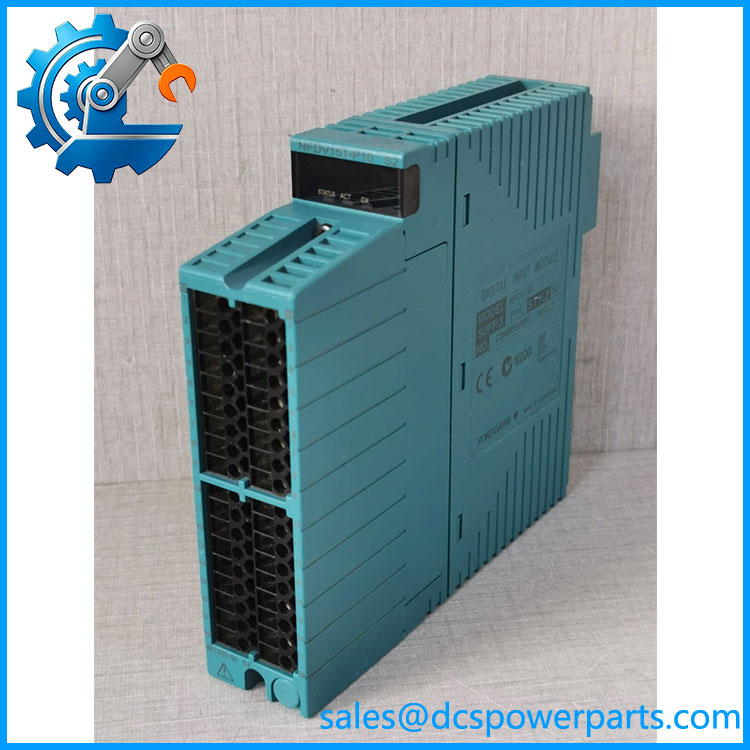
NFDV557-S00
Major Features / Practical Advantages
32-channel discrete output density
Thirty-two outputs in one module make the suitable for applications with a large number of binary commands. Typical examples include valve solenoid interfaces, motor-control permissives, annunciation circuits, interlocks, and auxiliary equipment commands.
That density can reduce the number of occupied I/O positions compared with lower-channel-count modules. In an existing cabinet, however, the actual benefit depends on how the original wiring was engineered.
24 VDC field output architecture
The module is specifically documented for 24 VDC digital outputs. It should therefore be evaluated against the actual field load rather than simply the controller-side signal voltage. Solenoid coils, relays, contactor interfaces, and other loads may have substantially different inrush and steady-state characteristics.
Do not assume that a 24 VDC output module can directly drive every 24 VDC field device. Load current, inductive behavior, suppression, external interposing relays, and circuit protection still need to be checked.
Field-to-circuit isolation
Yokogawa identifies the as an isolated digital output module. That separation is important when discrete field wiring enters a controller cabinet from equipment with different electrical noise or grounding conditions.
Isolation does not eliminate the need for proper field wiring, shielding, grounding, fusing, and surge suppression. It is one layer of the electrical interface, not a substitute for correct cabinet design.
Pressure-clamp termination
This is one of the defining characteristics of the . Yokogawa explicitly lists the module as supporting pressure-clamp terminals only, with NFTC5S identified as the corresponding digital terminal block arrangement.
That makes terminal compatibility a first-line procurement check. A replacement module with the same channel count and voltage but a different connector architecture is not an equivalent field replacement.
Suitable for legacy FCN maintenance
The belongs to the Yokogawa FCN/STARDOM I/O ecosystem. Yokogawa’s hardware documentation also identifies the module in FCN hardware configurations and documents its relationship to the pressure-clamp terminal system.
For maintenance teams, this makes the full ordering code important. Do not purchase only on the basis of “ digital output module”; retain the -S00 suffix when matching a replacement.
Related Products
- NFDV551 — 32-channel, 24 VDC digital output module with isolated outputs. Functionally close to , but its documented connection arrangement uses the NFTD5S/MIL-connector architecture rather than the pressure-clamp-only interface.
- NFDV561 — 64-channel, 24 VDC digital output module. Useful where channel density is more important than maintaining the ‘s exact interface.
- NFDV157 — 32-channel, 24 VDC digital input module with pressure-clamp terminal support only. It handles field feedback rather than output commands.
- NFDV151 — 32-channel, 24 VDC digital input module. The complementary input-side option for discrete field status signals.
- NFDV532 — Four-channel pulse-width output module for 24 VDC isolated applications. Intended for pulse-based control rather than ordinary 32-point discrete switching.
- NFDR541 — 16-channel isolated relay output module supporting substantially different field voltage ranges. Use when relay contacts rather than transistor-style 24 VDC digital outputs are required.
- NFTC5S — Pressure-clamp terminal block associated with the digital I/O arrangement. It should be checked as part of the complete field-interface assembly.
FAQ
Is a PLC output module or a DCS module?
It is best treated as a Yokogawa FCN/STARDOM digital I/O module rather than a universal PLC output card. Yokogawa lists it within FCN autonomous-controller hardware and digital I/O documentation.
How many ouoes provide?
The documented configuration provides 32 digital output channels, with a 24 VDC field-output architecture.
Can I use NFDV551 of ?
Not as a blind plug-in replacement. Both are 32-channel, 24 VDC digital output modules, but Yokogawa documents different field-termination arrangements. is pressure-clamp-terminal-only, while NFDV551 is associated with the NFTD5S/MIL connector arrangement.
Can I hot-swap this module?
Do not assume unrestricted hot swapping from the part number alone. Online replacement procedures depend on the specific FCN controller/rack configuration and operating procedure. Before removing an energized module, verify the applicable Yokogawa hardware manual and the plant’s approved maintenance procedure.
oes support firmware v3.1?
The ordering code does not provide enough information to establish a firmware version. Firmware should be verified from the installed controller/I/O environment or the actual module documentation rather than inferred from the part number.
oes use a MIL connector?
No. Yokogawa specifically identifies the as pressure-clamp terminal support only. The documented associated terminal block is NFTC5S.
What should I verify before buying a replacement?
At minimum, match the complete code, FCN controller/rack generation, terminal-block model, field wiring arrangement, module revision, and required output-load characteristics. If the existing cabinet uses a pressure-clamp interface, photograph the module label and terminal assembly before issuing the purchase order.
Is a “neus” automatically equivalent to a new production unit?
No. For an older Yokogawa module, condition verification matters. Check the nameplate, manufacturing/revision information, terminal condition, storage history when available, and functional test evidence. A clean housing does not prove that the output channels have been tested under load.
Procurement Note
The should be purchased as a matched FCN I/O component, not as a generic 32-point 24 VDC output card. The most important identification detail is the pressure-clamp-only interface. Yokogawa documentation distinguishes this module from other 32-channel digital output modules specifically on the basis of its terminal arrangement.
For a replacement order, provide the complete part number, module revision/nameplate information, controller or FCN station type, associated terminal block, and field-load requirements. If the project involves migration rather than like-for-like repair, document every existing output circuit before selecting a newer I/O architecture. Channel count alone is not a compatibility specification.