Description
Woodward WIP1 (OLC) Self-Powered Overcurrent Protection Relay
Product Introduction
The Woodward WIP1 (OLC) is part of Woodward’s WIP1 family of self-powered time overcurrent protection relays. The WIP1 is designed to provide phase overcurrent and short-circuit protection without depending on a conventional auxiliary control-power source. It derives operating energy from the current-transformer circuits and can provide the energy required for its circuit-breaker trip pulse. This architecture makes the relay particularly useful in switchgear where dependable protection must remain available even when auxiliary power is unavailable. Woodward documentation describes selectable definite-time and inverse-time overcurrent characteristics, together with high-set overcurrent protection.
The Woodward WIP1 also supports additional protection functions depending on the exact hardware configuration. The documented family includes two-stage earth-fault supervision, load-unbalance supervision, phase and earth-current measurement, fault memory, internal self-supervision, remote tripping, and external trip indication. The WIP1-3 configuration can provide an RS-485 serial interface for SCADA communication, with either Modbus RTU or Woodward-Pro Open Data Protocol depending on the selected option. These configuration differences matter during replacement: “” alone does not establish the exact CT rating, earth-fault option, communication interface, auxiliary-power arrangement, or flag-indicator configuration.
For procurement, the Woodward (OLC) should therefore be identified from its complete nameplate and order code rather than from the family name alone. The historical documentation defines multiple variants, including -1, -2, and -3. A technically similar relay can still be unsuitable if its CT input configuration, trip output, auxiliary supply, earth-fault option, or communications hardware differs from the installed unit.
Technical Specifications
| Parameter | Specification |
|---|---|
| Manufacturer | Woodward |
| Product Family | |
| User Designation | OLC |
| Product Type | Self-powered time overcurrent relay |
| Main Protection | Phase overcurrent / short circuit |
| Protection Elements | I> and I>> |
| Time Characteristics | Definite-time and inverse-time |
| Inverse Curves | Normal, very inverse, extremely inverse, and special characteristics, depending on configuration |
| Earth Fault | Two-stage earth-fault protection available as an option |
| Load Unbalance | Two-stage load-unbalance supervision available as an option |
| Auxiliary Supply | Not required for the basic self-powered arrangement |
| CT Input | CT-powered measuring circuit; exact rated current depends on ordered configuration |
| Trip Output | High-capacity electrical pulse output and/or potential-free relay contacts |
| Communication | RS-485 on -3 configuration |
| Protocol | Modbus RTU or Woodward-Pro Open Data Protocol, depending on option |
| Display | LCD with battery-backed indication |
| Fault Memory | Five fault memories documented |
| Self-Diagnostics | Internal watchdog/self-supervision |
| Remote Trip | Supported |
| External Reset | Supported |
| Operating Temperature | -20°C to +55°C |
| Storage Temperature | -40°C to +85°C |
| Humidity | Up to 95% RH at 40°C, according to documented environmental specification |
| Protection Standards | IEC 60255-related requirements documented for the family |
| Exact Enclosure / Mounting | Verify against installed version and nameplate |
The historical Woodward documentation gives a 1 A rated-current configuration and identifies multiple hardware variants. Because the user-supplied “OLC” designation does not establish the complete order code, the exact CT rating and option set should not be assumed from family data alone.
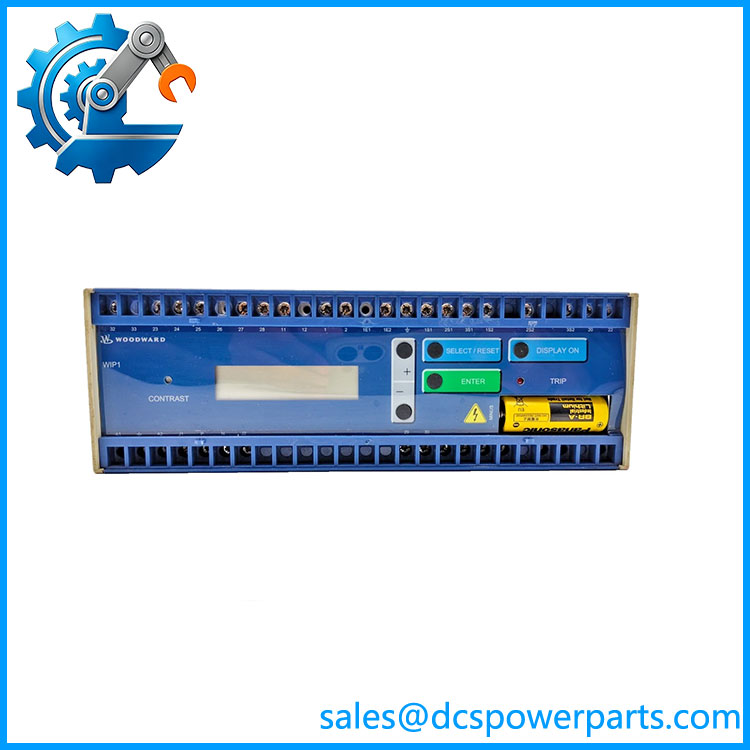
Woodward WIP1 (OLC)
Main Features and Engineering Considerations
Self-Powered Protection
The defining feature of the is its ability to obtain operating energy from the main CT circuits. This removes the normal dependency on an auxiliary control-power supply for the basic relay function. The relay also provides the energy needed for its circuit-breaker trip pulse. This makes the design particularly relevant to switchboards where loss of auxiliary power must not eliminate basic overcurrent protection.
Flexible Overcurrent Characteristics
The provides two overcurrent stages, including a high-set element, and supports definite-time as well as inverse-time operation. The documented inverse characteristics include normal inverse, very inverse, extremely inverse, and special curves. Selecting the correct curve and pickup is a protection-engineering task; the settings should be coordinated against upstream and downstream protection rather than copied blindly from another installation.
Direct Breaker Tripping
The relay can issue an electrical pulse directly to the circuit-breaker trip coil. Historical documentation describes repeated 250 ms trip pulses until the breaker is switched off. Potential-free relay contacts are also available for signaling or alternative trip arrangements. The actual trip circuit must be checked against the installed version and breaker mechanism before commissioning.
Communication Is Configuration-Dependent
Do not assume that every has a communications port. Woodward documentation identifies RS-485 as a hardware option associated with -3. Modbus RTU and Woodward-Pro Open Data Protocol are available depending on the selected interface configuration. A replacement without the required communication option can create an unexpected SCADA integration problem even when the basic protection functions appear correct.
Fault Recording and Diagnostics
The can store fault information and display fault values on its LCD. Internal self-supervision uses a watchdog arrangement, with internal faults reported through an alarm relay. This provides useful commissioning and maintenance information, but it should not be confused with a modern disturbance recorder. The relay is fundamentally a protection device rather than a high-resolution power-quality recorder.
Application Scenarios
- Generator and alternator overcurrent protection
- Industrial switchgear
- Medium-voltage distribution protection
- Circuit-breaker trip protection
- Power-station auxiliary systems
- Industrial motor and feeder protection
- Switchboards without dependable auxiliary control power
- Retrofit protection installations using existing CT circuits
- Applications requiring earth-fault supervision when the appropriate option is installed
Engineer’s Guide: Field Pitfalls
1. Do not order from “” alone.
The family contains different hardware configurations. -1, -2, and -3 differ in areas such as auxiliary supply and communications.
2. Verify the CT secondary rating.
A protection relay designed around a 1 A CT circuit cannot simply be substituted into a different CT arrangement. Confirm the CT secondary current, ratio, burden, wiring, polarity, and shorting arrangements.
3. Check whether earth-fault protection is installed.
Earth-current measurement is an option. Do not assume that a without the appropriate earth-current input has the same protection coverage as an earth-fault-equipped version.
4. Check the breaker trip circuit carefully.
The can provide a direct electrical trip pulse. Confirm trip-coil voltage, pulse requirements, wiring, breaker mechanism, and the exact relay output arrangement before energizing the circuit.
5. Do not assume RS-485 communication.
RS-485 is associated with the -3 configuration. If the existing relay communicates with a SCADA system, confirm the physical interface and protocol before purchasing a replacement.
6. Preserve the existing protection settings.
Pickup currents, time delays, inverse curves, high-set thresholds, earth-fault settings, and blocking functions should be documented before removing an installed relay. Protection settings are part of the electrical design, not merely device configuration.
Frequently Asked Questions
What is Woodward ?
Woodward is a self-powered digital time overcurrent relay intended for electrical protection applications. It provides phase overcurrent and short-circuit protection and can include earth-fault and load-unbalance functions depending on configuration.
What does OLC mean on this item?
“OLC” is not sufficiently documented in the sources reviewed to establish a unique hardware configuration. It should therefore be retained as the user’s supplied designation rather than expanded into an unsupported Woodward option code.
Does require auxiliary power?
The basic is self-powered from the CT circuits and does not require an auxiliary voltage supply. Certain variants, such as, can incorporate an additional power supply arrangement.
Does support Modbus?
Yes, but not every . version can be equipped with an RS-485 interface and can use Modbus RTU or Woodward-Pro Open Data Protocol depending on the ordered configuration.
Can directly trip a circuit breaker?
Yes. The documented design includes a high-capacity electrical pulse output for direct circuit-breaker tripping.
Is a PLC or generator controller?
No. It is an electrical protection relay. Its job is to monitor CT-derived current and execute configured protection and trip functions. It should not be treated as a replacement for a Woodward generator controller or PLC.
Procurement Note
For a replacement purchase, specify the item as Woodward (OLC) self-powered time overcurrent relay, but request a photograph or transcription of the complete nameplate/order code before confirming equivalency.
The critical checks are variant, CT rated current, earth-fault option, load-unbalance option, auxiliary-power configuration, RS-485/communication option, trip-output arrangement, flag indicator, battery version, and existing protection settings. The “OLC” designation by itself is not enough to establish those parameters.
A visually similar can have materially different electrical functionality. For an installed protection relay, exact configuration matching is more important than simply matching the family name.