Description
Woodward SPM-D11 8440-1703 Product Page
Product Overview
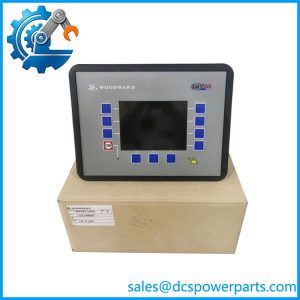
The Woodward SPM-D11 8440-1703 is a microprocessor-based synchronizing unit for generator installations that require controlled connection to an energized bus. Before a generator circuit breaker closes, the controller evaluates the generator and bus electrical conditions and coordinates adjustments to frequency, phase, and voltage. Its purpose is not simply to indicate synchronism; it also provides control outputs that can interface with compatible engine speed governors and automatic voltage regulators. This makes it relevant to generator paralleling systems where synchronization, breaker operation, and subsequent power management must work together.
This specific part number identifies an SPM-D11 with the LSR package, 12/24 VDC auxiliary supply, 100/120 VAC measuring inputs, and 5 A current-transformer inputs. The SPM-D11 family supports synchronization and synch-check functions, black-start or dead-bus operating logic where correctly configured, generator power and power-factor control, and active/reactive load sharing. Generator protection functions include overvoltage and undervoltage, overfrequency and underfrequency, overload, reverse power, and reduced-power protection. Actual behavior depends on the package, configuration, wiring, and operating logic implemented in the application.
For plant maintenance teams, the Woodward SPM-D11 8440-1703 is primarily a legacy power-generation control component. It may be encountered in diesel-generator switchgear, industrial utility systems, and installations that parallel multiple generator sets. When replacing a failed unit, the main risks are usually configuration and interface mismatches rather than the physical fit alone. Confirm the CT secondary rating, voltage-transformer secondary, auxiliary supply, governor and AVR interface, breaker timing, and load-sharing connections. The LSR and LSXR packages are not identical: the LSXR version adds analog control options that the LSR package does not provide in the same way. Recover and verify the existing settings before commissioning any replacement.
Product Introduction — Engineering Perspective
Incorrect CT or voltage-transformer ratings can make a synchronizer unsuitable even when its model family appears correct. The Woodward SPM-D11 8440-1703 is the LSR variant for 100/120 VAC voltage measurement and 5 A CT inputs, with a 12/24 VDC auxiliary supply. It is intended for generator synchronization and related power-management duties, including breaker control and load-sharing functions.
For legacy generator-control maintenance, match the hardware variant and restore the approved configuration before testing synchronization. Verify governor bias outputs, AVR interfaces, phase sequence, breaker-closing logic, and load-sharing wiring as part of the commissioning procedure.
Key Technical Specifications
| Parameter | Specification |
|---|---|
| Model | |
| Part number | 8440-1703 |
| Manufacturer | Woodward |
| Product type | Synchronizing unit with integrated power-control functions |
| Package | LSR |
| Auxiliary power | 12/24 VDC variant |
| Voltage measurement | 100/120 VAC configuration |
| Generator CT input | 5 A secondary |
| Synchronization | Supported |
| Synch-check | Supported |
| Breaker control | One circuit breaker |
| Operating functions | Synchronization, dead-bus operation, and black-start logic where configured |
| Power management | Active-power and power-factor control |
| Load sharing | Active and reactive load-sharing functions |
| Generator protection | Over/undervoltage, over/underfrequency, overload, reverse power, and reduced-power functions |
| Discrete inputs | 12/24 VDC variant |
| Configuration | Front panel and PC, subject to software and package compatibility |
| Mounting | Flush-panel mounting |
| Operating frequency range | Refer to the applicable manual and installation configuration |
| Operating temperature | Verify against the relevant hardware documentation and site requirements |
Important: Confirm the ratings printed on the actual unit label before connecting power or measurement circuits. Do not infer the input ratings from the family name alone.
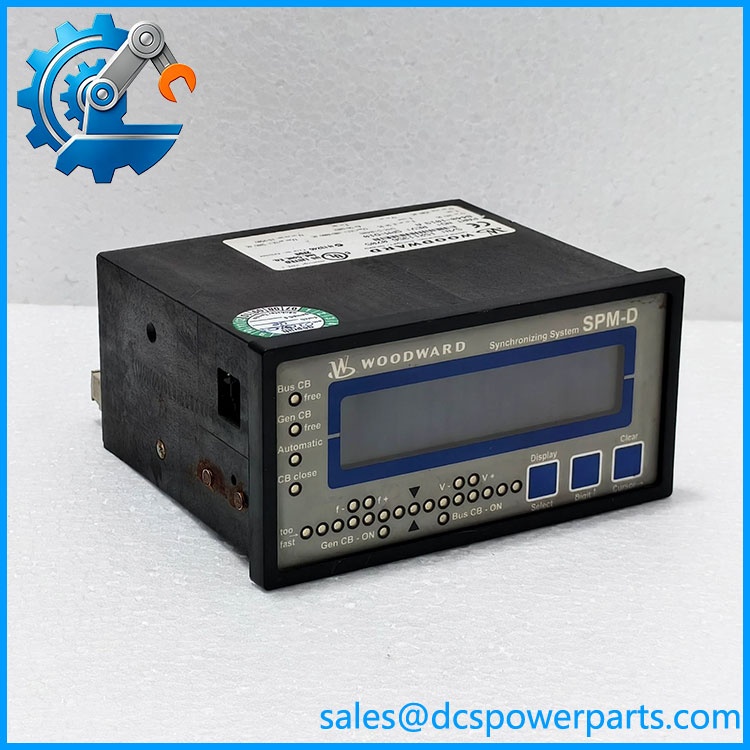
SPM-D11 8440-1703
Related Products
- Woodward 8440-1702: LSR variant with 100 VAC measurement and 1 A CT input. The CT rating differs from the 8440-1703.
- Woodward 8440-1705: LSXR variant with 100 VAC measurement and 1 A CT input.
- Woodward 8440-1706: LSXR variant with 100/120 VAC measurement and 5 A CT input; package differs from the LSR version.
- Woodward 8440-1708: 24 VDC LSR variant with 100 VAC measurement and 1 A CT input.
- Woodward 8440-1686: LSR variant configured for 400 VAC measurement and 5 A CT input.
- Woodward 8440-1666: LSXR variant configured for 400 VAC measurement and 5 A CT input.
- Woodward SPM-D2 11: A newer synchronizer family with updated configuration and interface features; assess application compatibility before considering a migration.
- Woodward 8923-1023: Back-panel mounting adapter accessory for compatible SPM-D installations.
These products are related by function or platform. Different input ratings, control packages, and mounting arrangements mean that a similar model number does not establish direct interchangeability.
Frequently Asked Questions
Q1. What does the Woodward 8440-1703 do?
It synchronizes a generator with an electrical bus and supports related breaker control, generator power management, load sharing, and protection functions. It interfaces with compatible speed governors and voltage regulators to adjust generator operating conditions.
Q2. What is the difference between the 8440-1703 and 8440-1706?
The 8440-1703 is an LSR package, while the 8440-1706 is an LSXR package. Both are associated with 100/120 VAC measurement and 5 A CT inputs, but their control-function packages differ. Check the required analog control outputs and the installed configuration before substituting one for the other.
Q3. Can the 8440-1703 operate with a 1 A current transformer?
The 8440-1703 is specified for a 5 A CT secondary. A 1 A CT installation normally requires the appropriate 1 A variant, such as the 8440-1702, subject to verification against the system design. Never connect a CT secondary based only on physical connector compatibility.
Q4. Can I hot-swap the 8440-1703?
Do not treat this synchronizer as a hot-swappable PLC card. Replacing it can affect generator synchronization and breaker-control functions. Follow the plant’s approved isolation and generator shutdown or transfer procedure, and verify that the affected generator cannot close onto the bus unexpectedly during maintenance.
Q5. Does the 8440-1703 require configuration after replacement?
Yes, the settings must be checked against the approved generator-control configuration. Important items include voltage and frequency limits, phase sequence, breaker-closing compensation, governor and AVR bias settings, and load-sharing parameters. A unit that powers up successfully is not necessarily configured safely for the plant.
Q6. Can this controller be used with different engine governors and AVRs?
The family is designed to work with Woodward or other compatible speed controls and automatic voltage regulators. Compatibility depends on the control signals, electrical ratings, polarity, wiring, and control response supported by the connected equipment. Confirm the interface details before installation.
Q7. What should procurement verify when buying a replacement?
Request a clear label photograph showing 8440-1703, the package designation, and the electrical ratings. Confirm the unit’s condition, revision where applicable, functional-test evidence, return terms, and warranty. For used or refurbished stock, inspect the terminal connections and enclosure and establish whether configuration data can be recovered.
Q8. Is the 8440-1703 interchangeable with the newer SPM-D2 11?
Do not assume direct interchangeability. The SPM-D2 family has updated features and configuration options, but migration still requires checking panel dimensions, wiring, measurement inputs, output interfaces, settings, and application logic. Treat it as an engineering migration unless Woodward documentation confirms a drop-in replacement for the specific installation.