Description
Woodward 9907-014 2301A Speed Control
Product Overview
The Woodward 9907-014 is a low-voltage 2301A electronic speed control designed to regulate the speed of diesel or gas engines and steam or gas turbines. It forms part of a conventional prime-mover governing loop consisting of the electronic speed control, an external DC supply, a speed-sensing device such as a magnetic pickup, and a proportional actuator controlling the fuel or steam metering mechanism. Woodward identifies the 9907-014 as the forward-acting standard-speed-control variant in the 10–40 VDC family.
The Woodward 9907-014 provides isochronous speed control, with external droop available through a potentiometer. The internal speed-range selector accommodates MPU frequency ranges from 500 Hz through 12 kHz, allowing the controller to be matched to different gear-tooth counts and sensing arrangements. For the documented 9907-014 configuration, actuator connections are made through terminals 9 (+) and 10 (−), while terminals 11 and 12 support an optional external speed-trim potentiometer or digital reference arrangement.
From a maintenance perspective, the Woodward 9907-014 is not simply a generic speed regulator. The actuator direction, supply-voltage class, MPU frequency range, minimum-fuel circuit, ramp settings, gain/reset adjustments, and external wiring all affect the commissioning result. Woodward specifically warns that changing the supply-voltage rating requires the properly rated control, while changing between direct- and reverse-acting configurations involves internal PCB changes.
Product Introduction
The 9907-014 targets conventional prime-mover governing systems where a magnetic pickup provides speed feedback and a proportional actuator controls fuel or steam demand. Its low-voltage supply range is 10–40 VDC, with a published 12 W power requirement.
For legacy governor replacement, the exact wiring cannot be assumed from the 2301A family name alone. Woodward documents specific terminal changes when the 9907-014 replaces the older 8272-689, including actuator connections moving to terminals 9 and 10 and changes to speed-trim, droop, and idle/rated-speed circuits.
Key Technical Specifications
| Parameter | Value |
|---|---|
| Product Model | 9907-014 |
| Manufacturer | Woodward |
| Product Series | 2301A |
| Product Type | Electronic Speed Control |
| Control Application | Diesel/gas engines; steam/gas turbines |
| Control Direction | Forward acting |
| Supply Voltage | 10–40 VDC |
| Power Consumption | 12 W |
| Speed Sensor | Magnetic pickup / MPU |
| Speed Range 1 | 500–1,500 Hz |
| Speed Range 2 | 1,000–3,000 Hz |
| Speed Range 3 | 2,000–6,000 Hz |
| Speed Range 4 | 4,000–12,000 Hz |
| Actuator Output Variant | 0–200 mA |
| Actuator Connections | Terminals 9 (+) and 10 (−) |
| External Speed Trim | 100 Ω, 10-turn potentiometer; approximately ±5% |
| External Droop | 2 kΩ potentiometer; approximately 8% maximum |
| Operating Temperature | −40 to +85°C |
| Mounting | Sheet-metal chassis |
| Control Adjustment | Front-accessible potentiometers |
| MPU Cranking Signal | Minimum 1.0 Vrms |
| MPU Rated-Speed Limit | Maximum 30 Vrms |
| Ramp Time | Approximately 1–22 seconds, idle to rated |
| Standard Control Mode | Isochronous |
| Optional Mode | Droop through external potentiometer |
The Woodward manual specifies the 9907-014 in the 10–40 VDC standard-speed-control group and documents the MPU frequency ranges, power requirement, environmental range, actuator connections, speed-trim and droop interfaces.
Major Features / Practical Advantages
2301A prime-mover speed regulation
The 9907-014 is intended to regulate the speed of the prime mover rather than act as a general PLC or DCS controller. Woodward describes the 2301A system as comprising the speed control, external power supply, speed-sensing device, and proportional actuator. The control therefore has to be evaluated as part of the complete governor loop.
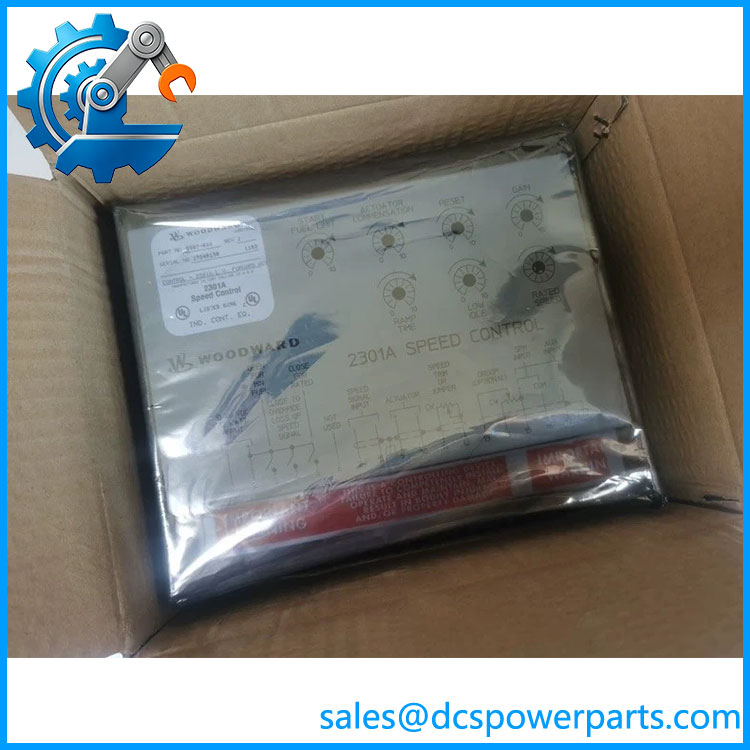
Woodward 9907-014
Low-voltage 10–40 VDC supply
The 9907-014 belongs to the low-voltage 2301A family and requires a 10–40 VDC supply. Woodward specifies approximately 12 W consumption and specifically calls for a low-impedance supply because the internal switching power supply requires a startup current surge. Direct battery-derived supplies are given as an example.
This is an important replacement check. A high-voltage 2301A variant should not be substituted merely because its front panel and general function appear similar.
Four selectable MPU frequency ranges
The internal four-pole selector provides four speed-sensing frequency ranges:
- 500–1,500 Hz
- 1,000–3,000 Hz
- 2,000–6,000 Hz
- 4,000–12,000 Hz
Only one range is selected to match the actual MPU signal. The required frequency depends on the sensing gear tooth count, gear speed, and speed ratio.
This is one of the first things I would check when diagnosing a replacement that powers up but does not regulate correctly.
Forward-acting actuator control
The 9907-014 is listed as the forward low-voltage standard-speed-control part number. In a forward-acting arrangement, increasing actuator command corresponds to increasing fuel or steam demand. The actuator is connected to terminals 9 (+) and 10 (−).
Do not assume a reverse-acting control is equivalent. Woodward states that changing the control’s operating direction requires internal PCB changes.
0–200 mA actuator configuration
The 9907-014 is documented as the 0–200 mA actuator-output variant in Woodward’s 2301A documentation. The troubleshooting section also references approximately 7 V actuator-terminal voltage for the 0–200 mA reverse-acting configuration under a specific diagnostic condition.
The practical replacement check is the actuator itself: its coil resistance, required current range, direction, and mechanical linkage must match the control configuration. Matching the 9907-014 label without checking the actuator is not sufficient.
Isochronous and droop operation
The 2301A normally operates in isochronous mode for constant prime-mover speed. External droop can be introduced with a potentiometer when the application requires speed to vary with load, including parallel-generator or infinite-bus operation.
Woodward specifies a 2 kΩ external droop potentiometer and approximately 8% maximum droop. The amount of droop must be tuned to the actual generator/prime-mover arrangement.
External speed trim
An optional 100 Ω, 10-turn potentiometer can provide approximately ±5% speed adjustment. When this device is not used, terminals 11 and 12 must be jumpered. This jumper detail is easy to overlook during a replacement and can produce a no-start or incorrect-speed condition.
Failed-speed-signal protection
The 2301A continuously monitors the MPU signal. If the speed signal falls below the minimum threshold, the controller commands minimum fuel on forward-acting configurations. An override input is provided for starting conditions where the MPU signal is not yet present.
Woodward specifies a minimum 1.0 Vrms MPU signal at cranking speed and warns that the MPU signal should not exceed 30 Vrms at rated speed.
Adjustable acceleration ramp
The idle-to-rated acceleration ramp is adjustable from approximately 1 to 22 seconds. The rated-to-idle transition is less than one second regardless of the ramp-time setting.
That adjustment is operationally significant on diesel engines because an overly aggressive ramp can produce overshoot, while an unnecessarily slow ramp can delay loading after startup.
EMI-conscious installation
Woodward requires shielded signal wiring for applicable circuits and specifies that shields terminate at the chassis grounding lug near terminal 9, with the opposite end left open and insulated. Signal cables should be kept away from high-current conductors.
This is not cosmetic wiring advice. Poor shielding can manifest as unstable governor behavior, intermittent speed changes, or apparent control tuning problems. Woodward explicitly identifies electrical noise as a possible source of instability.
Related Products
- 9907-015 — High-voltage forward-acting standard 2301A speed-control variant; used where the supply requirement differs from the 10–40 VDC 9907-014.
- 9907-016 — Low-voltage reverse-acting 2301A standard speed-control variant. Direction and actuator behavior differ from the 9907-014.
- 9907-017 — High-voltage reverse-acting 2301A standard speed-control variant.
- 9905-131 — Low-voltage forward-acting 2301A standard speed-control model in the same documented family, while 9907-014 is the EU Directive-compliant version.
- 9905-133 — Low-voltage reverse-acting counterpart to the 9905-131 configuration.
- 9905-135 — Low-voltage tandem-actuator 2301A variant for applications requiring tandem actuator operation.
- 9905-137 — Low-voltage reverse-acting tandem-actuator variant.
- 8272-689 — Earlier 2301 control that Woodward documents as replaced by the 9907-014 in the Caterpillar application covered by Application Note 51191. Wiring is not identical.
- SPM-A Synchronizer — Optional synchronizer input can be connected to the 2301A through the documented SPM interface.
FAQ
Can I replace an 8272-689 directly with a 9907-014?
Not by simply moving the wires terminal-for-terminal. Woodward specifically documents the 9907-014 as the replacement for the older 8272-689 in the referenced application, but also identifies several wiring changes. The actuator connections move to terminals 9 and 10, while speed trim, droop, and idle/rated-speed connections also change.
Can I hot-swap the 9907-014?
No general hot-swap procedure should be assumed. The 2301A is a standalone electronic governor control with external field wiring, an actuator, and a prime mover. Replacement should be performed with the prime mover in a safe maintenance state and according to the site’s approved shutdown/isolation procedure.
What power supply does the 9907-014 require?
The 9907-014 is the low-voltage 2301A version and requires 10–40 VDC, with approximately 12 W power consumption. Woodward specifies a low-impedance supply and warns against powering the low-voltage control from an inappropriate high-voltage source through resistors or zener arrangements.
What MPU signal does the 9907-014 need?
The internal selector supports four frequency ranges: 500–1,500 Hz, 1,000–3,000 Hz, 2,000–6,000 Hz, and 4,000–12,000 Hz. For the magnetic pickup voltage itself, Woodward specifies at least 1.0 Vrms at cranking speed and no more than 30 Vrms at rated speed.
Does the 9907-014 support a 0–200 mA actuator?
Yes. The 9907-014 is the documented low-voltage forward-acting 2301A variant associated with the 0–200 mA actuator configuration. The actual actuator must still be checked for electrical resistance, current requirements, mechanical travel, and direction.
Does it support 4–20 mA?
Do not confuse the 9907-014 with a generic 4–20 mA governor controller. Woodward’s 2301A family includes special controls with 4–20 mA or other outputs, but the 9907-014 is identified in the standard low-voltage forward-acting group. Its primary actuator configuration is the 0–200 mA variant.
Can the 9907-014 operate in droop mode?
Yes. The 2301A provides isochronous operation, with external droop available through a potentiometer. Woodward documents approximately 8% maximum droop using a 2 kΩ potentiometer.
Does this support firmware v3.1?
The 9907-014 is an analog/electronic 2301A governor control rather than a modern firmware-managed PLC/DCS module. A “firmware v3.1” compatibility check is therefore not an appropriate way to identify this part. For replacement, verify the hardware revision, supply class, actuator configuration, MPU range, and external wiring.
What is the operating temperature?
Woodward specifies an ambient operating range of −40 to +85°C (−40 to +185°F). The manual also states that the control should not be mounted directly on the engine and should be protected from excessive vibration, water/condensation, and strong electromagnetic interference.
Procurement Note
For a Woodward 9907-014 replacement, the part number is only the starting point. Confirm the complete nameplate, revision, forward/reverse configuration, 10–40 VDC supply requirement, actuator current rating, MPU frequency range, terminal wiring, and external potentiometer/synchronizer arrangement.
The most important field check is the governor loop. Verify the MPU signal at cranking and rated speed, actuator coil characteristics, fuel-rack or steam-valve linkage, minimum-fuel circuit, and grounding/shielding before commissioning. Woodward’s documentation makes clear that the 2301A must be tuned to the specific prime-mover system.
If replacing an older 8272-689, use the Woodward application note as a wiring-conversion reference rather than treating the 9907-014 as a pin-for-pin replacement. Woodward explicitly documents terminal changes between the two controls.
For legacy spare procurement, verify whether the offered unit is new surplus, unused original packaging, refurbished, or previously installed. Ask for the actual nameplate showing 9907-014, revision, and serial information. A visually clean 2301A is not enough evidence that its internal adjustments, actuator output stage, and speed-sensing circuit have been functionally verified.
Most importantly, do not substitute another 2301A variant solely because it has the same enclosure and general function. Woodward specifies different supply-voltage classes and forward/reverse configurations across the 2301A family; those differences directly affect field compatibility.