Description
Woodward 8237-2600 ProTech-GII Overspeed Protection System
Product Overview
The Woodward 8237-2600 is a ProTech-GII overspeed protection system configured for panel mounting, HV/LV power input, voted trip relays, voted inputs, and math functions. It is not a conventional PLC CPU or DCS I/O card. Its job is much narrower and more important: independently monitor rotating equipment speed and acceleration and issue a turbine shutdown command when configured protection limits are reached. Woodward documents the ProTech-GII as a three-module architecture, with modules A, B, and C independently processing their local speed inputs. For the 8237-2600, the trip commands are voted 2-out-of-3 before driving two redundant Form-C trip relays.
From a turbine protection standpoint, the Woodward 8237-2600 sits in the dedicated overspeed protection layer rather than the normal turbine control layer. Each module accepts one speed input and can be configured for a passive magnetic pickup or an active speed sensor. Passive MPU operation supports an input range of 1–35 Vrms, while active and eddy-current configurations can use the internally provided 24 V sensor supply. The configuration also supports gear-tooth and gear-ratio parameters, with overspeed trip settings extending to 80,000 RPM within the configuration limits.
For plant integration, the Woodward 8237-2600 provides three isolated 4–20 mA speed outputs—one associated with each internal module—and Modbus RTU communications. The serial interface can be configured for RS-232 or RS-485, with baud rates from 19.2 to 115.2 kbit/s and slave addresses from 1 to 247. That makes the ProTech suitable for DCS monitoring without making the DCS the primary overspeed protection path. This separation is important in turbine projects: the DCS can supervise speed, alarms, and trip status, while the dedicated ProTech architecture retains the shutdown function.
The HV/LV configuration is equally important during replacement. Each internal module accepts two independent power inputs, and Woodward specifies separate protection for each input to support module removal procedures. The high-voltage input range is 90–264 VAC or 100–150 VDC, while the low-voltage input range is 18–32 VDC. The 8237-2600 specifically belongs to the HV/LV voted-relay configuration, so it should not be treated as electrically interchangeable with the HV/HV 8237-2601.
Product Introduction
A turbine shutdown system cannot be evaluated like an ordinary controller replacement. The Woodward 8237-2600 combines three independent protection modules with 2oo3 voting, giving the trip architecture a defined fault-tolerance structure while retaining individual speed sensing and diagnostics.
For a legacy replacement, the critical checks are not limited to the part number. Confirm the original ProTech-GII revision, power wiring, speed-probe type, gear-tooth count, trip philosophy, configuration file, and external trip circuit before commissioning.
Key Technical Specifications
| Parameter | Specification |
|---|---|
| Product Model | 8237-2600 |
| Manufacturer | Woodward |
| Product Series | ProTech-GII |
| Mounting | Panel mount |
| Power Configuration | HV/LV |
| Internal Architecture | Three independent modules A/B/C |
| Trip Logic | 2-out-of-3 voted |
| Trip Relay Configuration | Two redundant Form-C voted relays |
| Trip Relay Rating | 8 A at 220 VAC / 8 A at 24 VDC |
| Maximum Switching Voltage | 220 VAC / 150 VDC |
| Maximum Switching Power | 2000 VA / 192 W |
| High-Voltage Input | 90–264 VAC, 47–63 Hz or 100–150 VDC |
| Low-Voltage Input | 18–32 VDC |
| Power per Module | 30 W maximum |
| Passive MPU Input | 1–35 Vrms |
| Active Sensor Supply | 24 VDC |
| Speed Input Channels | One per internal module |
| Speed Configuration | Passive MPU or active sensor |
| Overspeed Setting Range | 0–80,000 RPM within configuration limits |
| Analog Outputs | One isolated 4–20 mA per module |
| Analog Output Resolution | 12 bit |
| Analog Output Accuracy | ±0.1% at 25°C; ±0.5% over temperature |
| Analog Output Load | Up to 500 Ω at 25 mA |
| Serial Communication | Modbus RTU |
| Serial Interface | RS-232 / RS-485 selectable |
| Modbus Baud Rate | 19.2–115.2 kbit/s |
| Modbus Address | 1–247 |
| Dedicated Discrete Inputs | Start, Reset, Speed Fail Override |
| Operating Temperature | −20 to +60°C |
| Storage Temperature | −20 to +65°C |
| Relative Humidity | Up to 95%, non-condensing |
| Altitude | Up to 3000 m |
| Panel-Mount Protection | IP56 when installed in an IP56-rated enclosure/cabinet |
| Approximate Weight | 22 lb / 10 kg |
| Functional Safety | TÜV certified for SIL 3 per IEC 61508 |
| Machinery Standards | API 670, API 612, API 611 |
Specifications above are drawn from Woodward’s ProTech-GII documentation. The 8237-2600 is specifically identified as the panel-mount HV/LV configuration with voted relays and voted inputs/math functions.
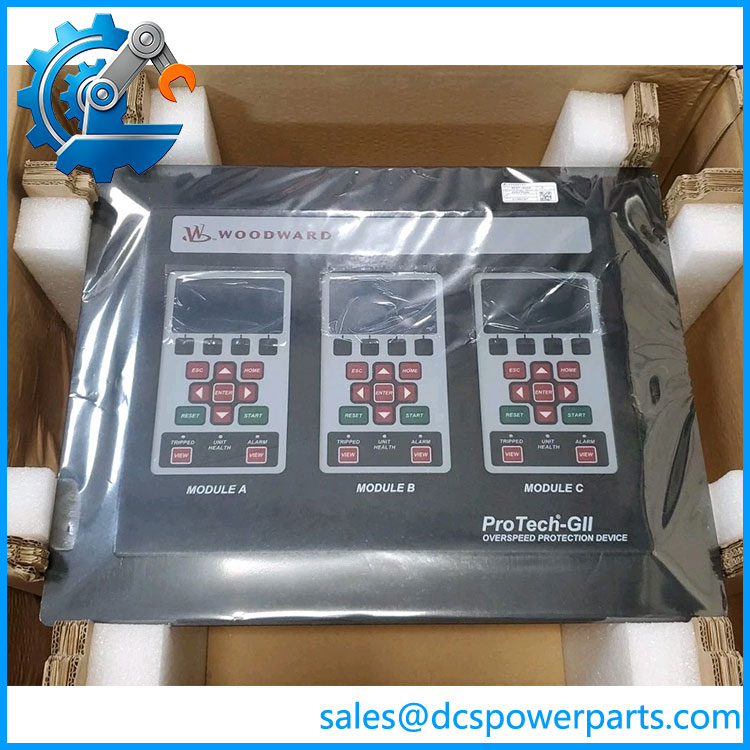
8237-2600
Major Features / Practical Advantages
1. True 2oo3 Trip Architecture
The defining characteristic of the 8237-2600 is its voted trip architecture. Three independent ProTech-GII modules each process a speed input, while the trip commands are combined through 2-out-of-3 voting. Two redundant Form-C trip relays then provide the external shutdown interface. This is materially different from simply connecting three speed sensors to three PLC inputs and writing voting logic in application software. The safety function is implemented inside the dedicated protection architecture.
2. HV/LV Power Configuration
The 8237-2600 accepts one high-voltage and one low-voltage power source per internal module. The HV input supports 90–264 VAC or 100–150 VDC, while the LV input accepts 18–32 VDC. Woodward specifies separate circuit protection for each power input, which is relevant when designing or reviewing turbine shutdown cabinets.
3. Flexible Speed Sensor Interface
Each module has one dedicated speed input. Passive magnetic pickups are supported at 1–35 Vrms, while active proximity and eddy-current sensors can use a 24 V supply. Configuration includes probe type, gear-tooth count, gear ratio, overspeed setpoint, and sudden-speed-loss behavior. This makes sensor matching a commissioning issue, not simply a wiring issue.
4. Fast Overspeed Detection
Woodward specifies total throughput response ranging from approximately 4 ms to 19 ms for frequencies above 1000 Hz, depending on the model, sensed frequency, and use of the Speed Redundancy Manager. The 2oo3 voted-relay architecture has additional internal relay processing, so its response characteristics must be evaluated from the actual application rather than copied from an independent-relay model.
5. DCS Integration Without Making the DCS the Safety Layer
Each module provides an isolated 4–20 mA speed output, and Modbus RTU allows supervisory monitoring from a plant DCS or other Modbus master. Modbus can read status and analog information and, when write commands are enabled, issue reset and test commands under the documented restrictions. It is not intended to turn the DCS into the primary overspeed trip controller.
6. Online Module Replacement
One practical advantage for turbine maintenance is the modular construction. Woodward documents replacement of individual ProTech-GII modules while the monitored equipment remains online, provided the prescribed procedure and configuration are followed. The installation procedure itself requires the affected module’s power to be disconnected before removal, so “hot replacement” should not be interpreted as pulling an energized module without following the manufacturer’s isolation and redundancy procedure.
7. Protection-System Environmental Design
The specified operating range is −20 to +60°C, with up to 95% non-condensing humidity. The panel-mounted version can achieve IP56 protection when installed inside an appropriately rated IP56 enclosure or cabinet. For hazardous-location installations, Woodward specifies additional enclosure and wiring requirements.
Related Products
- 8237-2596 — ProTech-GII bulkhead-mounted HV/LV model with voted relays; useful where the enclosure is mounted directly rather than through a control-panel cutout.
- 8237-2597 — HV/HV bulkhead-mounted ProTech-GII with voted relays; differs from 8237-2600 primarily in mounting and power-input configuration.
- 8237-2601 — Panel-mounted HV/HV voted-relay configuration; the closest electrical comparison to 8237-2600 but uses two high-voltage inputs rather than HV/LV.
- 8237-2598 — Panel-mounted HV/LV configuration with independent trip relays rather than the 8237-2600’s internal 2oo3 voted relay architecture.
- 8237-2599 — Panel-mounted HV/HV configuration with independent trip relays.
- 8237-1596 — Earlier preferred-number ProTech-GII bulkhead HV/LV voted-relay configuration; useful when tracing older installations.
- 8237-1600 — Earlier preferred-number panel-mounted HV/LV voted-relay ProTech-GII; Woodward documentation identifies 8237-2600 as the newer preferred configuration for this arrangement.
- 5437-2124 — Spare module associated with ProTech-GII 8237-2596 and 8237-2600 configurations.
- 8929-039 — Conversion kit used for specified older ProTech-GII units when the hardware revision is compatible.
Woodward’s current catalog identifies 8237-2600 as the panel-mount HV/LV voted-relay model, while Woodward’s conversion documentation maps compatible earlier configurations to the newer model family.
FAQ
Can I hot-swap a Woodward 8237-2600?
Individual ProTech-GII modules are designed for online replacement under t