Description
ABB TTR200 Rail-Mount Temperature Transmitter
Product Overview
The ABB TTR200 is a compact rail-mount temperature transmitter designed to convert signals from industrial temperature sensors into a standardized 4–20 mA output with HART communication. Unlike a simple signal converter, it provides a universal sensor interface covering RTDs, thermocouples, resistance measurements, and millivolt signals. ABB specifies 0.1% accuracy and 0.05% per-year long-term stability for the product family. The 17.5 mm housing makes the ABB TTR200 particularly useful in control cabinets where panel width is limited.
The transmitter is the rail-mounted counterpart to ABB’s TTH200 temperature transmitter and adds two local status LEDs: green for powered operation and red for a transmitter or sensor fault. Configuration can be performed through ABB tools such as DAT200 using DTM, through EDD-based handheld tools, or through standard FDT/FDI-compatible tooling.
For a PLC or DCS installation, the ABB TTR200 normally sits between the field temperature sensor and the control-system analog input. Its job is to handle sensor linearization, conversion, diagnostics, and HART communication before transmitting the measured value to the control system. That makes it useful for process-temperature measurement in skids, utility systems, chemical processing, power equipment, HVAC/process plants, and general industrial instrumentation.
The engineering advantage is not simply the 4–20 mA signal. A properly configured TTR200 can provide additional diagnostic and configuration information through HART while retaining compatibility with conventional analog-input infrastructure. ABB also documents wire-break and corrosion monitoring in accordance with NE 89 and device diagnostics in accordance with NE 107.
Product Introduction
A narrow cabinet rail often leaves very little room for instrumentation. The ABB TTR200 addresses that constraint with a 17.5 mm rail-mounted housing while still accepting RTD, thermocouple, resistance, and mV inputs. Its primary output remains the familiar 4–20 mA loop, with HART superimposed for configuration and diagnostics.
For a DCS system upgrade or legacy temperature-loop replacement, this makes the a practical interface between field sensors and conventional analog-input cards. The exact transmitter suffix still needs to be checked when hazardous-area approval or a particular HART/software revision is required.
Key Technical Specifications
| Parameter | Value |
|---|---|
| Product Model | |
| Manufacturer | ABB |
| Product Type | Rail-mount temperature transmitter |
| Housing Width | 17.5 mm |
| Input Types | RTD, thermocouple, Ω, mV |
| Output Signal | 4–20 mA |
| Communication | HART |
| Accuracy | 0.1% |
| Long-Term Stability | 0.05% per year |
| Sensor Diagnostics | Wire-break / corrosion monitoring, NE 89 |
| Device Diagnostics | NE 107 |
| Configuration | DTM, EDD, FDT/FDI-compatible tools |
| Mounting | Rail / control cabinet |
| Safety Capability | SIL 2 / SIL 3 according to applicable IEC 61508 conditions |
| Explosion-Protection Options | ATEX, IECEx, FM/CSA and other approvals depending on version |
| Housing Protection | IP20 for the transmitter; final cabinet/system protection depends on installation |
ABB’s current product page confirms the universal sensor input, 4–20 mA/HART output, accuracy, diagnostics, safety capability, and approval families.
Electrical Supply
ABB’s published documentation for earlier versions specifies a 2-wire loop-powered architecture. An older ABB datasheet lists 12–42 VDC for non-ignition-proof applications and 12–30 VDC for ignition-proof applications, with the available loop load determined by supply voltage. Because hardware and approval variants have evolved, the exact order-code datasheet should be checked before publishing a single supply figure as universally applicable to every .
Major Features / Practical Advantages
1. Universal Sensor Input
The is not restricted to one RTD type. ABB specifies inputs for resistance thermometers, thermocouples, resistance-type transmitters, and millivolt signals. This allows one transmitter family to cover a broad range of temperature-measurement applications.
That flexibility is useful during plant standardization, but it should not be mistaken for automatic sensor compatibility. The actual sensor type, wiring arrangement, range, and transmitter configuration still need to match the installed instrument.
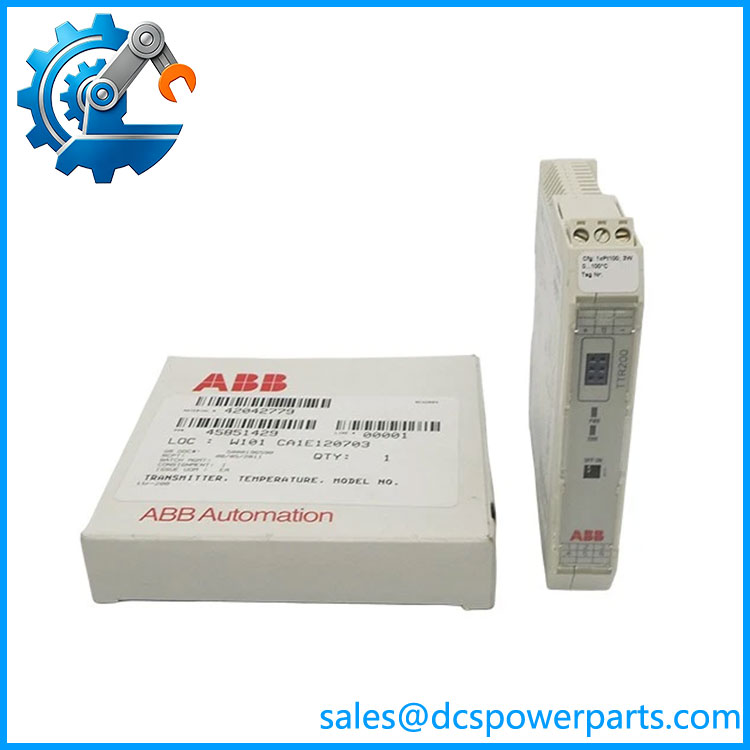
ABB TTR200
2. 4–20 mA with HART
The primary process signal is 4–20 mA, while HART provides digital communication over the same current loop. This allows the transmitter to remain compatible with conventional DCS and PLC analog-input infrastructure while giving maintenance personnel access to additional device information.
For legacy systems, this is often more useful than replacing an entire analog-input architecture simply to obtain digital diagnostics.
3. Compact 17.5 mm Housing
ABB specifies a housing width of only 17.5 mm. The transmitter is designed for cabinet/rack installation and is particularly suitable where multiple temperature channels must be packed into a limited DIN-rail area.
Cabinet thermal conditions still matter. High channel density does not eliminate the need to maintain acceptable ambient temperature around the instrumentation.
4. Local Status Indication
Two LEDs are provided. ABB identifies the green LED as the power indication and the red LED as an indication of a fault in either the transmitter or sensor.
This is a small feature, but it has real maintenance value. A technician can identify a basic instrument fault without immediately connecting a configuration computer.
5. NE 89 Sensor Monitoring
The includes wire-break and corrosion monitoring according to NAMUR NE 89.
This is particularly useful with remote RTD and thermocouple wiring. An open sensor circuit should not simply appear as an unexplained process-value problem; appropriate diagnostics can help separate sensor-loop faults from genuine process temperature changes.
6. NE 107 Diagnostics
ABB also specifies diagnostic information according to NAMUR NE 107.
For plants using HART asset-management systems, this provides more information than a basic analog transmitter can offer. The value is greatest when the DCS, maintenance system, and HART infrastructure are configured to actually collect and use those diagnostics.
7. Functional Safety Capability
ABB lists SIL 2 / SIL 3 capability according to IEC 61508 for the family.
This point needs careful interpretation. A transmitter having SIL capability does not automatically make the entire temperature loop SIL 2 or SIL 3. The sensor, logic solver, wiring, proof-test interval, architecture, failure-rate assumptions, and safety application all have to satisfy the applicable safety calculation and documentation.
8. Configuration and Maintenance Tools
The can be configured using ABB’s DAT200 environment through DTM, with handheld tools using EDD, or through standard FDT/FDI-compatible tools.
That matters during replacement because a physically identical transmitter can still be configured for a different sensor type, range, damping value, fault behavior, or output mapping.
Related Products
- ABB TTH200 — Head-mounted member of the same TTx200 family; functionally similar but intended for installation at the sensor/head rather than DIN-rail cabinet mounting.
- ABB TTF200 — Field-mount temperature transmitter for applications requiring a field housing rather than a compact rail-mounted instrument.
- ABB TTR300 — Higher-function rail-mount temperature transmitter family with expanded communication and diagnostic capabilities depending on configuration.
- ABB TTX200 Family — Product family encompassing ABB’s compact temperature-transmitter architecture.
- ABB TSP Series RTD Sensors — Temperature-sensor products that can be paired with ABB temperature transmitters where the sensor configuration is appropriate.
- ABB TSC Series Thermocouples — Thermocouple products suitable for temperature measurement applications requiring transmitter conversion.
- ABB FIM — Field Information Manager environment used with compatible ABB field devices for configuration and device management.
- ABB DAT200 / Asset Vision Basic — ABB configuration and asset-management environment supporting through DTM.
FAQ
Is ABB a PLC or DCS I/O module?
No. It is a temperature transmitter. It normally connects a field temperature sensor to a PLC/DCS analog input through a 4–20 mA loop, while HART provides additional digital communication.
Can I use with a Pt100?
Yes. RTD inputs are part of the universal sensor-input capability. The exact wiring arrangement and configuration must be set correctly for the installed Pt100 sensor.
Does support thermocouples?
Yes. ABB specifies thermocouple input capability in addition to RTD, resistance, and mV inputs.
Can I hot-swap the ?
Do not assume unrestricted hot swapping. The transmitter is a loop-powered field instrument, and removing it can interrupt the associated measurement loop. Follow the plant’s electrical isolation and instrumentation-maintenance procedure before disconnecting the transmitter.
Does support firmware v3.1?
The family name alone does not establish a particular firmware revision. ABB provides hardware/software version-matrix documentation for the TTx200 family, so firmware compatibility should be checked against the exact hardware revision and configuration rather than assumed from the generic model name.
Can I replace a TTH200 with a ?
Not as a direct mechanical replacement. Both belong to ABB’s TTx200 family and share core temperature-transmitter functions, but TTH200 is a head-mounted transmitter while is designed for rail mounting. The wiring arrangement and physical installation are different.
Is a New Surplus equivalent to factory-new stock?
Not necessarily. Verify the exact ABB order code, hardware revision, enclosure/approval markings, terminal condition, calibration configuration, and functional test status. For hazardous-area installations, the certification marking on the actual unit is particularly important.
Procurement Note
The is a well-defined industrial temperature transmitter, but “” by itself is not enough information for a safety-critical replacement order. ABB offers multiple approval and configuration variants, and the exact hardware/software revision can affect compatibility.
For replacement procurement, match the complete nameplate/order code, sensor type, wiring configuration, measurement range, HART requirements, hazardous-area certification, and existing DCS/PLC loop design. If the application is safety-related, verify the exact safety documentation rather than treating the generic family SIL statement as proof that the installed loop meets a particular SIL target.