Description
Woodward 8237-1369 | ProTech-GII Overspeed Protection Device
Key Technical Specifications
| Parameter | Specification |
|---|---|
| Product Model | 8237-1369 |
| Manufacturer | Woodward |
| Product Family | ProTech-GII |
| Product Type | Overspeed Protection Device |
| Mounting | Panel Mount |
| Power Architecture | HV/LV |
| High-Voltage Input | 90–264 VAC, 47–63 Hz or 100–150 VDC |
| Low-Voltage Input | 18–32 VDC |
| Power Consumption | 30 W maximum per internal module |
| Internal Modules | 3 independent modules |
| Voting Logic | 2-out-of-3 |
| Trip Relays | Two redundant Form-C voted relays |
| Speed Inputs | 1 per module |
| Passive MPU Input | 100 Hz–32 kHz, 1–35 Vrms |
| Active Probe | Proximity or eddy-current probe |
| Speed Accuracy | ±0.04% of current speed, -20 to +60°C |
| Over-Acceleration Range | 0–25,000 rpm/s |
| Analog Speed Output | 4–20 mA per module |
| Analog Output Accuracy | Better than ±0.5% of 20 mA |
| Discrete Inputs | Start, Reset, Speed-Fail Override per module |
| Modbus | RS-232/RS-485 RTU, one port per module |
| Operating Temperature | -20 to +60°C |
| Storage Temperature | -20 to +65°C |
| Relative Humidity | Up to 95%, non-condensing |
| Altitude | Up to 3,000 m |
| Panel-Mount Protection | IP56 when installed in an IP56 enclosure/cabinet |
| Panel-Mount Weight | Approx. 22 lb / 10 kg |
| Voted-Relay Response | Less than 20 ms under specified test conditions |
Woodward specifies two power inputs for each internal module. For the HV/LV configuration, the high-voltage input accepts 90–264 VAC or 100–150 VDC, while the low-voltage input accepts 18–32 VDC. Each module is designed to operate from either or both inputs, although Woodward recommends using both supplies for improved availability.
The speed input can be configured for either a passive magnetic pickup or an active proximity/eddy-current probe. A passive MPU input accepts 100 Hz–32 kHz and 1–35 Vrms. Each module also provides a configurable 4–20 mA speed output, and the three modules have separate Modbus communication ports.
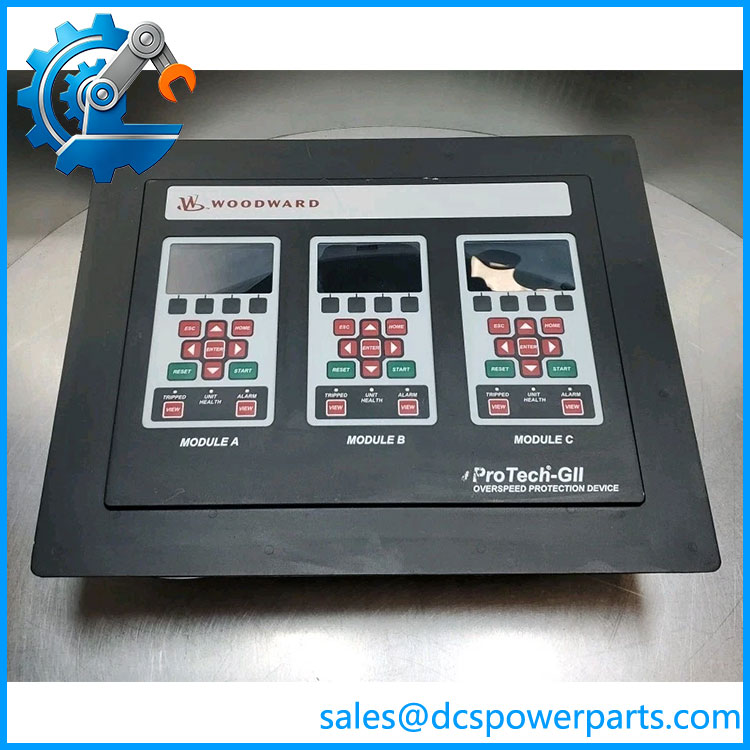
8237-1369
Product Introduction
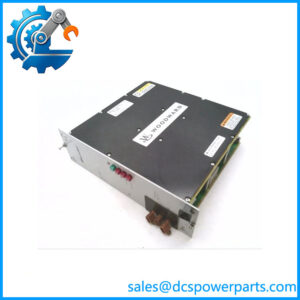
The Woodward 8237-1369 is a ProTech-GII overspeed protection device configured for panel mounting, HV/LV power inputs, and voted trip relays. It is designed to provide an independent protection layer for steam turbines, gas turbines, hydro turbines, reciprocating engines, compressors, and other rotating equipment where excessive speed or acceleration can create a mechanical or process hazard. Woodward’s ProTech-GII architecture uses three independent modules, with the voted-relay version combining their trip decisions through 2-out-of-3 logic.
Each module accepts its own speed signal and includes dedicated Start, Reset, and Speed-Fail-Override inputs, an alarm relay, and a 4–20 mA speed output. The system can detect both overspeed and over-acceleration conditions, while its configuration can be managed from the front panel or through Woodward’s Programming and Configuration Tool.
Application Scenarios & Field Pitfalls — The Engineer’s Perspective
Engineering Pain Point
The main replacement risk with an 8237-1369 is confusing the ProTech-GII family designation with the exact hardware configuration. The part number defines several important characteristics simultaneously: panel mounting, HV/LV power architecture, and voted trip relays. Replacing it with another ProTech-GII that has independent relays, HV/HV power, or bulkhead mounting can require changes to power wiring, trip logic, enclosure arrangement, and commissioning procedures.
Typical Applications
- Steam turbine overspeed protection: Independent speed monitoring and shutdown initiation.
- Gas and hydro turbine protection: 2oo3 voting for the ProTech-GII voted-relay architecture.
- Reciprocating engine protection: Overspeed and configurable over-acceleration detection.
- Rotating process equipment: Protection for compressors and other machinery where excessive speed can damage mechanical components.
Technical Pitfalls to Avoid
- Do not confuse 8237-1369 with 8237-1246.
Both are HV/LV and use voted relays, but 8237-1246 is bulkhead mounted, while 8237-1369 is panel mounted. The physical installation and enclosure arrangement are different. - Do not substitute an HV/HV model without checking the plant power architecture.
8237-1369 is specifically an HV/LV configuration. The corresponding HV/HV panel-mounted model is 8237-1370, which has a different power-input arrangement. - Preserve the 2oo3 trip architecture.
The voted version uses two redundant Form-C voted relays and produces a 2-out-of-3 trip decision from the three independent modules. Replacing it with an independent-relay model changes where the voting function is implemented. - Verify the speed-wheel calculation.
Woodward requires the configured gear-tooth count and gear ratio to correspond to the actual speed-sensing hardware. An incorrect value changes the conversion between input frequency and calculated RPM and can affect protection behavior. - Check sensor type and signal level.
The passive MPU input and active-probe input have different electrical requirements. A passive MPU is specified for 1–35 Vrms, while an active probe is supplied with 24 V from the module unless an appropriately referenced isolated external supply is used. - Do not ignore response-time assumptions.
Woodward specifies less than 20 ms for the voted-trip version under its stated measurement conditions. The complete process safety time still includes the sensor, ProTech-GII, trip circuitry, actuator, and final shutdown element. - Verify the hardware revision before planning an upgrade.
Woodward states that 8237-1369 Rev D or later can be converted using Field Software Conversion Kit 8929-039 to the preferred 8237-1600 model. Earlier revisions require a different conversion path and should not be assumed field-convertible.
Related Products
- Woodward 8237-1600 — Preferred successor corresponding to the 8237-1369 configuration: panel mount, HV/LV, voted relays. This is the key model to investigate for an upgrade rather than assuming any ProTech-GII model is equivalent.
- Woodward 8237-1246 — Bulkhead-mounted HV/LV ProTech-GII with voted relays; same broad power/relay concept but different mechanical package.
- Woodward 8237-1370 — Panel-mounted HV/HV ProTech-GII with voted relays; mounting is similar but the power architecture differs.
- Woodward 8237-1367 — Panel-mounted HV/LV version using independent trip relays rather than the 8237-1369 voted-relay architecture.
- Woodward 8237-1368 — Panel-mounted HV/HV version using independent trip relays.
- Woodward 8237-1598 — Preferred ProTech-GII model corresponding to the panel-mounted HV/LV independent-relay configuration.
- Woodward 8237-1599 — Preferred panel-mounted HV/HV independent-relay configuration.
- Woodward 8929-039 — Field Software Conversion Kit applicable to eligible Rev D-or-later ProTech-GII units, including 8237-1369.
- Woodward 5437-1119 — Spare module associated with 8237-1369 Rev B or later in Woodward’s replacement-parts documentation.
Procurement and Replacement Note
For an existing 8237-1369, capture the complete nameplate, hardware revision, module revisions, configuration file, overspeed setpoint, over-acceleration settings, speed-wheel tooth count, gear ratio, sensor type, power wiring, and trip-relay wiring before approving a replacement.
Woodward classifies 8237-1369 as a non-preferred model and identifies 8237-1600 as its preferred successor. Woodward’s change notification states that non-preferred ProTech-GII models continue to be supported for a defined period after inactivation, while new applications should use preferred part numbers.
For an installed unit, the practical procurement distinction is:
8237-1369 = panel mount + HV/LV + voted relays
8237-1600 = preferred corresponding configuration
Do not approve the substitution solely from the family name. For turbine protection equipment, the power architecture, voting arrangement, hardware revision, sensor configuration, and trip-circuit design all need to match the installed protection scheme.