Description
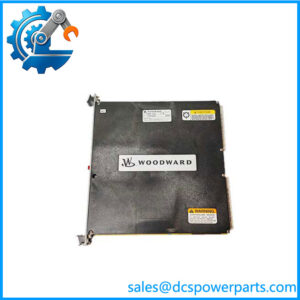
Woodward 1751-6058 4-Channel Transformer Isolation Module
Product Overview
The Woodward 1751-6058 is a four-channel transformer isolation module used in Woodward MicroNet Simplex and MicroNet Plus control systems. Its documented purpose is specific: it works with the Analog Input Field Terminal Module (FTM) to provide MPU speed-input signals to the Digital Speed Sensor Module while providing electrical isolation for customer overspeed protection devices. Each Woodward 1751-6058 contains four 1691-1082 isolation transformers. This makes it a signal-interface and isolation component rather than a standalone speed controller, PLC input module, or turbine governor.
In a turbine control cabinet, the module sits between the field-side magnetic pickup circuitry and the control-system signal-processing architecture. The four transformer channels allow multiple MPU circuits to be isolated within the same assembly. That arrangement is particularly relevant where speed measurement and independent overspeed protection must coexist without unnecessarily coupling their electrical circuits. The Woodward 1751-6058 therefore belongs to the signal-conditioning layer of the MicroNet architecture, while the Digital Speed Sensor Module and controller perform the actual speed-processing and control functions.
Procurement requires more care than simply matching the four-channel count. Woodward’s documentation specifically states that the device must be wired using Class I, Division 2 methods where applicable and warns that component substitution can impair suitability for Class I, Division 2 or Zone 2 installations. For a DCS system upgrade or legacy replacement, the original cabinet drawings, FTM configuration, hazardous-area classification, and installed Woodward hardware should therefore be checked before treating another transformer assembly as equivalent.
Product Introduction — Non-Templated
Speed-sensor isolation is easy to overlook until a turbine cabinet develops ground-loop problems or an overspeed protection circuit no longer has the electrical separation expected by the original design. The Woodward 1751-6058 addresses that interface point with four transformer-isolated channels specifically intended for MPU speed signals and overspeed-protection isolation.
For MicroNet maintenance, this is a signal-isolation component, not a replacement CPU or speed governor. That distinction matters when planning a legacy replacement because the module does not contain the application logic or speed-control algorithm.
Key Technical Specifications
| Parameter | Value |
|---|---|
| Product Model | 1751-6058 |
| Manufacturer / Brand | Woodward |
| Product Series | MicroNet Simplex / MicroNet Plus |
| Product Type | 4-Channel Transformer Isolation Module |
| Number of Channels | 4 |
| Transformer Devices | Four 1691-1082 isolation transformers |
| Primary Application | MPU speed-signal isolation |
| Secondary Application | Isolation for customer overspeed-protection devices |
| System Interface | Used with Analog Input FTM and Digital Speed Sensor Module |
| Input Signal Type | Magnetic Pickup Unit (MPU) speed signal |
| Communication Protocol | Not applicable |
| Controller Function | Signal isolation/interface; not a controller |
| Hazardous-Area Wiring | Class I, Division 2 wiring methods where applicable |
| Firmware | None identified for the passive transformer module itself |
| Protection / Certification | Application-dependent; verify installed assembly and certification marking |
The Woodward manual is the primary reference for the module’s function and internal transformer configuration. It does not provide enough reliable evidence in the cited section to justify the commonly repeated commercial specifications for exact MPU voltage range, frequency range, turns ratio, operating temperature, or IP rating. Those values should therefore be confirmed from the applicable system documentation rather than treated as universal specifications for every 1751-6058 assembly.
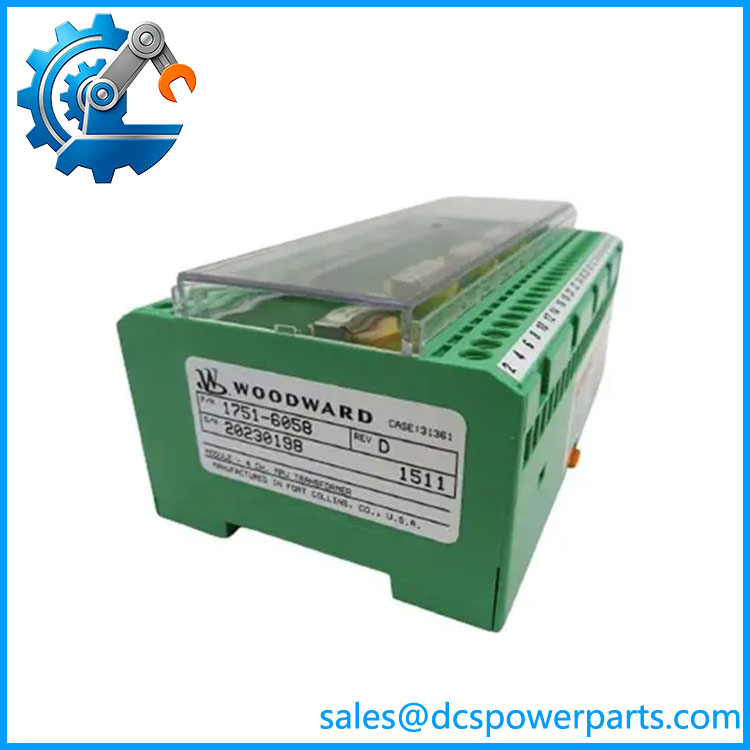
1751-6058
Major Features / Practical Advantages
1. Four Independent Isolation Channels
The 1751-6058 provides four transformer-isolated signal paths in one assembly. Woodward identifies four 1691-1082 isolation transformers inside the module.
For a turbine using multiple MPU pickups, this reduces the need to construct separate external transformer arrangements. The important point is architectural rather than simply numerical: the four channels are part of the Woodward speed-signal interface design.
2. Designed for MPU Speed Signals
The module is specifically associated with magnetic pickup unit speed inputs. MPU sensors generate an AC speed-related signal from rotating machinery, and that signal must reach the speed-processing circuitry without compromising the intended electrical separation between field and protection circuits.
Do not confuse this module with the MPU sensor itself. The 1751-6058 does not detect rotor teeth directly; it provides transformer isolation between the field signal and downstream Woodward circuitry.
3. Interfaces With the Digital Speed Sensor Architecture
Woodward documentation states that the 1751-6058 is used with the Analog Input FTM to provide MPU speed-input signals to the Digital Speed Sensor Module.
That distinction is important during troubleshooting. If an MPU signal is absent downstream, the fault can exist at the sensor, wiring, transformer channel, FTM, Digital Speed Sensor Module, or associated configuration. Replacing the transformer module without checking the entire signal path can waste valuable outage time.
4. Provides Isolation for Overspeed Protection
The module also provides isolation to customer overspeed-protection devices.
That makes the part relevant to turbine protection architecture, not merely routine speed measurement. During a retrofit, engineers should verify that the replacement maintains the intended isolation arrangement rather than substituting a generic signal converter with a superficially similar connector configuration.
5. Hazardous-Area Installation Considerations
Woodward explicitly specifies Class I, Division 2 wiring methods for the device in the referenced MicroNet documentation. The same documentation warns that removing covers or connecting/disconnecting electrical connectors requires power to be switched off unless the area is known to be non-hazardous. It also warns that component substitution may impair Class I, Division 2 or Zone 2 suitability.
This is not a cosmetic certification issue. The exact replacement assembly, cabinet installation method, and area classification need to remain consistent with the approved system design.
6. No Software Configuration to Transfer
The 1751-6058 is a transformer isolation assembly. There is no evidence that the module itself contains application firmware, controller logic, or a user-programmable configuration database.
That makes replacement fundamentally different from replacing a MicroNet CPU or Digital Speed Sensor Module. The important data to preserve are the wiring, channel assignment, FTM configuration, system drawings, and protection architecture.
Related Products
- Woodward 1751-147 — Another Woodward signal-interface module found in the same legacy component family; exact electrical interchangeability with 1751-6058 must be verified rather than assumed.
- Woodward 1691-1082 — Isolation transformer used inside the 1751-6058 according to Woodward’s MicroNet documentation.
- Woodward 1751-6091 — 16-channel relay Field Terminal Module; different function and signal type from the 1751-6058. Woodward’s MicroNet TMR documentation identifies it as a 16-channel relay FTM.
- Woodward 5466-332 — MicroNet high-density analog I/O module; performs active I/O processing rather than passive transformer isolation.
- Woodward 5501-376 — MicroNet Field Terminal Module used for field-level signal interfacing.
- Woodward MicroNet Simplex — Control platform in which the 1751-6058 is documented for MPU speed-input isolation.
- Woodward MicroNet Plus — Related control platform with the same documented 4-channel transformer isolation function.
- Woodward Digital Speed Sensor Module — Downstream speed-processing component receiving MPU signals through the documented FTM/isolation arrangement.
- Woodward Analog Input FTM — Field-terminal interface used together with the 1751-6058 for MPU speed-input signals.
FAQ
What is the Woodward 1751-6058 used for?
It is a 4-channel transformer isolation module for Woodward MicroNet systems. Its documented functions are providing MPU speed-input signals to the Digital Speed Sensor Module and isolating customer overspeed-protection devices.
Is the 1751-6058 an MPU sensor?
No. The MPU is the field speed sensor. The 1751-6058 is the transformer isolation assembly used in the signal path between the field circuitry and Woodward control hardware.
How many channels does it have?
The module has four transformer-isolated channels. Woodward specifies four 1691-1082 isolation transformers within the assembly.
Can I hot-swap the 1751-6058?
Do not assume hot replacement. Woodward’s manual specifically warns against connecting or disconnecting electrical connectors while energized unless the area is known to be non-hazardous. Follow the applicable MicroNet maintenance procedure and site hazardous-area requirements before removing the module.
Does the 1751-6058 have firmware?
No user firmware or application configuration has been identified for the transformer isolation assembly itself. It should not be treated like a programmable MicroNet CPU or Digital Speed Sensor Module.
Does this module support Modbus or Ethernet?
No. The documented function is transformer isolation of MPU signals. It is not a communications module and should not be specified as a Modbus, Ethernet, or fieldbus interface.
Can I replace it with another four-channel signal isolator?
Not automatically. The original system depends on the electrical characteristics, transformer arrangement, wiring, isolation requirements, and hazardous-area approvals of the installed assembly. Woodward specifically warns that component substitution can impair Class I, Division 2 or Zone 2 suitability.
Does the 1751-6058 require programming after replacement?
The module itself does not have an identified programmable application layer. However, the connected MicroNet system may have configured speed channels, protection logic, and FTM wiring assignments. Those system-level settings and drawings should be checked before commissioning.
Is a New Surplus 1751-6058 necessarily factory-new?
Not necessarily. For a legacy transformer module, verify the actual nameplate, revision, physical condition, connector condition, packaging history, and test status. If the module is being installed in a protection-related circuit, functional verification should be part of the acceptance process.
Procurement Note
When sourcing a Woodward 1751-6058, verify:
- Exact part number: 1751-6058
- Hardware/revision marking
- Four-channel transformer configuration
- Compatibility with the installed MicroNet Simplex or MicroNet Plus architecture
- Existing Analog Input FTM arrangement
- Digital Speed Sensor Module interface
- MPU sensor wiring and channel assignment
- Overspeed-protection isolation requirements
- Hazardous-area classification of the installation
- Required Class I, Division 2 / Zone 2 suitability
- Connector and terminal condition
- Functional test evidence for used or surplus stock
A generic four-channel signal isolator may look attractive during an outage, but that is exactly where substitution risk increases. The 1751-6058 is part of a defined Woodward speed-signal and overspeed-protection architecture, so electrical isolation and system certification matter as much as channel count.
For a DCS system upgrade or legacy replacement, verify the complete signal path—MPU → field wiring → Analog Input FTM → 1751-6058 isolation → Digital Speed Sensor Module → control/protection logic—before approving the replacement.