Description
VIPA 216-2BM02 CPU 216DPM
Product Introduction
The VIPA 216-2BM02 CPU 216DPM is a System 200V PLC central processing unit designed for STEP 7-based automation applications with integrated PROFIBUS-DP master functionality. VIPA’s documentation identifies the exact 216-2BM02 order number as the CPU 216DPM and specifies 128 KB of integrated work memory and 192 KB of integrated load memory. The CPU operates from 24 VDC and includes an MP²I interface for programming and communication.
The defining feature of the VIPA 216-2BM02 is its integrated PROFIBUS-DP master. The interface supports communication with distributed PROFIBUS devices at transmission rates up to 12 Mbit/s and can address up to 125 slaves. This makes the CPU suitable for machine-control and distributed-I/O architectures where PROFIBUS DP is the primary fieldbus. The CPU also includes an MMC slot for application storage, while the System 200V architecture supports up to four racks and a maximum of 32 modules according to VIPA’s catalog data.
The VIPA 216-2BM02 CPU 216DPM is particularly relevant to installed VIPA System 200V equipment and legacy STEP 7 applications. Its architecture is different from the closely related 216-2BP02: the 216-2BM02 contains a PROFIBUS-DP master, whereas the 216-2BP02 is a PROFIBUS-DP slave. The distinction is critical during replacement because a CPU with the wrong PROFIBUS role will not reproduce the existing system architecture. Engineers should also verify the stored STEP 7 application, MMC contents, PROFIBUS configuration, station addresses, and connected distributed-I/O devices before commissioning.
Technical Specifications
| Specification | Details |
|---|---|
| Product Model | CPU 216DPM |
| Order Number | 216-2BM02 |
| Manufacturer | VIPA |
| Product Family | System 200V |
| Product Type | PLC CPU |
| Programming | STEP 7 |
| Integrated Bus Interface | PROFIBUS-DP master |
| PROFIBUS Transmission Rate | Up to 12 Mbit/s |
| Maximum PROFIBUS Slaves | 125 |
| Work Memory | 128 KB |
| Load Memory | 192 KB |
| Memory Card | MMC, up to 512 MB |
| Programming Interface | MP²I |
| Rated Supply Voltage | 24 VDC |
| Permitted Supply Range | 20.4–28.8 VDC |
| Rated Current Consumption | 1.5 A |
| Maximum Racks | 4 |
| Maximum Modules | 32 |
| Bit Instruction Time | Minimum 0.18 µs |
| Word Instruction Time | Minimum 0.78 µs |
| Communication | PROFIBUS-DP / MP²I |
| Installation | System 200V rack/backplane |
| Clock | Real-time clock supported |
| Protection | System installation dependent |
VIPA’s catalog identifies the 216-2BM02 with 128 KB work memory, 192 KB load memory, 24 VDC supply, one integrated DP master, four maximum racks, and 32 maximum modules.
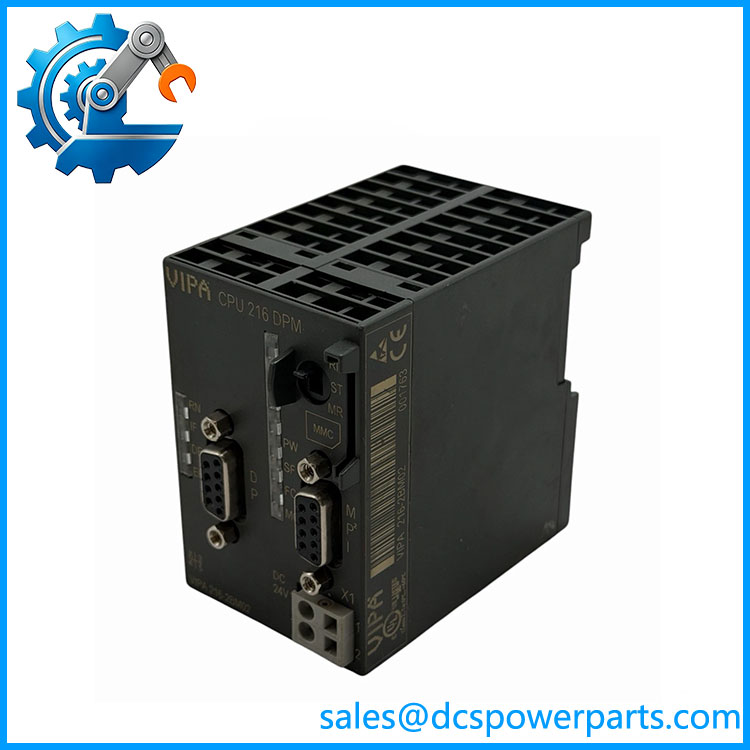
VIPA CPU 216 DPM 216-2BM02
Main Features and Engineering Considerations
Integrated PROFIBUS-DP master
The VIPA 216-2BM02 has a built-in PROFIBUS-DP master, eliminating the need for a separate communication processor for the basic DP-master function. VIPA documentation identifies transmission rates up to 12 Mbit/s and up to 125 PROFIBUS slaves.
STEP 7 compatibility
The CPU belongs to VIPA’s STEP 7-programmable System 200V family. This is important in legacy machine environments where the existing application was engineered around Siemens STEP 7 concepts and VIPA-compatible hardware.
Memory architecture
The CPU provides 128 KB of work memory and 192 KB of load memory. The integrated MMC slot supports memory cards up to 512 MB according to the VIPA catalog. During replacement, preserve the existing application and retained data requirements rather than assuming the new CPU will boot correctly without the original memory configuration.
MP²I interface
The MP²I interface provides the CPU’s programming and communication connection. It should not be confused with the PROFIBUS interface. The front-panel layout documented by VIPA separately identifies the MP²I interface and PROFIBUS-DP connection.
24 VDC power
The CPU operates from a nominal 24 VDC supply with a specified permitted range of 20.4–28.8 VDC. VIPA’s catalog lists 1.5 A rated current consumption for this CPU family.
System 200V architecture
The CPU is part of the VIPA System 200V platform. VIPA specifies up to four racks and a maximum of 32 modules for the 216-2BM02 configuration. Existing installations should therefore be checked for actual backplane/module configuration before replacement.
PROFIBUS master versus slave
This is the most important ordering distinction. The 216-2BM02 is the DP master version. The similarly numbered 216-2BP02 is a DP slave version. These are not interchangeable simply because both contain “216” and “2B” in their model numbers.
Legacy replacement considerations
The System 200V CPU is a legacy automation component. For an existing machine, replacement with the same model is generally much less disruptive than redesigning the PLC and fieldbus architecture. However, the replacement should be validated against the original STEP 7 project, MMC, PROFIBUS GSD configuration, slave addresses, and I/O mapping.
Application Scenarios
- VIPA System 200V PLC installations
- STEP 7-based machine automation
- PROFIBUS-DP distributed I/O
- Manufacturing machinery
- Material-handling equipment
- Packaging systems
- Process-machine control
- Legacy Siemens-compatible PLC applications
- PROFIBUS field-device networks
- Maintenance of installed VIPA control systems
Engineer’s Guide: Field Pitfalls
1. Do not confuse master and slave versions.
216-2BM02 is the PROFIBUS-DP master. 216-2BP02 is the DP slave version.
2. Preserve the original MMC.
The application may depend on the existing memory-card contents. Confirm the card capacity and stored project/data before replacing the CPU.
3. Verify PROFIBUS addresses.
A CPU replacement should be followed by verification of every DP station address and its configured device type.
4. Check the GSD configuration.
The connected distributed I/O and field devices must match the configuration stored in the STEP 7 project.
5. Confirm the MP²I connection.
Do not mistake the MP²I programming/communication interface for the PROFIBUS connection.
6. Check the power supply.
The CPU expects 24 VDC within the specified 20.4–28.8 VDC range. Check voltage at the CPU terminals under load rather than relying only on the power-supply nameplate.
7. Verify the complete System 200V configuration.
The CPU is only one part of the rack. Check the installed I/O and function modules, rack arrangement, and backplane configuration before commissioning.
Frequently Asked Questions
What is VIPA 216-2BM02?
It is the VIPA System 200V CPU 216DPM, a STEP 7-programmable PLC CPU with an integrated PROFIBUS-DP master.
How much memory does it have?
It has 128 KB work memory and 192 KB load memory.
Is PROFIBUS-DP integrated?
Yes. The CPU contains one integrated PROFIBUS-DP master interface.
What is the maximum PROFIBUS speed?
The interface supports up to 12 Mbit/s.
How many PROFIBUS slaves can it handle?
VIPA documentation lists up to 125 slaves.
What is the supply voltage?
Nominal supply is 24 VDC, with a permitted range of 20.4–28.8 VDC.
What is the difference between 216-2BM02 and 216-2BP02?
The 216-2BM02 has an integrated PROFIBUS-DP master, while 216-2BP02 provides PROFIBUS-DP slave functionality.
Is 216-2BM02 compatible with Siemens STEP 7?
Yes. VIPA identifies the CPU 216DPM as a STEP 7-programmable CPU.
Procurement Note
For an exact replacement, specify VIPA CPU 216DPM / 216-2BM02. Before purchasing, verify the PROFIBUS-DP master role, MMC contents, STEP 7 project, PROFIBUS station configuration, System 200V rack arrangement, and connected distributed I/O. Do not substitute the visually similar 216-2BP02, because that model is a PROFIBUS-DP slave rather than a master.