Description
Key Technical Specifications
| Parameter | Specification |
|---|---|
| Product Model | VM600 ABE042 |
| Ordering Number | 204-042-100-011 |
| Manufacturer | Vibro-Meter |
| Product Family | VM600 / VM600Mk2 |
| Product Type | System Rack / Backplane Chassis |
| Rack Format | 19-inch |
| Rack Height | 6U |
| Architecture | Modular VM600 card rack |
| Backplane | Integrated VME-based backplane |
| Supported Modules | VM600 processing, I/O, relay, controller, and power modules |
| Maximum Capacity | Up to 15 single-width VM600 modules/card pairs |
| Mounting Brackets | Rear-mounted |
| Power Architecture | Supports VM600 rack power-supply configurations |
| Operating Temperature | Approximately −20°C to +70°C, depending on configuration/source |
| Storage Temperature | Approximately −40°C to +85°C |
| Relative Humidity | Up to 95% RH, non-condensing |
| Construction | Aluminum rack structure |
| Primary Application | Machinery protection and condition monitoring |
The ABE040 and ABE042 share the same basic 6U/19-inch architecture; the key mechanical distinction is mounting-bracket position, with the ABE042 using rear-mounted brackets.
The rack is not itself a vibration measurement instrument. It provides the carrier, backplane, power distribution, and interconnection required by the functional cards.
Application Scenarios & Pain Points
A damaged rack can create symptoms that look like individual module failures: intermittent communication, unexpected card resets, missing channels, or unstable power. On a turbine train, troubleshooting the wrong component can burn several hours before anyone checks the backplane.
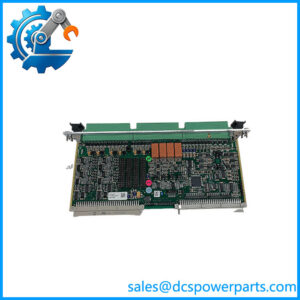
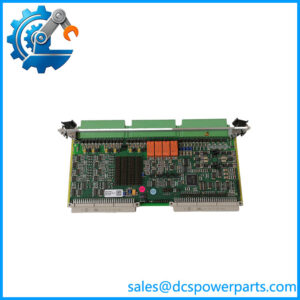
- Turbine machinery protection: The ABE042 can house protection hardware such as MPC4/MPC4Mk2 cards together with their associated I/O modules for rotating-equipment protection.
- Condition monitoring: Processing and monitoring cards can be installed in the rack to acquire and process vibration and other dynamic machinery signals.
- Power-generation equipment: Suitable for architectures monitoring turbines, compressors, pumps, fans, and other rotating machinery where protection and condition monitoring are integrated.
- Legacy replacement: Useful when the installed functional cards remain serviceable but the rack, backplane, mechanical assembly, or power-distribution section needs replacement.
Field note: When inspecting a used ABE042, look closely at the rear backplane and card connectors. A rack can appear nearly new from the front while having worn contacts, damaged connector guides, or evidence of localized heating around the power section. Those details matter more than cosmetic condition.
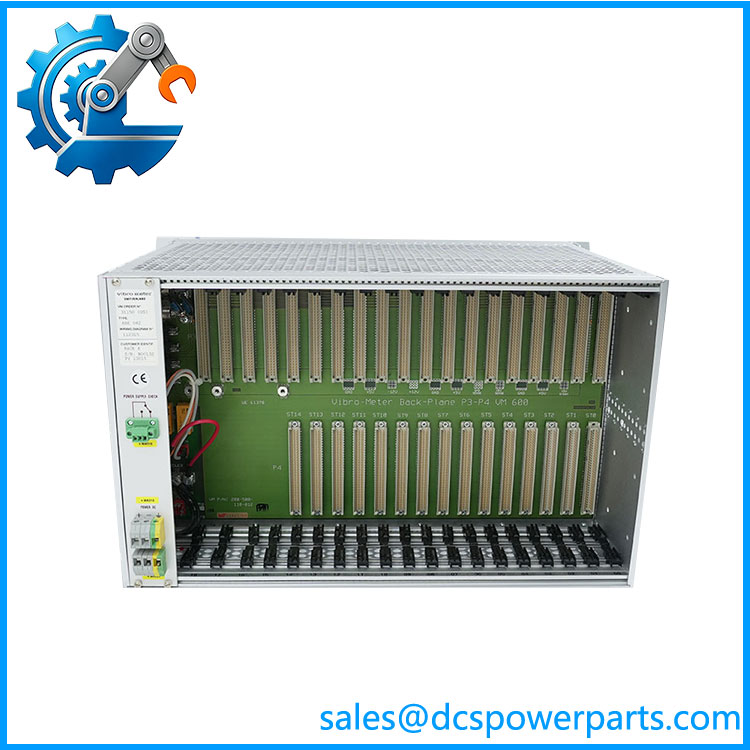
ABE042
Related Products
- ABE040 / 204-040-100-011 — Closely related 6U system rack. Its primary mechanical distinction from ABE042 is the mounting-bracket arrangement; verify cabinet depth and mounting orientation before substitution.
- / 204-042-100-012 — Same family with a different ordering suffix. Useful for cross-reference work, but the complete suffix should be checked against the installed configuration.
- MPC4 / 200-510-xxxx — machinery protection card family. These processing cards install within the rack and perform vibration, position, speed, and related protection functions.
- MPC4Mk2 — Updated machinery-protection card family for later architectures. Compatibility must be checked against rack generation and associated I/O modules.
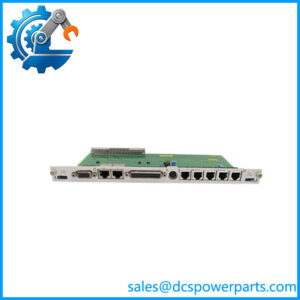
- IOC4T / 200-560-000-xxx — Rear-mounted I/O card family used with compatible MPC4-based protection systems. It provides the field interface while the supplies the rack infrastructure.
- CMC16 / XMx16 — Condition-monitoring card families used for dynamic data acquisition and analysis. They occupy the functional card positions within the rack rather than replacing the rack itself.
- CPUM / CPUx — rack controller family. These controller cards provide system-level management and communication functions and depend on the rack backplane for interconnection.
- RPS6U — rack power-supply family. The rack is designed to accommodate the appropriate rack power architecture; verify the exact power configuration before ordering.
- RLC16 — relay card family used for alarm/trip interfacing. It complements the protection cards and rack but does not replace the chassis.
- protected/coated variants — Certain rack configurations use additional environmental protection or conformal-coating options. Match the original suffix when the installation has specific environmental requirements.
The Engineer’s Guide: Field Pitfalls to Avoid
WARNING 1 — Do not confuse ABE040 and .
They are mechanically similar 6U racks, but the mounting-bracket arrangement differs. uses rear-mounted brackets.
How to avoid it: Check the cabinet drawing and photograph the existing rack mounting points before approving a substitute.
WARNING 2 — Do not treat the rack as a passive metal enclosure.
The contains the system backplane and provides the electrical interconnection between installed modules. Connector condition and backplane integrity directly affect system operation.
How to avoid it: Inspect every card connector, backplane contact, guide, grounding point, and power connection. Check for oxidation, bent contacts, carbonization, or signs of overheating.
WARNING 3 — Do not mix generations without checking the complete card set.
The rack may accept several modules, but actual system compatibility depends on the processing cards, I/O cards, controller, power supplies, and system configuration.
How to avoid it: Before replacing the rack, document the complete installed card list and slot positions. Record part numbers and revisions—not just card family names.
Frequently Asked Questions (FAQ)
What is 204-042-100-011?
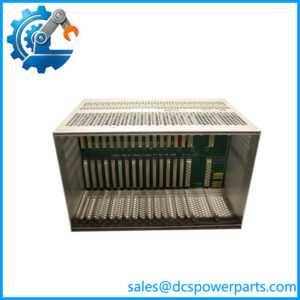
It is a Vibro-Meter 19-inch, 6U system rack used to house and interconnect machinery-protection and condition-monitoring hardware. The rack provides the mechanical structure and integrated backplane required by the modular system.
Is a vibration monitoring card?
No. is the system rack, not a vibration-processing module.
The actual measurement and protection functions are performed by installed cards such as MPC4/MPC4Mk2, CMC16/XMx16, and associated I/O or relay modules.
What is the difference between ABE040 and ?
Both are 6U system racks with broadly similar functional architecture. The significant mechanical difference is the position of the mounting brackets. uses rear-mounted brackets.
For a replacement project, cabinet mounting geometry should therefore be checked before accepting an ABE040 as an alternative.
How many modules can the rack accommodate?
Available documentation indicates that the ABE04x rack can provide mounting space for up to 15 single-width modules/card pairs, or a combination of single- and multiple-width modules depending on the configuration.
The actual usable capacity depends on the installed module widths and system architecture.
Does the contain the backplane?
Yes. The rack incorporates the system backplane used for power distribution and module-to-module communication. The architecture includes dedicated VME, Tacho, Raw, and Open Collector buses.
This is why a damaged should not be treated as merely a mechanical enclosure.
Can I move my existing MPC4 and IOC4T cards into a replacement ?
Potentially, yes, provided the replacement rack is the correct generation and configuration.
Before moving the cards:
- Photograph the complete rack.
- Record every card position.
- Record all part numbers and revisions.
- Inspect the replacement backplane.
- Verify power-supply configuration.
- Check connector and grounding condition.
- Reinstall each card in its documented position.
- Perform system-level diagnostics after power-up.
For protection systems, do not assume that a successful boot means the trip chain has been validated.
What should I check when buying a used or refurbished ?
Focus on the backplane and mechanical condition, not just the front-panel appearance.
Ask for clear photographs of:
- Complete front and rear assemblies
- Backplane connectors
- Card guides
- Power-supply mounting areas
- Grounding points
- Mounting brackets
- Product label and full 204-042-100-011 identification
For a refurbished unit, request evidence that the rack was inspected and that its backplane and power-distribution paths were tested. A rack with clean aluminum surfaces but damaged connector contacts is not a good spare.