Description
Meggitt Vibro-Meter TQ412 111-412-000-013 Proximity Transducer
Product Introduction
The Meggitt Vibro-Meter TQ412 111-412-000-013 is a non-contact eddy-current proximity transducer designed for displacement and vibration measurement on rotating machinery. Unlike a conventional front-mounted probe arrangement, the TQ412 is intended for reverse-mount installations where access to the target surface from the normal direction is restricted. The probe detects changes in the gap between its sensing tip and a conductive target, normally a rotating shaft or similar machine component. The resulting measurement is processed through the appropriate Vibro-Meter signal-conditioning system. Meggitt documentation identifies the TQ412 as part of the TQ402/TQ412 and IQS900 proximity measurement system.
The TQ412 111-412-000-013 is not a standalone PLC sensor with a conventional 24 VDC output. It requires a high-frequency excitation source from a compatible IQS900 signal conditioner. Depending on the complete system configuration, the transducer can support displacement measurement ranges associated with approximately 2 mm or 4 mm linear spans. Published technical records report DC to 20 kHz frequency response for the matched system, making the sensor suitable for both static shaft-position measurement and dynamic vibration monitoring.
The Meggitt Vibro-Meter 111-412-000-013 uses a compact stainless-steel sensing body and FEP-insulated coaxial cable. The manufacturer data sheet shows M10 × 1 and 3/8″-24UNF body-thread options, while the complete ordering code specifies environment, cable length, optional mechanical protection, and total system length. This is important during replacement: 111-412-000-013 identifies the base transducer family/order number, but the complete suffix must be matched to the installed probe and cable arrangement.
Technical Specifications
| Parameter | Specification |
|---|---|
| Product Model | |
| Ordering Number | 111-412-000-013 |
| Manufacturer | Meggitt Vibro-Meter |
| Product Type | Eddy-current proximity transducer |
| Measurement Principle | Non-contact eddy-current |
| Mounting | Reverse-mount |
| Primary Measurement | Shaft displacement / vibration |
| Compatible Signal Conditioner | IQS900 |
| Compatible Extension Cable | EA402 |
| Measurement Range | 2 mm or 4 mm system configuration, depending on sensitivity/conditioning |
| Sensitivity | Approximately 8 mV/µm for 2 mm configuration or 4 mV/µm for 4 mm configuration |
| Frequency Response | DC to 20 kHz (-3 dB), matched system |
| Transducer Operating Temperature | -40 to +180°C |
| Short-Term Survival | +180 to +220°C with increased measurement drift reported |
| Ex-System Temperature | Up to approximately +195°C for transducer and cable in Ex-zone applications |
| Cable Temperature | Up to approximately +200°C |
| Protection | IP68 for transducer head and integral cable |
| Vibration Resistance | 5 g peak, 10–500 Hz |
| Shock Resistance | 15 g peak, half-sine, 11 ms |
| Cable Type | FEP-covered 70 Ω coaxial |
| Cable Diameter | Approximately 3.6 mm |
| Probe Body | AISI 316L stainless steel |
| Probe Tip | Torlon polyamide-imide |
| Connector | Self-locking miniature coaxial |
| Standard Thread Options | M10 × 1 or 3/8″-24UNF |
| Excitation | High-frequency source from IQS900 conditioner |
| Signal Output | Conditioner-dependent voltage/current measurement |
| Environmental Variants | Standard, Ex i, Ex nA configurations available within ordering system |
| Integral Cable Options | 0.5, 1, 1.5, 2, 5, or 10 m |
| Extension System | EA402 |
| Total System Length | Determined by integral and extension cable configuration |
The measurement range and sensitivity are configuration-dependent rather than properties that should be assigned indiscriminately to every assembly. The manufacturer ordering table shows that the complete part number includes additional suffix fields for environment, thread, cable length, protection, and total system length.
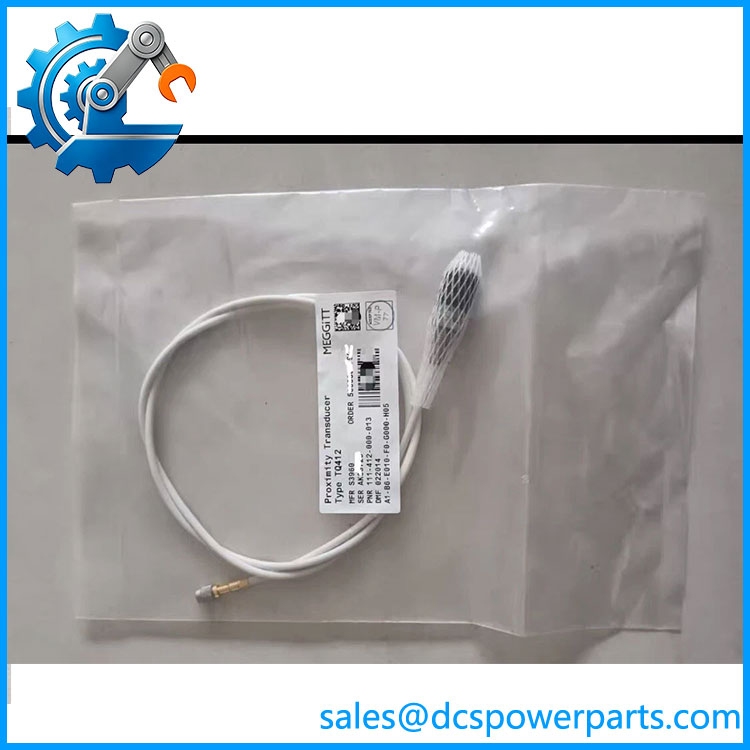
TQ412 111-412-000-013
Main Features and Engineering Considerations
Reverse-mount installation
The primary mechanical advantage of the is its reverse-mount configuration. This is useful when the machine casing or surrounding hardware prevents conventional access to the shaft target. The probe can be installed from the opposite side of the mounting arrangement while maintaining non-contact measurement of the conductive target.
Eddy-current measurement
The uses an eddy-current measurement principle. Shaft-to-probe gap changes modify the electromagnetic response of the sensing coil, allowing the associated conditioner to produce a proportional displacement signal. This makes the technology suitable for turbine and rotating-equipment applications where direct mechanical contact with the shaft is undesirable.
IQS900 system dependency
A critical procurement point is the signal conditioner. The does not function like a conventional 4–20 mA proximity switch. The manufacturer specifies a high-frequency power source from an IQS900 signal conditioner. The probe, extension cable, and conditioner therefore need to be treated as a matched measurement chain.
2 mm and 4 mm measurement configurations
Published system information identifies 2 mm and 4 mm linear measurement configurations, with corresponding sensitivities of approximately 8 mV/µm and 4 mV/µm. These values should be checked against the actual conditioner configuration and target material before commissioning rather than assumed from the model name alone.
High-temperature construction
The probe is designed for demanding machinery environments. Published specifications give -40 to +180°C operating temperature for the transducer, with higher short-term exposure possible at increased drift. The probe uses an AISI 316L stainless-steel body, Torlon sensing tip, and FEP-covered coaxial cable.
IP68 transducer head
The transducer head and integral cable are reported as IP68. This should not be interpreted as an IP68 rating for the entire measurement system. The connector, extension cable, conditioner, junction arrangement, and cabinet have their own environmental requirements.
Configurable ordering code
The base number 111-412-000-013 is followed by configuration fields. The manufacturer’s ordering table defines environment, body thread, integral cable length, optional protection, flexible-hose length, and total system length. For replacement procurement, the complete suffix is therefore more important than the base designation alone.
Application Scenarios
- Steam turbine shaft displacement monitoring
- Gas turbine machinery monitoring
- Hydraulic turbine applications
- Turbo-compressor monitoring
- Pump shaft vibration measurement
- Alternator monitoring
- Rotating-shaft position measurement
- Radial vibration measurement
- Axial displacement measurement where the mechanical arrangement permits reverse mounting
- High-temperature machinery instrumentation
Engineer’s Guide: Field Pitfalls
Do not treat as a conventional proximity switch.
It requires the appropriate high-frequency signal-conditioning architecture rather than a generic PLC proximity-input circuit.
Verify the complete suffix.
111-412-000-013 is the base ordering number. Environment, thread, cable length, protection, and total system length are encoded by the additional suffix fields.
Check the conditioner.
Probe performance depends on the matched conditioner. Replacing only the probe without checking the conditioner configuration can produce incorrect sensitivity or scaling.
Confirm 2 mm versus 4 mm range.
The associated system can use different sensitivity configurations. Do not assume that every installation has the same linear range.
Check target material and mechanical gap.
Eddy-current probes are sensitive to target material and installation geometry. A replacement probe should reproduce the original mechanical setup as closely as practical.
Do not confuse reverse-mount and standard-mount probes.
TQ402 and belong to the same proximity measurement family, but their mechanical installation arrangements differ.
Inspect the coaxial connector carefully.
The miniature self-locking connector should be properly locked. Cable damage or a poor connection can appear as an unstable or missing vibration signal.
Do not apply the temperature rating to the whole assembly.
The probe, cable, connector, extension cable, and signal conditioner have different environmental limits.
Frequently Asked Questions
What is 111-412-000-013?
It is a Meggitt Vibro-Meter reverse-mount eddy-current proximity transducer for non-contact displacement and vibration measurement.
What does the measure?
It measures the distance between the transducer tip and a conductive target. In rotating machinery, this is commonly used for shaft displacement and vibration measurements.
Is a vibration sensor?
It can be used as part of a vibration measurement system, but technically it is an eddy-current proximity transducer measuring displacement. The associated conditioner converts the probe response into the usable monitoring signal.
What signal conditioner is required?
The manufacturer’s data sheet specifies a high-frequency power source from an signal conditioner. EA402 can be used as the associated extension cable.
What is the operating temperature?
The published transducer operating range is -40 to +180°C, with higher short-term exposure reported at increased drift. The cable and Ex-system limits must be checked separately.
Is suitable for hazardous areas?
The ordering system includes standard, Ex i, and Ex nA environmental variants. The actual hazardous-area suitability depends on the complete suffix and system certification, not merely the model name.
What cable lengths are available?
The manufacturer’s ordering information lists integral cable options including 0.5, 1, 1.5, 2, 5, and 10 m. The final system length can also incorporate an EA402 extension cable.
What should be checked before purchasing a replacement?
Verify the complete ordering code, environmental classification, thread, integral cable length, protection arrangement, total system length, conditioner configuration, measurement range, and mechanical mounting orientation.
Procurement Note
For a replacement 111-412-000-013, the base model is not enough for final compatibility verification. Obtain the complete suffix from the existing probe label or equipment documentation. The critical fields are environment classification, M10 × 1 versus 3/8″-24UNF thread, integral cable length, optional hose/protection, and total system length.
The practical incoming inspection should include probe-body condition, tip condition, cable insulation, connector locking action, dimensional comparison, and verification of the matched conditioner. For a turbine or compressor installation, also confirm the original probe gap and target material before commissioning.