Description
VIBRO-METER GSI122
Key Technical Specifications
| Parameter | Specification |
|---|---|
| Manufacturer | Vibro-Meter |
| Model | GSI 122 |
| Part Number | 244-122-000-20 |
| Product Type | Galvanic separation unit |
| Main Function | Electrical isolation and signal transmission |
| Supply Voltage | +24 VDC ±5% |
| Maximum Transducer/Conditioner Consumption | Less than 20 mA |
| Galvanic Isolation | 4 kV |
| Transfer Function | 1 V/mA |
| Frequency Response | DC to 20 kHz |
| Dynamic Signal | Voltage output proportional to input current |
| Application | Vibration measurement / machinery monitoring |
| Ex Version | EEx ib IIC documented for the certified version |
| Mounting | Panel/PCB-type installation depending system configuration |
The original Vibro-Meter documentation describes the GSI 122 as a galvanic separation unit intended to supply transducers and signal conditioners while providing an isolated voltage output to monitoring electronics. The documented transfer function is 1 V/mA from DC to 20 kHz, with galvanic isolation used to prevent problems caused by voltage differences and ground loops between the measurement point and monitoring system.
Product Introduction
The VIBRO-METER GSI122 is not a vibration sensor and should not be treated as a conventional PLC analog-input module. It is an interface component in a Vibro-Meter measurement chain, supplying compatible two-wire transducers or conditioners while electrically separating the field-side measurement circuit from the monitoring electronics. This architecture was particularly useful for long-distance transmission of dynamic vibration signals and for installations where ground-potential differences could introduce measurement errors.
The GSI 122 can also replace the function normally associated with a Zener barrier in appropriate intrinsically safe measurement arrangements. The documented GSI 122 version provides 4 kV isolation, and the certified version was intended for use where intrinsic safety was required.
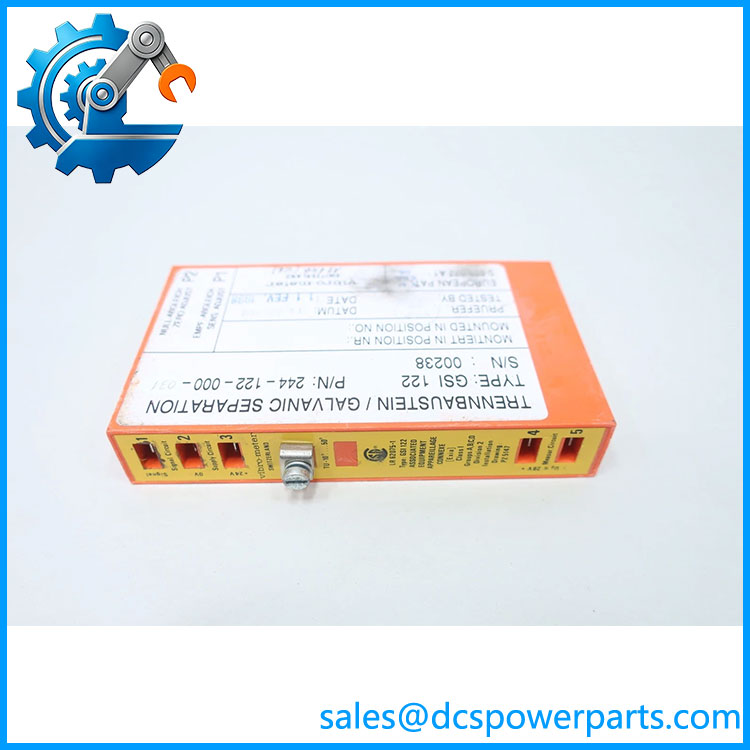
VIBRO GSI122
Engineering Pain Point
The main issue with a GSI122 replacement is compatibility with the complete vibration measurement chain. The unit is designed around the current consumed by the connected transducer or conditioner, so replacing it with a generic isolator can change the sensor excitation, signal scaling, frequency response, or intrinsic-safety characteristics. Verify the connected CE/CA accelerometer, IPC conditioner, cable arrangement, and monitoring input before selecting a substitute.
Typical Applications
- Vibro-Meter machinery vibration monitoring systems
- Turbine and rotating-equipment condition monitoring
- Long-distance transmission of dynamic vibration signals
- Measurement systems using two-wire current-modulated transducers
- Intrinsically safe vibration-monitoring installations
- Isolation between field measurement equipment and plant monitoring electronics
Technical Pitfalls to Avoid
- Do not confuse GSI122 with a vibration sensor. The GSI 122 is an interface/separation device. The actual vibration measurement originates from the connected transducer or signal conditioner.
- Check the complete signal chain. Vibro-Meter documentation shows the GSI 122 being used with transducers such as accelerometers and with signal conditioners. Its output is proportional to the current consumed by the connected device.
- Verify the intrinsic-safety configuration. The GSI 122 was available as an intrinsically safe unit with documented EEx ib IIC certification. Do not substitute a non-Ex isolation module in an Ex-rated measurement circuit without reviewing the complete certification and entity parameters.
- Do not assume every GSI122 has identical adjustment. The original documentation describes a DC-level adjustment potentiometer whose setting depends on the connected transducer/conditioner combination. Check the existing setting before removing the unit.
- Account for lifecycle status. Vibro-Meter documentation states that GSI 122 and GSI 130 units were being replaced by the GSI 124 in a later generation of the measurement system. Current Meggitt Vibro-Meter documentation has also removed the earlier GSI122 certification from its active product documentation.
- Verify the exact part number. The documented ordering information identifies GSI 122 / 244-122-000-20. If the installed nameplate contains a different suffix or revision, verify that version separately rather than assuming it has identical electrical and certification characteristics.
Related Products
- GSI 130 — Vibro-Meter galvanic separation unit for standard, non-intrinsically-safe applications; functionally related to but with different certification positioning.
- GSI 124 — Later Vibro-Meter galvanic separation unit identified as a replacement for , GSI123, and GSI130 in the relevant measurement-chain documentation.
- GSI 127 — Later-generation Vibro-Meter galvanic separation unit appearing in current installation documentation.
- IPC 620 — Older Vibro-Meter signal conditioner associated with vibration measurement chains; later documentation identifies IPC 704 as its replacement.
- IPC 704 — Later signal-conditioning platform used in Vibro-Meter vibration measurement chains.
- CA-series accelerometers — Vibro-Meter accelerometers that can form the sensor side of the GSI 122 measurement chain.
- CE-series accelerometers — Vibro-Meter piezoelectric sensors used with compatible signal-conditioning arrangements.
Procurement note: For VIBRO-METER , use 244-122-000-20 as the primary identification when it appears on the nameplate or documentation. Before replacement, verify the transducer/conditioner type, 24 VDC supply arrangement, signal-current range, output scaling, Ex certification, and the monitoring-system input. The later GSI124 is identified as a replacement family member, but a retrofit should still be checked against the installed measurement chain rather than treated as an automatic plug-in substitution.