Description
Product Overview
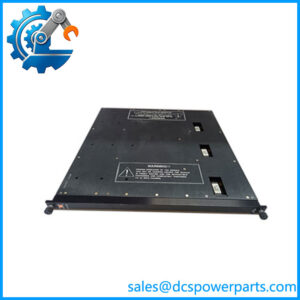
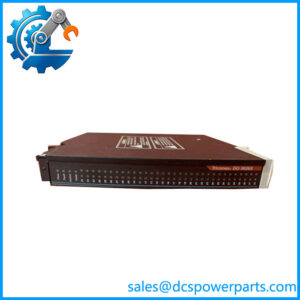
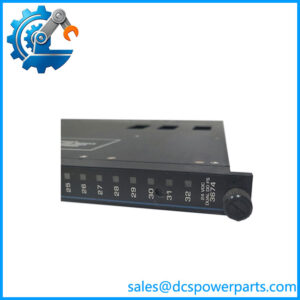
AO3482 is the high-current variant of the Trident analog output module, and the distinction between it and the standard AO3481 is narrower than the model numbers suggest — and more consequential. Both are four-point, commoned-return, DC-coupled output modules with three isolated channels, a voter that selects one channel to drive the output and shunts the others, a forced-switch diagnostic, and 12-bit resolution. The difference is on the last two points: where 3481 gives all four points a 4–20 mA span with 0–22 mA over-range, 3482 gives points 3 and 4 a 4–40 mA span with 0–44 mA over-range. Points 1 and 2 keep the standard span. The module is therefore not a higher-resolution or faster part; it is a part with more drive current on half its channels, bought at a price in load capability and temperature range.
That trade-off is written into the specifications and is the most useful thing to understand before ordering. The standard 3481 loop drives 300 Ω at 16 VDC loop supply and 800 Ω at 28 VDC. The high-current channels of AO3482 drive 125 Ω at 16 VDC, 210 Ω at 20 VDC, 295 Ω at 24 VDC and 340 Ω at 28 VDC — roughly a third of the resistance, because forty milliamperes through a loop consumes the supply voltage twice as fast as twenty. A 4–40 mA positioner on a long, resistive loop run is the wrong pairing; a short run to a device that genuinely wants the extra current is the right one.
The second constraint is stricter and easier to miss: the Model 3482 module is compatible with the Model 2481 Analog Output Baseplate only. The 3481 can also sit on 2483 and 2483A for HART, or on the DO external termination baseplate with a 9863-610 panel in a hazardous area; AO3482 cannot. If the loop has a HART positioner that must be read from the asset-management software, or if field wiring is brought to an external marshalling panel, this module is not the answer, however well its current range suits the valve. There is no adapter and no configuration that changes it.
Temperature behaves the same way. Trident specifies 70 °C ambient as the maximum for all I/O module types, and the module’s logic and diagnostic behaviour follows that. The accuracy figure for the high-current points, however, is quoted from 0 °C to 50 °C. A cabinet running at 60 °C does not stop the module working; it stops the high-current points being inside their published accuracy band. That is a legitimate reason to specify 3491-class standard outputs into a hot enclosure and keep the high-current channels for cabinets with real margin.
Operationally the module is what the platform expects of an output card. Each of the three channels independently accepts data from its main processor; voter circuitry picks one to drive the field and actively shunts the others so a failed channel cannot influence the loop. Diagnostics run continuously, and the Fault indicator reports a channel fault rather than a module failure — the module is specified to operate properly through a single fault and may continue through multiple faults. A zero-output capability is retained with a step limitation of less than 4 mA, which is the honest way of saying the output can reach 0 mA but not instantly. Over-range protection is 36 VDC continuous and 0 VDC continuous, and loop power is 24 VDC nominal, 32 VDC maximum, with reverse-voltage protection.
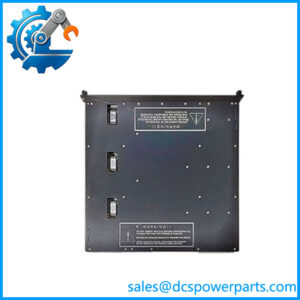
The packaged form is the 5382 High-Current Analog Output TriPak: one 3482 module and one 2481 baseplate, which is how most projects buy it.
Dealer material on this number is characteristically useless and, in one respect, actively wrong: pages describe AO3482 as a four-channel 4–20 mA module identical to the 3481, some quote 220 V or 30 kHz specifications that belong to nothing in this family, and several pair it with HART baseplates it cannot use. The differentiator is not the channel count but the two high-current points and the single permitted carrier.
Technical Specifications
| Parameter | Value |
|---|---|
| Model and platform | AO3482 — Triconex Model 3482 High-Current Analog Output Module; Trident (Trident v2) TMR safety controller |
| Module type | Analog output; three isolated channels; voter selects one drive channel, others shunted; hot-spare, mechanically keyed |
| Points | 4, commoned-return, DC-coupled; isolated points: none |
| Output current range | Points 1–2: 4–20 mA controlled, 0–22 mA over-range. Points 3–4: 4–40 mA controlled, 0–44 mA over-range |
| Zero-output capability | 0 mA available; step function limited to < 4 mA |
| Accuracy and resolution | 12 bits; < 0.25 % of FSR (0–44 mA) in the 4–40 mA range on points 3–4, 0–50 °C |
| Output loop power | 24 VDC nominal, 32 VDC maximum, reverse-voltage protected |
| Load capability, high-current points | 125 Ω at > 16 VDC; 210 Ω at > 20 VDC; 295 Ω at > 24 VDC; 340 Ω at > 28 VDC (1 A minimum loop supply) |
| Protection | Over-range 36 VDC continuous and 0 VDC continuous |
| Diagnostics | Forced-switch diagnostic (FSD); fault reported per channel, not per module |
| Compatible baseplate | Model 2481 Analog Output Baseplate only — not 2483, 2483A or the DO external termination baseplate |
| Power and environment | Logic power from MP baseplate, 24 VDC (19.2–30 VDC), < 3 W; 70 °C maximum ambient, high-current point accuracy specified to 50 °C |
| Mechanical and packaging | 44 × 220 × 169 mm; packaged as 5382 High-Current Analog Output TriPak (3482 + 2481); system limit 14 I/O modules, 10 when AO or PI modules are present |
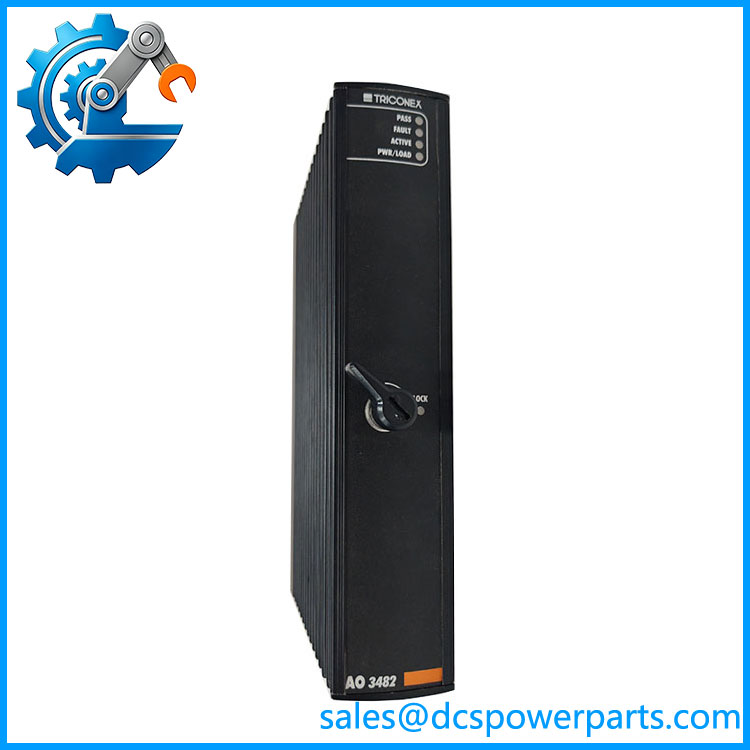
TRICONEX AO3482
Key Features and Advantages
Two current spans on one carrier: points 1 and 2 run the standard 4–20 mA span while points 3 and 4 run 4–40 mA, so a single module position can serve ordinary control valves and the one device that needs double the drive current, without a second card and a second spare.
A load table that tells the truth about loop length: 125 Ω at 16 VDC and 340 Ω at 28 VDC on the high-current points are honest numbers, not marketing. Reading them against the field loop’s actual resistance before installation is the difference between a valve that strokes fully and one that stalls at 70 % travel with an output card blamed for it.
One permitted baseplate, no ambiguity: the Model 3482 works on 2481 only. That removes an entire class of ordering error — no HART carrier, no external termination carrier, no hazardous-area external panel — and makes the bill of materials simple at the cost of flexibility.
Voter logic that protects the loop: three channels accept data independently, one is selected to drive, and the others are shunted so a failed channel cannot load the output. The field sees one clean current, not a contest between three electronics.
Forced-switch diagnostics with channel-level reporting: the output path is exercised continuously, and a detected failure raises the Fault indicator as a channel fault. The module is specified to keep operating through a single fault, which is exactly when a technician needs to know which channel to look at.
Protection ratings fit real cabinets: 36 VDC continuous over-range and 0 VDC continuous withstand, plus reverse-voltage protection on the loop supply, cover the mis-wired supply and the solenoid-induced excursion that damage output cards in the field.
A zero-output step that is documented rather than hidden: 0 mA is available, with the step limited to under 4 mA. That is a specification an engineer can design around when a shutdown requires the loop to be driven below the live-zero region.
Ambient honesty: the module works to 70 °C, but the high-current points hold their 0.25 % accuracy only to 50 °C. Publishing both figures lets a hot-cabinet application choose standard outputs deliberately instead of discovering the derating in service.
Service without disturbing the loop: terminals live on the baseplate, modules are keyed, and an I/O set holds an active and a hot-spare module, so replacement is a lift-and-seat with no conductor touched.
Applications
Valve positioners and I/P converters that need more than twenty milliamperes: certain high-force electro-pneumatic positioners and older current-to-pressure converters draw their full travel authority only above the standard span, and the 4–40 mA points on AO3482 drive them directly from a safety output rather than through a signal converter.
Split applications inside one module position: a shutdown valve on a standard 4–20 mA point and a control valve requiring the high-current span on points 3–4, sharing one carrier and one spare. This is the configuration the module was designed for, and it is why the two spans coexist instead of one replacing the other.
Compressor and turbine auxiliary loops with short field runs: where the loop resistance stays well inside the 295 Ω at 24 VDC figure — a cabinet-local I/P, a short marshalling run — the extra current is available without a resistance penalty.
Steam and feedwater valve actuation in power plants: positioner loops in balance-of-plant service on Trident columns, where the practical question is whether the installed position is a 2481 carrier at all, since accepts nothing else.
Retrofit of a standard output position where a high-force device has been fitted: a valve upgrade that outgrew 4–20 mA is a legitimate reason to change the module rather than add conversion hardware — provided the field wiring stays on 2481 and the cabinet has thermal margin for the high-current points.
Where it does not belong, plainly: HART positioners that must be read from asset-management software, hazardous-area loops wired to an external termination panel, and long resistive loop runs. Each of those is a 3481 case with the appropriate carrier, and choosing for them ends in a module that is electrically fine and topologically wrong.
Related Products
3481 Analog Output Module — the standard four-point 4–20 mA output; the module most positions actually need, and the direct alternative to this one. 2481 Analog Output Baseplate Kit — the only carrier the 3482 accepts; sold with the module as the 5382 High-Current Analog Output TriPak. 2483 Analog Output HART Baseplate Kit — HART carrier for the 3481, not usable with the high-current module. 2483A Analog Output HART Baseplate Kit, Hazardous Location — hazardous-area HART carrier, again 3481 only. 9863-610 External Termination Panel — used with the DO external termination baseplate for 3481 outputs in hazardous areas; outside the 3482’s permitted set. 5381 Analog Output TriPak — one 3481 plus one 2481, the standard-output packaged pairing. 2480A Analog Output Baseplate Kit, Hazardous Location — hazardous-area output carrier in the same baseplate family. 3351 Analog Input Module — the analog input counterpart, on 2351, whose loops these outputs close. 3381 Pulse Input Module — speed inputs on 2381, and one of the two module types that lowers the system’s I/O count to ten. 2921 I/O Interconnect Assembly — the passive link that carries I/O messages and logic power between baseplates in a column.
Installation and Maintenance
Before installation: confirm the model on the label — , not 3481 — and confirm the position carries a Model 2481 carrier, since no other baseplate will accept this module. Establish which points are high-current: 3 and 4 carry the 4–40 mA span and the reduced load capability, and a 4–40 mA device wired to point 1 will sit in its over-range for its whole life. Calculate loop resistance against the published load figures at the actual supply voltage, check cabinet ambient against the 50 °C accuracy limit for those points, and verify the loop supply is 24 VDC nominal with reverse protection and adequate current.
Installation: with the carrier already terminated, seat the module, engage the lock lever, and check keying. Bring up loop power and read the output with a milliammeter in series before connecting the actuator — 4, 12, 40 mA on the high-current points. Verify the field device strokes fully at the top of its span, because a load that is marginally too high shows up as a valve that stops short rather than as a card fault. Record the module type and the point allocation in the as-built file; the next technician’s assumption will be that all four points are standard.
Maintenance: a Fault indication is a channel diagnosis, not proof of module failure — check the field loop, its supply and its terminations first, and remember the module keeps operating through a single fault. A valve that reaches only part of its travel while the output reads the commanded current is a load or supply problem, not an output problem. Inspect the baseplate terminals on planned outages and re-torque; the high-current points carry twice the current through the same terminal type. Keep a spare of the correct model — AO3481 will not substitute in a high-current position if the device needs the extra span, and swapping in either direction changes the loop’s behaviour silently. Where cabinets run hot, trend ambient and record it, since the high-current points lose their accuracy band above 50 °C long before the module stops working.
Warranty and Quality
Every is supplied as the Triconex Model 3482 High-Current Analog Output Module — four commoned-return points with 4–20 mA on points 1–2 and 4–40 mA on points 3–4, TMR voting, forced-switch diagnostics — and is identified by label before dispatch, because this model number is sold online as an ordinary four-channel 4–20 mA card, as a 220 V device, and as a HART-capable module that can sit on carriers it does not accept. Each unit is inspected for front-panel and housing condition, connector and lock-lever integrity, keying, indicator operation, and evidence of prior repair, heat damage or moisture ingress. Where a Trident bench is available, the module is seated on a 2481 carrier with a resistive load sized to the published table, driven at 4, 20 and 40 mA on a high-current point and at 4, 12 and 20 mA on a standard point, checked for accuracy and for forced-switch diagnostic response, and observed for clean active/hot-spare transfer. A 12-month repair, replacement or refund commitment applies. Technical support covers the questions this module actually generates: telling 3482 from 3481 in a bill of materials, calculating loop resistance against supply voltage, explaining why only 2481 is permitted, and judging whether a hot cabinet or a HART positioner should move the application to the standard module instead.
免费
今天 11:02