Description
Key Technical Specifications
| Parameter | Specification |
|---|---|
| Manufacturer | SCANLAB GmbH |
| Model | intelliSCANde 14 |
| Commercial Configuration | INTELLISCANDE14-1064NM |
| Scanner Type | 2-axis galvanometer scan head |
| Position Detection | Digital encoder |
| Aperture | 14 mm |
| Laser Wavelength | 1064 nm configuration |
| Maximum Laser Power | 440 W @ 1064 nm, standard system, 100% duty cycle |
| Typical Scan Angle | ±0.35 rad optical |
| Image Field | 95 × 95 mm @ 1064 nm, f = 160 mm |
| Typical Spot Size | 23 µm @ 1064 nm, f = 160 mm, M² = 1.0 |
| Tracking Error | 0.15 ms |
| Marking Speed | 2.0 m/s @ f = 160 mm |
| Positioning Speed | 5.0 m/s @ f = 160 mm |
| Positioning Resolution | Up to 20 bit |
| Repeatability | <0.4 µrad RMS |
| Nonlinearity | <0.5 mrad / 44° |
| Control Interfaces | Digital SL2-100; Digital XY2-100 Enhanced |
| Diagnostics | iDRIVE |
| Power Options | 30 VDC max. 3 A or 48 VDC max. 3 A |
| Cooling | Optional air or water cooling |
| Weight | Approx. 3 kg without objective |
| Dimensions | Approx. 175 × 114 × 147 mm |
| Operating Temperature | 25°C ±10°C |
The performance figures above are from SCANLAB’s official intelliSCANse 14 documentation, which uses the same 14 mm architecture and published 1064 nm optical specifications. The digital-encoder intelliSCANde is distinguished from the standard analog-position-detector intelliSCAN 14.
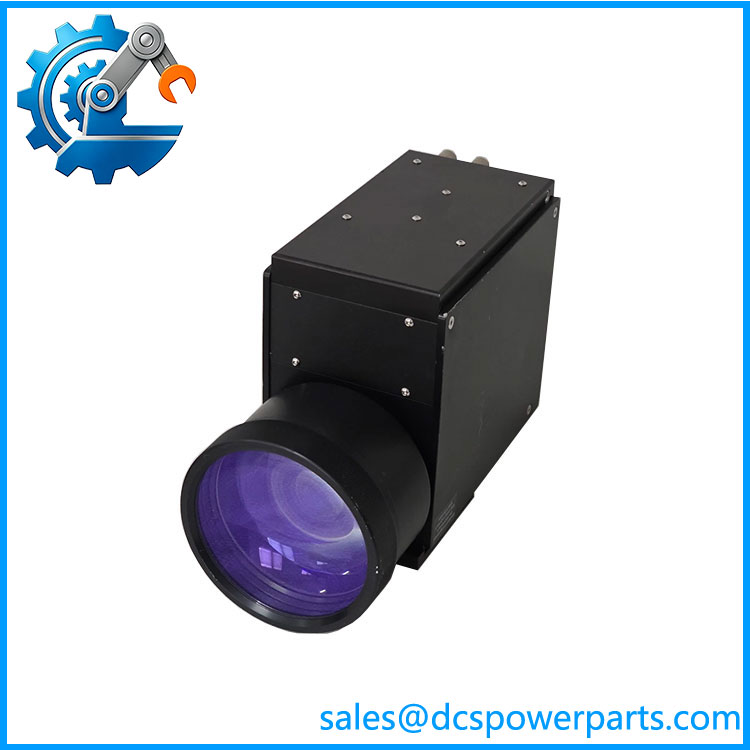
intelliSCANde
Application Scenarios & Pain Points
Laser scan heads live in a surprisingly unforgiving environment. Thermal drift, dirty optics, poor beam alignment, and incorrect control-interface settings can all show up as “bad marking,” even when the scanner itself is healthy.
Typical Applications
- Laser Micromachining: The 14 mm aperture and digital encoder architecture suit precision material processing where repeatable beam positioning is important. SCANLAB lists micromachining among the intended applications for the intelliSCAN family.
- Laser Marking: At a typical 2.0 m/s marking speed with a 160 mm F-Theta lens, the scanner is suitable for industrial marking and coding systems.
- Laser Welding and Drilling: The two-axis scan architecture allows rapid beam movement across a defined processing area, making it applicable to localized welding, drilling, and material-processing operations.
- Photovoltaic and Advanced Materials Processing: SCANLAB lists photovoltaic production and processing-on-the-fly among intelliSCAN applications.
Field Case:
A production laser can appear to have a scanner problem when the actual issue is beam alignment or an incorrect F-Theta lens. Before replacing an expensive scan head, compare commanded versus actual scan behavior, inspect the encoder/diagnostic status, verify the lens focal length, and check the beam path. That sequence often saves a needless scanner replacement.
Related Products
- SCANLAB intelliSCAN 14 — The standard 14 mm version uses an analog position detector rather than the digital encoder architecture of the intelliSCANde 14. It shares the 14 mm aperture and similar optical envelope but should not be assumed electrically interchangeable.
- SCANLAB intelliSCANse 14 — Digital-encoder version with enhanced positioning precision and stability. SCANLAB specifies <0.4 µrad RMS repeatability and up to 20-bit resolution. This is the closest documented family reference when evaluating the digital-encoder configuration.
- SCANLAB intelliSCAN III 14 — Another 14 mm scanner family intended for industrial laser processing. Its mechanical and optical characteristics overlap with the intelliSCAN family, but hardware generation and control compatibility must be verified.
- SCANLAB intelliSCAN 10 — Smaller 10 mm aperture scanner. It offers higher typical marking and positioning speeds but handles a different beam/aperture requirement, so it is not a direct substitute for a 14 mm system.
- SCANLAB intelliSCAN 20 — Larger 20 mm aperture model for applications requiring greater beam aperture and higher power capability. The 20 mm version is specified for up to 2000 W at 1064 nm with air cooling, making it a substantially different optical configuration.
- SCANLAB intelliSCAN 30 — 30 mm aperture version for larger beams and high-power processing. It belongs to the same product family but requires corresponding optics and mechanical integration.
- SCANLAB varioSCAN II — Dynamic focusing unit that can be combined with intelliSCAN scan heads for 3D processing. It complements the two-axis scan head rather than replacing it.
- SCANLAB RTC control boards — Real-time scanner/laser control hardware used to coordinate scan-head movement and laser processing. The scan head itself does not replace the system-level RTC controller.