Description
Key Technical Specifications
| Parameter | Value |
|---|---|
| Model | DMP10.24-20 |
| Manufacturer | RPSTECH |
| Product Family | DMP10.24 SIC |
| Product Type | Industrial power supply module |
| Input Voltage | 205–250 VAC |
| Input Frequency | 50 Hz |
| Listed Input Current | 6 A |
| Output Voltage | 22–28 VDC |
| Output Current | Verify exact rating on the module nameplate |
| Application | Industrial control / communication power systems |
Specification warning: Published references are inconsistent about whether the DMP10.24-20 designation corresponds to a 20 A or 40 A output configuration. One listing explicitly describes the -20 version as 20 A, while the same page separately gives a 40 A output description for DMP10.24-20. Do not size the replacement load from a reseller listing alone.
Product Introduction
What the DMP10.24-20 Does
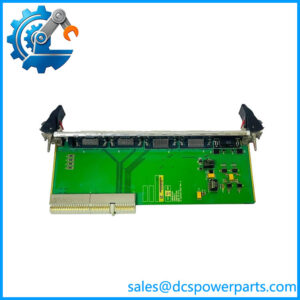
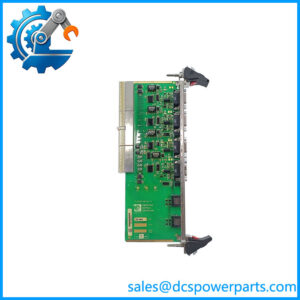
The RPSTECH DMP10.24-20 is an AC-to-DC industrial power module in the .24 SIC family. Available technical listings identify it as a power-supply module with a 205–250 VAC input and a nominal 24 VDC-class output range of 22–28 VDC. It is intended for industrial control and communication power architectures rather than serving as a PLC CPU or I/O module.
The important engineering point is output capacity. A power module may appear interchangeable with another 24 VDC supply while having different current capability, protection behavior, or mechanical interfaces. For a legacy DCS or PLC cabinet, the can be useful when the existing installation requires the same form factor and electrical characteristics, but the complete load calculation and cabinet wiring should be checked before substitution.
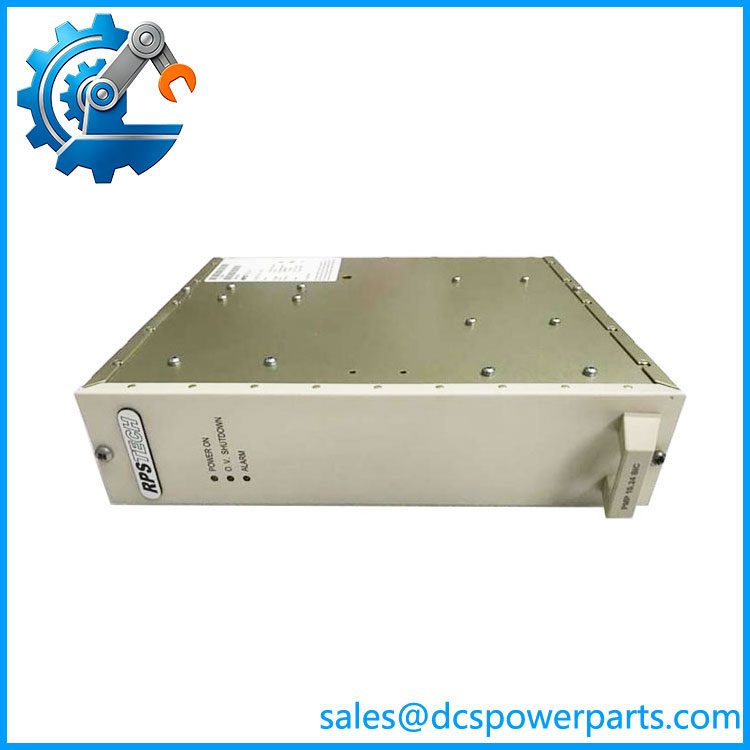
DMP10.24-20
Application Scenarios & Field Pitfalls
Engineering Pain Point
A control system can remain healthy while its power module becomes the failure point. The symptoms are often misleading: intermittent communication loss, multiple I/O faults appearing together, controller resets, or unexplained instrument dropouts. When several downstream devices fail simultaneously, check the DC distribution and power module before replacing individual control cards. The .24 SIC family is documented as an industrial power-supply platform associated with AC input and 24 VDC-class output service.
Typical Applications
- Power Generation — 24 VDC control-power distribution for auxiliary automation equipment.
- Oil & Gas — DC supply for control and communication equipment in legacy process-control cabinets.
- Petrochemical Plants — Power distribution for PLC/DCS-related field and cabinet equipment.
- Factory Automation — AC-to-DC conversion for industrial control and communication loads.
Technical Pitfalls to Avoid
- Do not assume “24 VDC” means direct interchangeability.
Verify input range, output adjustment range, current rating, protection characteristics, terminal arrangement, and cabinet mounting dimensions. - Resolve the output-current discrepancy before procurement.
Available references describe the .24-20 inconsistently, with both 20 A and 40 A information appearing in published listings. Treat the exact unit’s nameplate and OEM documentation as authoritative. - Check the DC load under real operating conditions.
Do not calculate only from nominal PLC consumption. Include remote I/O, communication equipment, relays, transmitters, solenoids, and startup/inrush loads where applicable. - Inspect the DC distribution after replacement.
A new power module will not correct undersized conductors, loose terminals, excessive voltage drop, poor grounding, or a downstream short circuit.
Related Products
- — The broader .24 power-module family associated with the .24-20. It is the appropriate family reference when checking electrical and mechanical compatibility.
- — A closely related designation appearing in current product listings. Confirm whether the installed system specifies the “-20” or “-20A” suffix before ordering; do not assume the suffix is cosmetic.
- — Higher-current variant listed alongside the -20A model. It may suit installations with greater DC demand, but output capacity alone does not establish drop-in compatibility.
- DMP1024L-40 — Related .24-family power module referenced as a 28 VDC/40 A unit. Its higher output capability makes it a different sizing option from a lower-current configuration.
- DMP1024L-40A — Another related .24-family designation appearing in published references. Verify the complete part number and electrical specification before considering it as an alternative.
- PMP10.24 SIC — Related communication/power-system hardware referenced together with the .24 SIC family. It should be evaluated as part of the complete power architecture rather than assumed to be a direct replacement.
- PCU10.24-48D — A related power-system module appearing in the same application context. Published references identify it with a DC input range, so its electrical role differs from the AC-input .24-20.
- DSP8.3/E/S/01/S/U/F/0 — A power-system monitoring module referenced together with .24 SIC and PMP10.24 SIC. It is complementary monitoring hardware, not a substitute for the power-conversion stage.
Procurement note: For a replacement request, specify RPSTECH .24-20 exactly as marked on the unit, including any suffix, revision, and nameplate ratings. The available documentation is not consistent enough to justify assuming the output-current rating from the model number alone.