Description
Product Overview
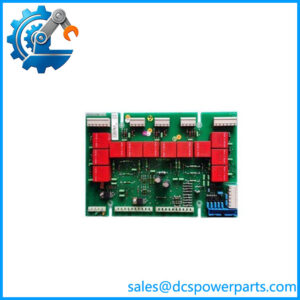
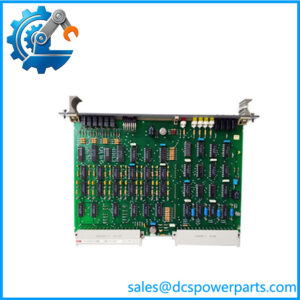
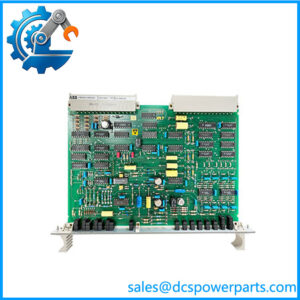
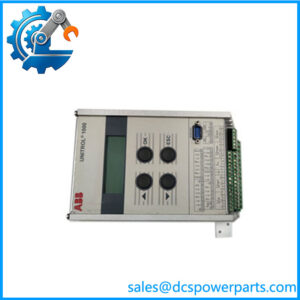
PFVO 102 is a matching unit in ABB’s Millmate roll force measurement chain, and that word “matching” carries the whole job description. A Millmate system is built from three kinds of hardware: the Pressductor load cells that sit inside the mill stand, the matching units that adapt each cell to the electronics, and a control unit — Millmate Controller 400 (type PFVA 401) in the current generation. The datasheet states the rule plainly: “Each load cell requires one matching unit, which is interchangeable between load cells”. PFVO 102 is the matching unit of the earlier PFV 100 generation, the box that sits between a pressductor cell and the control electronics of that era.
Why a separate box at all comes down to the transducer. ABB’s Pressductor principle, patented in 1954, is magnetoelastic: force applied to the cell changes the magnetic properties of the core, and the cell answers with a high-level, low-impedance AC signal rather than the millivolt output of a strain-gauge bridge. That signal is large but it is an AC excitation measurement — the cell’s primary winding has to be driven at the system frequency, and the secondary has to be read against that drive, not against earth. The matching unit is where that happens: it delivers the excitation the specific cell needs and conditions the return signal so the control unit can digitise it as force. Get the excitation class wrong and the measurement does not drift — it reads wrong by a factor, or not at all.
The generation matters for sourcing, because the numbers on this family are not cosmetic. In the PFV 140 generation the same physical box is ordered as PFVO 142 with 25 A excitation at 1638 Hz for PFVL 141V, 141C and 141R cells above 8 MN, and as PFVO 143 with 5 A at 1638 Hz for the lighter cells. ABB’s own application data adds the consequence: “Load cells requiring different types of excitation cannot be mixed in the same control unit.” So a matching unit is not a universal adapter — it is the member of the chain that fixes which cells a control unit can accept.
What is verified about PFVO 102 specifically is its role and its family behaviour, not a full electrical datasheet. No ABB catalogue record — product ID, net weight, customs tariff — has been located for this code, which is the honest state of the evidence, and this article is written around that instead of filling the gap with invented numbers. The parameters that govern a working unit — excitation class, cable limits, enclosure — are read from the unit’s label and from the load cell and control unit it serves. That is exactly what a mill spare-parts engineer does before ordering anyway, because on a 20 MN stand the cost of a wrong matching unit is a month of gauge error, not a returned parcel.
The mechanical reality is a rugged stainless-steel box mounted near the stand, not a card in a rack. In the PFV 140 generation ABB gives it 300 × 200 × 120 mm, IP 65, 8 kg, installable up to 25 m from the relevant load cell, and states that the permissible distance falls as nominal load rises. Those numbers describe the generation that succeeded this unit and are quoted here as the family reference, not as a measurement of PFVO 102 — the same class of enclosure doing the same job in the same place.
Technical Specifications
表格
| Parameter | Value |
|---|---|
| Model | PFVO 102 |
| Manufacturer | ABB (Pressductor / Millmate, Sweden) |
| Product type | Matching unit (excitation and signal-matching box for pressductor load cells) |
| System | Millmate Roll Force measurement, PFV 100 generation |
| Function in chain | One unit per load cell; adapts cell excitation and return signal to the control unit |
| Excitation frequency | 1638 Hz (Millmate system excitation) |
| Excitation current class | Class-specific (5 A / 25 A classes exist in the PFVO 14x generation) — confirm on the unit label |
| Interchangeability | Matching units are interchangeable between load cells of the same excitation class |
| Mixing rule | Load cells requiring different excitation types cannot share one control unit |
| Cell cable length | Up to 25 m from the cell, derated by nominal load (e.g. 20 MN: ≈22 m with two cells, ≈12 m with four) |
| Enclosure (family reference) | Stainless-steel box, IP 65, approx. 300 × 200 × 120 mm, approx. 8 kg |
| Mounting | Field or cabinet installation near the mill stand; not a rack card |
| Compatible cells | PFVL 141C circular, PFVL 141V rectangular, PFVL 141R annular; small QGPR cells use QIPZ 127 instead |
| Compatible control units | Millmate Controller 400 (PFVA 401); earlier PFVA 101 / PFVA 131 with their own matching units |
| Catalogue data | No published ABB product ID, net weight or customs tariff for the 102 code — verify from nameplate and ABB document |
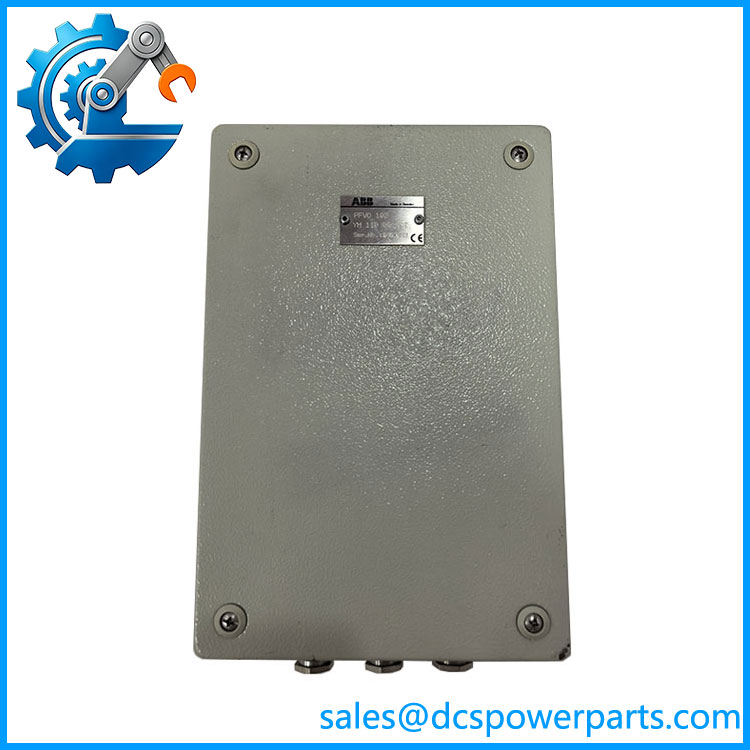
PFVO-102
Key Features and Advantages
Matching, not merely connecting: the PFVO 102 delivers the excitation a pressductor cell needs and reads its return against that drive. A general-purpose signal conditioner cannot do this — the measurement is an AC excitation bridge, and the matching unit is the part that keeps the ratio honest across the load range.
Class-correct by design: the PFVO family separates excitation classes rather than offering one adjustable box. That is a deliberate constraint, and it is the reason a mill can trust a replacement: the unit either belongs to the cell’s class or it does not, and the answer is on the label rather than in a parameter menu somebody may have changed.
Interchangeable between cells of the same class: ABB states matching units are interchangeable between load cells, which is what makes a mill spare strategy possible — one unit on the shelf covers both stands that use the same cell class, instead of one spare per stand.
A field box, not a cabinet card: stainless steel, IP 65, mounted near the stand, up to 25 m of cable from the cell. In a rolling mill the run from the stand to a clean cabinet is exactly where a low-level signal dies, and the matching unit shortens that run to where the cell actually lives.
Cable length as a real engineering limit: the permissible distance falls as nominal load rises, and with four cells on one control unit the allowance tightens further. Knowing this before a swap prevents the classic failure where a replacement “works” but the force signal carries noise the AGC interprets as eccentricity.
High-level, low-impedance signal: pressductor cells output hundreds of millivolts per volt and tolerate earth faults and insulation degradation far better than strain-gauge bridges. The matching unit preserves that advantage instead of throwing it away in a pre-amplifier.
Overload behaviour inherited from the cell: 300 % of nominal load without permanent change and 700 % without mechanical damage. The electronics chain around PFVO 102 is chosen to match cells that survive cobbles, so the box is not the weak link in a mill stand event.
A known position in a known generation: PFV 100-era hardware, superseded in new systems by PFVO 142 and PFVO 143 on the MC 400. Saying so plainly is more useful than implying a universal fit — legacy mills need the right generation, and new builds need the current one.
Applications
Hot strip and plate mills: roll force measurement on the finishing stands, where the force signal feeds gauge control and roll gap setup. A PFVO 102 in this chain is what makes the cell’s output usable by the controller, and a drifting or mis-matched unit shows up first as thickness deviation at the head end.
Cold rolling mills: high-force stands and skin-pass mills where force distribution across the barrel and roll eccentricity supervision depend on a clean signal from each cell. Here the matching unit’s cable-length limit is a design constraint, not a detail.
Backup roll bearing supervision: force signals are used to watch load distribution and bearing condition, so a matching unit that adds noise is worse than a failed one — it produces plausible but wrong diagnostics.
aluminium and non-ferrous rolling: foil and strip mills that run pressductor cells at lower nominal loads, where the lighter excitation class matters and where the wrong-class unit yields a scaled, quietly incorrect force reading.
Legacy PFV 100 system support: the practical reason most orders for this code exist today. A mill built in the 1990s still runs its original control electronics, the cell is fine, and the matching unit is the item that has to be found, verified and reinstalled with its cable discipline intact.
Mill spare-parts standardisation: plants that keep one matching unit per excitation class on the shelf, so a stand can be returned to service without waiting on a procurement cycle measured in weeks.
Replacement and upgrade projects: installations moving from PFV 100-era electronics toward MC 400, where the cell and the stand stay and the matching units and control unit change together — which is precisely when the excitation class has to be re-checked rather than assumed.
Related Products
PFVO 142 (3BSE023732R1) — the 25 A, 1638 Hz matching unit for PFVL 141V/141C/141R cells above 8 MN on Millmate Controller 400; the direct successor role to this generation. PFVO 143 (3BSE023150R1) — the 5 A, 1638 Hz matching unit for the lighter cells of the same generation. PFVO 131 (3BSE007137R1) — panel unit of the PFV 130 series; a different function in the same PFVO numbering family, and a reminder that the prefix alone does not define the part. PFVI 101 — power supply unit of the PFV 100 series this matching unit belongs to. PFVK 104 — signal processing board of the PFV 100 series; the electronics the matching unit feeds. PFVK 128 (3BSE010547R1) — relay board with four relays, used alongside the roll force electronics for limit signalling. PFVA 401 (3BSE024388R1) — Millmate Controller 400, two-analogue-input version; the control unit that supplies excitation, processes cell signals and communicates the result. PFVL 141C / PFVL 141V / PFVL 141R — circular, rectangular and annular pressductor load cells; the sensors whose excitation class dictates which matching unit is permissible. QIPZ 127 — the matching device for the small QGPR 102/104 annular cells; not interchangeable with PFVO units, and a common mis-order.
Installation and Maintenance
Before installation: read the labels, not the part number. Confirm the excitation class marked on the existing PFVO 102 against the load cell’s type and nominal load, and confirm the control unit accepts that class — ABB’s rule that cells with different excitation cannot share a control unit applies to whatever replaces this box. Check the permitted cable length for the stand’s nominal load and cell count before mounting, because on a high-force stand the limit can be half the mill’s natural cable route. Inspect the replacement enclosure for cracked seals and corroded glands, verify the stainless box is the IP 65 assembly the mill environment demands, and plan the swap for a scheduled stop: force measurement is usually part of the gauge-control loop, and a mismatched unit will not announce itself until the first coil is measured.
Fitting: isolate the control unit and the cell excitation supply, then mount the unit near the stand on its bracket with the cable entries facing away from coolant and scale. Use the manufacturer’s shielded cell cable, ground the shield at the matching unit end only, and keep the run at least 300 mm from power cables above 380 V — do not parallel it in a trunking with drive wiring. Reconnect the cell and the control-unit side in their recorded positions, check that no gland is left loose on a washdown stand, and record the unit’s label data and cell serial number in the mill’s measurement file.
Maintenance: the practical checks are excitation at the cell terminals, signal stability at zero load, and cable and gland condition. No excitation points at the matching unit’s supply and internal protection first; a noisy or drifting force signal at stable load points at cable integrity, shield termination and the frequency reference, not at the cell. Re-zero the measurement after any cell or matching-unit work and compare against the previous calibration record. Keep one spare per excitation class, store it with its label data legible, and treat the unit as a calibrated member of the measurement chain rather than as a passive junction box.
Warranty and Quality
Every PFVO 102 is supplied as the Millmate matching unit it is, with its excitation class, enclosure type and labelling verified against the buyer’s load cell type, nominal load and control unit before dispatch — because in this family the class, not the code, decides whether the measurement is right. Units are inspected for enclosure and seal condition, gland and terminal integrity, transformer and excitation-stage damage or prior rework, label legibility, and evidence of previous installation; where a compatible cell and control arrangement is available, units are energised and checked for excitation output, signal stability at zero load and interchange behaviour against a reference cell of the same class. A 12-month repair, replacement or refund commitment applies. Support covers the questions this part actually raises: how to read the excitation class from the label, why a unit of the wrong class produces a scaled rather than a failed reading, how cable length is derated by nominal load and cell count, why QIPZ 127 and PFVO units are not interchangeable, where to ground the cell shield, and how a PFV 100-generation mill should plan its migration to PFVO 142/PFVO 143 on Millmate Controller 400.
免费
今天 10:06