Description
Technical Specifications
| Parameter | Specification |
|---|---|
| Product Model | PCI-4462 |
| Manufacturer | National Instruments |
| Part Number | 779309-01 |
| Product Type | Dynamic signal acquisition device |
| Host Interface | PCI |
| Analog Input Channels | 4 |
| Simultaneous Sampling | Yes, all four channels |
| ADC Resolution | 24 bits |
| ADC Architecture | Delta-sigma |
| Sampling Rate | 1 kS/s to 204.8 kS/s |
| Input Configuration | Differential or pseudodifferential |
| Input Coupling | Software-selectable AC or DC |
| Sensor Conditioning | IEPE |
| Programmable Gain | Six gain settings |
| Analog Connectors | 4 × BNC female |
| Digital Trigger Connector | SMB |
| Analog Output Channels | None |
| Operating Temperature | 0°C to 50°C |
| Calibration | External calibration supported; one-year calibration interval recommended |
The 204.8 kS/s maximum applies to the supported sampling configuration. The PCI-4462 is an input-only device; it does not generate analog output signals.
Product Introduction
NI PCI-4462 24-Bit Sound and Vibration Acquisition Board
The National Instruments PCI-4462 is a four-channel dynamic signal acquisition board designed for precision sound, vibration, and frequency-domain measurements. Its 24-bit delta-sigma converters acquire all four analog input channels simultaneously at sampling rates up to 204.8 kS/s per channel. AC/DC coupling and integrated IEPE conditioning support direct connection to compatible microphones, accelerometers, and other dynamic measurement sensors.
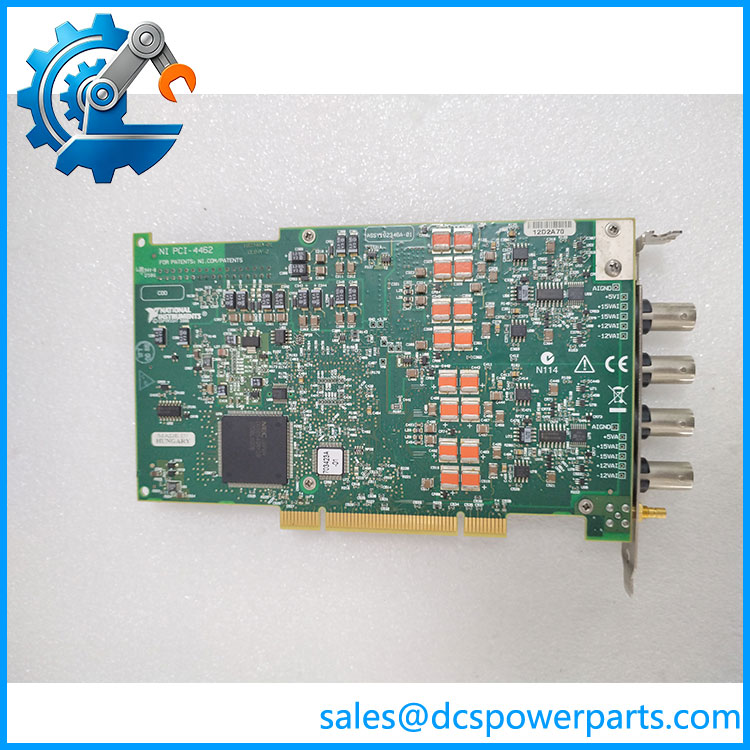
PCI-4462
The PCI-4462 is particularly useful when phase alignment between measurement channels matters. Its simultaneous acquisition architecture supports vibration analysis, acoustic testing, and machine-condition monitoring. Engineers should verify sensor sensitivity, excitation requirements, measurement bandwidth, and calibration status before integrating a replacement into an established test system.
Application Scenarios & Field Pitfalls
The PCI-4462 is designed for dynamic measurements where signal amplitude, frequency response, and phase relationships are important. In vibration testing, an incorrect coupling setting or unsuitable IEPE configuration can produce misleading measurement results even when the acquisition board is functioning normally.
Typical application scenarios
- Machine vibration analysis: Acquires accelerometer signals for rotating machinery condition monitoring and fault investigation.
- Acoustic measurement: Interfaces with compatible microphones for sound pressure and frequency-response testing.
- Automotive NVH testing: Supports noise, vibration, and harshness measurements involving multiple synchronized sensors.
- Industrial equipment diagnostics: Records dynamic signals for identifying abnormal vibration patterns, resonance, and mechanical degradation.
- Laboratory instrumentation: Provides high-resolution acquisition for frequency-domain analysis and dynamic test measurements.
Engineering checks before replacement
- Verify sensor compatibility. The IEPE conditioning supports compatible powered sensors. Confirm sensor excitation requirements, sensitivity, and connector wiring before connecting accelerometers or microphones.
- Select the correct coupling mode. AC coupling removes the DC component, while DC coupling retains it. The wrong selection can distort low-frequency measurements or remove useful signal information.
- Check the sampling configuration. The maximum sampling rate is 204.8 kS/s per channel. Select a rate appropriate for the measurement bandwidth and anti-aliasing requirements.
- Inspect the PCI host interface. Confirm that the computer has a compatible conventional PCI slot. A PCI Express slot is not a direct mechanical or electrical replacement.
- Check grounding and electromagnetic interference. NI warns that the sensitive measurement inputs are not protected against electromagnetic interference for functional reasons. Cable routing and grounding can affect measurement accuracy.
- Confirm calibration status. NI specifies accuracy validity relative to external calibration, with a one-year calibration interval referenced in its specifications. For precision testing, request calibration documentation rather than relying only on a power-on test.
Related Products
- PCI-4461: Two-channel dynamic signal acquisition board from the same NI 446x family. It shares the 24-bit measurement architecture but provides fewer analog input channels.
- PXI-4462: Four-channel, 24-bit dynamic signal acquisition module for PXI systems. It offers similar measurement functionality but uses a different hardware platform.
- PCI-4472: Eight-channel dynamic signal acquisition board for sound and vibration applications. Its higher channel count may suit systems requiring more simultaneous measurement points.
- PCI-4474: Four-channel sound and vibration acquisition board in the NI 447x family. Compare sampling performance, filtering, and sensor-conditioning requirements before selecting it as an alternative.
- PXI-4472: Eight-channel PXI dynamic signal acquisition module. Suitable for compatible PXI measurement platforms, not a direct card replacement.
- USB-4431: USB dynamic signal acquisition device for sound and vibration measurement. Its external USB interface changes the system integration and synchronization requirements.
Procurement note: Specify NI , part number 779309-01. For used or surplus inventory, request photographs of the board label and BNC/SMB connectors, confirmation of all four input channels, IEPE operation, and calibration status. Also verify the host computer’s PCI compatibility and the installed NI-DAQmx driver environment before approving a replacement.