Description
Product Overview
MS4128-L2P is the basic module of Hirschmann’s PowerMICE modular switch: the part that holds the CPU, the management software, the redundancy functions, the voltage connection and the diagnosis displays — and none of the network ports. Ports come from media modules plugged into its slots. Four slots take 10/100 Mbit/s modules (MM2 or MM3, each carrying two to four ports), and one slot on the left takes a gigabit module. Add the MB-2T expansion module and two more 10/100 slots appear, which is how the chassis reaches its ceiling of 28 ports: 24 Fast Ethernet segments plus four gigabit.
The suffix is the software edition, and this is the single most important thing to get right before ordering. L2P is Layer 2 Professional: the full professional management feature set applied to a purely Layer 2 switch — VLAN, IGMP snooping, port mirroring, port security, rate limiting, QoS, HIPER-Ring and RSTP/MSTP, with web, Telnet/SSH, CLI and SNMP management. It does not route. A project that needs the chassis to move traffic between IP subnets must specify MS4128-L3E or MS4128-L3P, and the price difference is nothing compared with discovering at commissioning that the switch can only bridge.
The rest of the order code matters just as much. 943 009-102 is the standard-temperature, non-ATEX model — 0 °C to +60 °C ambient. 943 009-101 adds the ATEX approval for Zone 2 (II 3G Ex nA IIC T4 Gc), and 943 009-103 is the EEC version with the low end extended to −30 °C. A cabinet in a heated control room is fine on the standard part; an unheated outdoor enclosure or a Zone 2 area is not, and the three numbers are visually indistinguishable on a shelf.
Mechanically it is a fanless DIN-rail unit roughly 315 × 134 × 140 mm and 2 kg, mounted on 35 mm rail per DIN EN 60175, grounded through the rail or the separate ground screw. Power arrives on two four-pin terminal blocks, P1 and P2, at 18–32 VDC with the two inputs uncoupled — the unit runs from whichever supply is higher and reports a power failure if only one is present. Consumption is 16.0 W, or 54.7 BTU/h, and a signal contact rated 1 A at 60 VDC gives a remote alarm for supply loss, temperature limit or link failure. The 6-pin DIP switch on the bottom panel sets the redundancy behaviour: Redundancy Manager, ring port selection, stand-by coupling and HIPER-Ring on or off.
The lifecycle is the uncomfortable part, and it is old news rather than a recent shock. Hirschmann closed orders for PowerMICE MS4128-L2P on 30 June 2013 with a final delivery date of 31 December 2013, and published a migration table pointing at the MSP30-24040 platform — for this exact code, the seven-slot crossing is MSP30-24040SCY999HHE2A. Two notes from that notice still bite today: backplanes with fewer media-module slots exist and must be configured deliberately, and MS20/MS30/MS4128 media modules are not compatible with MSP media modules, so a migration replaces the modules as well as the chassis. Any MS4128-L2P bought now is tested surplus, and its value lies in keeping an installed PowerMICE network alive.
Technical Specifications
| Parameter | Value |
|---|---|
| Model / order number | MS4128-L2P / 943 009-102 (ATEX 943 009-101, EEC 943 009-103) |
| Manufacturer / family | Hirschmann (Belden), PowerMICE modular industrial Ethernet switch |
| Product type | Basic switch module — switching, management, redundancy and power; LAN ports supplied by media modules |
| Slot capacity | 4 slots for 10/100 Mbit/s media modules (MM2/MM3, 2–4 ports each) + 1 slot for a gigabit media module (MM4); +2 slots with MB-2T |
| Maximum port count | 16 Fast Ethernet segments, 24 with MB-2T, plus 4 gigabit segments — 28 ports in total |
| Software edition | Layer 2 Professional (L2P): VLAN, IGMP snooping, QoS, port security, rate limiter, HIPER-Ring, RSTP/MSTP; no IP routing |
| Supply voltage / consumption | 18–32 VDC on two uncoupled inputs P1/P2; 16.0 W, 54.7 BTU/h |
| Management interfaces | Web browser, Telnet/SSH, CLI via V.24, USB for ACA 21-USB configuration, SNMP v1/v2/v3, Industrial HiVision, HiDiscovery, DHCP/BOOTP |
| Redundancy | HIPER-Ring with 6-pin DIP switch (RM, ring port, stand-by, HIPER-Ring), RSTP/MSTP, redundant supply inputs |
| Signal contact | 1 relay, max 60 VDC / 30 VAC, 1 A |
| Dimensions / weight / mounting | Approx. 315 × 134 × 140 mm, approx. 2.0 kg, 35 mm DIN rail per DIN EN 60175, IP20, pollution degree 2 |
| Environment / approvals | 0 to +60 °C operating (EEC variant −30 to +60 °C), 10–95 % RH non-condensing, up to 2000 m; CE, UL 508; ATEX only on 943 009-101 |
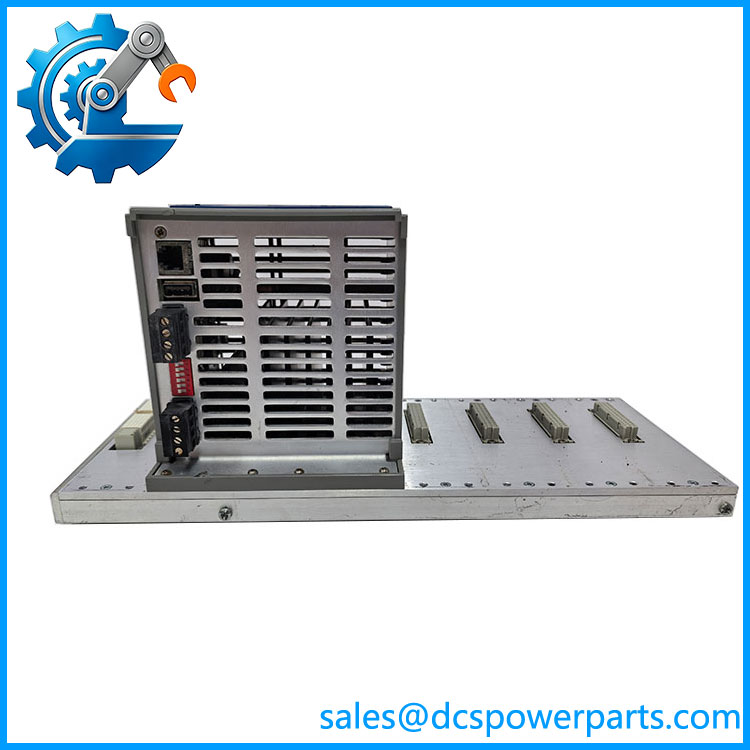
MS4128-L2P
Key Features and Advantages
A chassis sized for the port count the plant actually has: MS4128-L2P does not force a port configuration at order time. Two copper modules and two fiber modules today; six mixed modules after the MB-2T goes in; a gigabit uplink in the dedicated slot whenever the backbone is ready. The same chassis covers a five-port machine cell and a 28-port plant backbone.
Media modules hot-swap under power: a failed or obsolete port type is replaced by pulling a module and fitting another, with the switch recognising the new type and applying port defaults. In a running plant that is a maintenance action rather than an outage, and it is why installations built on this family in the 2000s are still operational.
Two uncoupled supply inputs as standard: P1 and P2 accept 18–32 VDC independently, and the unit runs from the higher of the two without load sharing. A single failed power supply therefore produces an alarm rather than a dead network segment, and the alarm arrives on the signal contact and in the management event log.
Ring recovery without a design compromise: the HIPER-Ring function with its dedicated Redundancy Manager and ring-port DIP switch gives sub-second recovery on a physical ring, and RSTP/MSTP remains available for mixed topologies. For a plant wired as a ring of cabinets — the normal shape of a process network — this is the difference between a 200 ms bump and a stopped line.
Diagnosis that survives a cabinet door: device status LEDs, selectable port-status LED meaning, a temperature threshold with an alarm, and a management view that lists every module slot with its type, version and port count. Reading a switch’s state from the front panel without a laptop is worth more on a night shift than any feature list.
Designed for the cabinet rather than the lab: fanless, IP20, 2 kg, DIN-rail mounted, 2000 m altitude, pollution degree 2 — the ratings of equipment that lives inside an enclosure, which is also why the standard 0…+60 °C range is the right one for a control room and the wrong one for an unheated kiosk.
The honest limit of the L2P edition: it is a Layer 2 switch with an excellent feature set and no routing engine. VLANs, multicast control and ring redundancy, yes; inter-subnet routing, no. Knowing that before the purchase order is cheaper than knowing it during commissioning.
Applications
Plant backbone rings: four to six cabinets on a fiber ring, each with an MS4128-L2P and the media modules its segment needs, HIPER-Ring carrying the ring and the gigabit slot feeding the plant-level backbone. The modularity is what makes one chassis type serve cabinets with very different port mixes.
Process and utility networks in power stations: switchgear and auxiliary systems where a managed Layer 2 fabric with VLAN separation, IGMP control for multicast and a ring topology is sufficient, and where the ATEX variant covers a Zone 2 annex. A station bus that needs IEC 61850-3 or routing is outside this part’s scope and should be specified accordingly.
Water, wastewater and tunnel installations: distributed cabinets linked by fiber, each chassis carrying two fiber modules for the ring and one or two copper modules for local PLCs, RTUs and HMIs. The −30 °C EEC variant covers unheated enclosures that the standard part cannot.
Machine and line integration: a line controller’s cell network on copper, a fiber uplink to the plant backbone in the gigabit slot, and spare 10/100 slots left free for the next machine that gets added. Expansion happens by module, not by project.
Port consolidation in brownfield plants: an installation that has outgrown a fixed 8- or 16-port switch, where the cabinets, wiring and IP plan are already established. A modular chassis with the same footprint adds ports without re-addressing the network.
Migration staging: because the type has been out of production since 2013, most current demand is for a like-for-like replacement of a failed unit, keeping an existing PowerMICE ring running until the planned move to MSP30 — and the official cross-reference makes that plan a document rather than a guess.
Related Products
MS4128-L3E (943 009-202) — same chassis with Layer 3 Enhanced software, adding routing; the variant for inter-subnet traffic. MS4128-L3P (943 009-302) — Layer 3 Professional, the full routing feature set. ATEX (943 009-101) — identical Layer 2 Professional switch with Zone 2 ATEX approval; the only variant permitted in an Ex area. EEC (943 009-103) — extended low temperature to −30 °C for unheated enclosures. MB-2T (943 733-102) — expansion module adding two 10/100 media-module slots; hot-pluggable, one per switch, taking the chassis to six slots. MB20-2TAHH (943 435-002) — the same expansion with the extended −40 to +70 °C rating, for cold or harsh locations. MM3-2FXM2/2TX1 (943 761-101) — two multimode SC fiber plus two copper ports, the common mixed module for ring plus local devices. MM20-Z6Z6Z6Z6SAHH (943 938-001) — four 100 Mbit/s SFP slots, the flexible optical module for mixed fiber plants. MM4-4TX/SFP (943 010-001) and MM4-2TX/SFP (943 622-001) — gigabit combo modules for the dedicated gigabit slot, with SFP sockets alternative to the copper ports. MSP30-24040 (e.g. MSP30-24040SCY999HHE2A) — the official successor platform per Hirschmann’s PowerMICE obsolescence and migration notice; note that MS media modules do not carry over. ACA 21-USB — configuration adapter for saving and restoring switch settings over the USB port, the practical tool for keeping a spare chassis interchangeable.
Installation and Maintenance
Before installation: confirm the unit is the right variant — 943 009-102 for standard temperature and no ATEX, -101 for Zone 2, -103 for −30 °C — and confirm the software edition is L2P rather than L3, since the label and the management screen look alike. Check that the enclosure temperature stays inside 0…+60 °C at the top of the cabinet, allow at least 10 cm of free space above and below for convection, and verify the rail is 35 mm per DIN EN 60175 with the unit able to ground through it. Plan the port map before fitting modules: which slot takes which media type, which ports form the ring, and which module sits in the gigabit slot. Check the 24 V supplies are inside 18–32 VDC and that both P1 and P2 are wired if the alarm on single-supply loss is to be avoided.
Installation: mount the chassis, connect P1 and P2 with the supplied terminal blocks and the Z-section sheet, ground through the rail or the separate screw with a conductor at least the size of the supply wiring, then fit the media modules and secure their corner screws. Set the 6-pin DIP switch for redundancy before power-up, since ring-port changes take effect after a restart. Give the switch an address — via HiDiscovery, DHCP/BOOTP or the V.24 port — change the default credentials immediately, then load the configuration or build it, and save a copy through the ACA 21-USB so a replacement chassis can be brought up without retyping the network.
Maintenance: the chassis is fanless with no serviceable internals, so the routine is inspection, cleaning and records. Check annually that both supply inputs are alive, that the signal contact is wired and reporting, that no module slot shows a type mismatch in the management view, and that cabinet temperature at the top of the enclosure has margin against the 60 °C limit. Keep the configuration file and the module inventory current — on an obsolete platform, a spare is only worth holding if its firmware and configuration match the network it may have to replace.
Warranty and Quality
Every is supplied against Hirschmann order number 943 009-102 — the standard-temperature, non-ATEX Layer 2 Professional basic module — and is identified by that number and by its software edition before dispatch, because the near neighbours differ invisibly: -101 changes the hazardous-area approval, -103 changes the temperature range, and L3E/L3P change the software to a routing edition. Each unit is inspected for housing and backplane connector condition, terminal-block and screw condition, DIP-switch function, display and LED operation, and evidence of prior repair or moisture ingress. Where a test bench is available the chassis is powered on both inputs, booted, addressed, checked for module recognition in every slot, exercised for ring switching with a media module pair, and verified for signal-contact operation and configuration save/restore through the USB port. A 12-month repair, replacement or refund commitment applies. Technical support covers what this platform actually raises: telling L2P from L3E and L3P, choosing between standard, ATEX and EEC codes, sizing slots and the MB-2T expansion, and planning the move to MSP30 knowing that the media modules do not migrate with the chassis.
免费
今天 10:31