Description
Moxa IMC-21A-M-ST Industrial Ethernet-to-Fiber Media Converter
Product Introduction
When an automation network has to cross an electrically noisy area, copper Ethernet can become the limiting factor rather than the controller or switch itself. The Moxa IMC-21A-M-ST addresses that interface problem by converting one 10/100BaseT(X) copper Ethernet connection to one 100BaseFX multimode fiber connection through an ST optical interface. It is intended for industrial Ethernet installations where a DIN-rail media converter is needed without adding unnecessary network-management functions.
The hardware accepts 12–48 VDC and provides built-in 1.5 kV magnetic isolation on the copper Ethernet interface. Its metal housing, reverse-polarity protection, overload-current protection, Link Fault Pass-Through, and selectable operating modes make it suitable for field cabinets and distributed industrial network infrastructure. One procurement detail matters: IMC-21A-M-ST is the standard-temperature model (-10 to 60°C). The visually similar IMC-21A-M-ST-T is the wide-temperature version rated -40 to 75°C and should not be treated as the same ordering code.
Key Technical Specifications
| Parameter | Specification |
|---|---|
| Product Model | IMC-21A-M-ST |
| Manufacturer | Moxa |
| Product Series | IMC-21A Series |
| Product Type | Industrial Ethernet-to-Fiber Media Converter |
| Copper Ethernet Port | 1 × 10/100BaseT(X), RJ45 |
| Fiber Port | 1 × 100BaseFX, multimode ST |
| Fiber Type | Multimode |
| Typical Fiber Distance | 4 km with OM1; 5 km with 50/125 µm multimode fiber |
| Typical Optical Wavelength | 1300 nm |
| Copper Magnetic Isolation | 1.5 kV built-in |
| Input Voltage | 12–48 VDC |
| Maximum Input Current | 265 mA |
| Power Connector | Terminal block |
| Reverse Polarity Protection | Supported |
| Overload Current Protection | Supported |
| Housing | Metal |
| IP Rating | IP30 |
| Installation Method | DIN-rail mounting |
| Operating Temperature | -10 to 60°C |
| Storage Temperature | -40 to 75°C |
| Relative Humidity | 5–95%, non-condensing |
| Dimensions | 30 × 125 × 79 mm |
| Weight | 170 g |
| MTBF | 353,000 hours, MIL-HDBK-217F |
| Safety Standards | EN 60950-1, UL 60950-1 |
| EMC/EMI | EN 55032/35; CISPR 32; FCC Part 15B Class A |
| Warranty Published by Moxa | 5 years |
Moxa’s current documentation identifies the IMC-21A-M-ST specifically as the multimode ST variant with the standard -10 to 60°C operating range. The -T suffix represents a separate wide-temperature model.
Application Scenarios & Field Considerations
1. Extending Industrial Ethernet Through Electrically Noisy Areas
Fiber provides electrical isolation between network segments, making the useful where copper Ethernet must cross areas with substantial electrical equipment, drives, motors, or other sources of interference. The converter itself does not perform routing or managed-switch functions; it is primarily a physical-layer media conversion device.
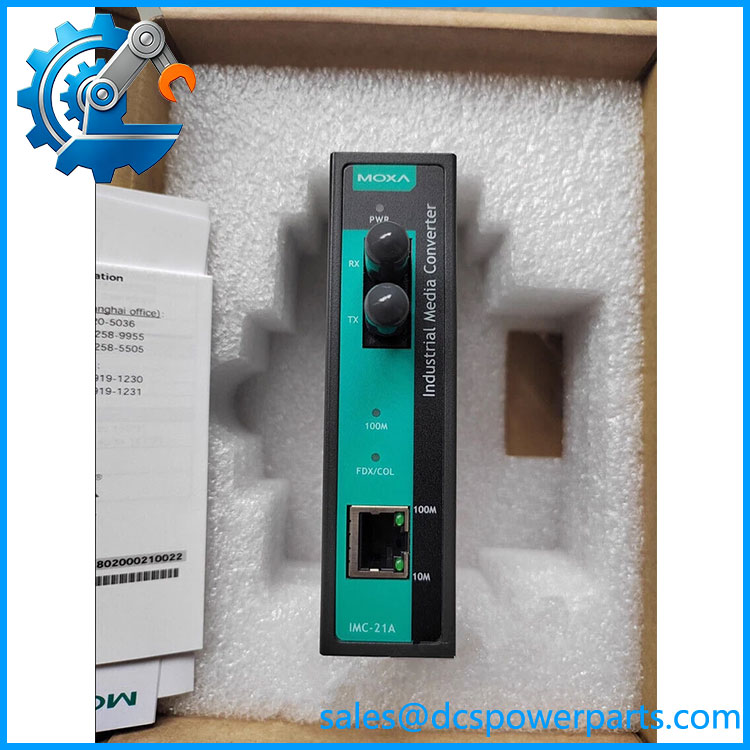
Moxa IMC-21A-M-ST
2. Connecting Legacy Copper Equipment to a Fiber Backbone
A PLC, industrial PC, HMI, or Ethernet-enabled controller with a standard RJ45 interface can be connected to a fiber-based network through the converter. The copper side remains 10/100BaseT(X), while the optical side uses 100BaseFX multimode fiber.
3. Distributed Control and Instrumentation Cabinets
The DIN-rail mounting format and 12–48 VDC input fit typical control-panel power arrangements. The 30 × 125 × 79 mm housing should still be checked against the actual cabinet layout, especially where multiple converters are installed side by side.
4. Power and Utility Communication Networks
The fiber interface can help separate copper Ethernet equipment from electrically harsh sections of a plant network. Moxa specifies industrial EMC and environmental testing for the IMC-21A family, including ESD, EFT, surge, vibration, and environmental testing.
Field note: This is a media converter, not a managed Ethernet switch. If the project requires VLAN configuration, SNMP, RSTP management, redundant network protocols, or detailed port diagn the alone will not provide those functions.
Major Features and Advantages
Copper-to-Fiber Conversion Without a Managed-Switch Layer
The provides a straightforward conversion path between 10/100BaseT(X) copper Ethernet and 100BaseFX multimode fiber. That makes it useful when the existing network architecture is already defined and only the physical transmission medium needs to change.
ST Multimode Fiber Interface
The ST connector is part of the exact model designation. Do not substitute an SC variant simply because the electrical specifications appear similar. Moxa lists th and as separate ordering models.
Link Fault Pass-Through
The family supports Link Fault Pass-Through (LFPT), allowing link-fault information to be passed between the copper and fiber sides. This can be useful during troubleshooting because a broken link is less likely to remain hidden behind the media-conversion boundary.
Flexible DC Supply
The converter accepts 12–48 VDC and includes reverse-polarity and overload-current protection. For cabinet installations, this gives more flexibility around the available control power supply than a single-voltage device.
Industrial DIN-Rail Construction
The metal housing and DIN-rail mounting arrangement are intended for industrial control cabinets and distribution boxes. Moxa specifies an IP30 enclosure rating, so this unit should be installed inside an appropriate cabinet rather than treated as a field-exposed weatherproof device.
Related Products
- Moxa -M-SC — multimode 100BaseFX version using an SC fiber connector.
- — multimode ST version with the wider -40 to 75°C operating range.
- Moxa -M-SC-T — multimode SC version with the wider temperature rating.
- Moxa -S-SC — single-mode SC variant.
- Moxa -S-SC-T — single-mode SC wide-temperature variant.
- Moxa IMC-21-M-ST — related IMC-21 series multimode ST converter; it is a different series and should not be assumed to be a direct ordering-code substitute.
The practical selection point is simple: match fiber mode, connector type, temperature rating, and exact model suffix. Moxa’s current documentation lists six distinct model combinations, so the final ordering code matters.
Engineer’s Guide — Field Pitfalls to Avoid
1. Do Not Confuse M-ST With M-ST-T
This is probably the easiest procurement error. is rated -10 to 60°C, while -T is rated -40 to 75°C. If the cabinet environment can fall below -10°C or exceed 60°C, the standard model does not provide the same specified operating range.
2. Verify the Fiber Connector Before Ordering
The ST designation is not cosmetic. Moxa also offers SC versions. Existing patch panels, fiber termination hardware, and maintenance spares must match the connector type.
3. Verify Multimode Fiber Type and Link Loss
The published typical distances depend on the fiber characteristics. Moxa lists approximately 4 km for OM1 and 5 km for 50/125 µm multimode fiber under its stated optical conditions. Do not use those numbers as a guaranteed field distance without checking cable attenuation, splice losses, connector losses, and the actual optical budget.
4. Do Not Treat IP30 as Outdoor Protection
IP30 is appropriate for protected cabinet installation, not direct exposure to water or dust. A control-panel installation should provide the environmental protection that the converter itself does not provide.
5. Check the Network Speed Requirement
The is designed around 10/100BaseT(X) and 100BaseFX. It is not a Gigabit media converter. If the existing backbone requires 1000 Mbps operation, select the media-conversion hardware accordingly rather than assuming backward compatibility is sufficient.
6. Check Existing Configuration Before Replacement
The family provides DIP-switch selections for operating modes including FDX/HDX, 10/100, Auto/Force. When replacing an installed unit, record the existing switch positions before removing the old converter. A physically compatible replacement can still behave differently if its operating-mode configuration is changed.
FAQ
Moxa a fiber-optic Ethernet switch?
No. It is an Ethernet-to-fiber media converter with one RJ45 10/100BaseT(X) port and one 100BaseFX multimode ST fiber port. It does not replace a managed industrial Ethernet switch where network management or multiple Ethernet ports are required.
What fib the use?
The model uses multimode 100BaseFX fiber with an ST connector. Moxa specifies typical distances of 4 km with OM1 fiber and 5 km with 50/125 µm multimode fiber under the documented optical conditions.
What is the diffe and -T?
The primary documented difference is temperature rating. The operates from -10 to 60°C, while operates from -40 to 75°C. They are separate ordering codes.
the operate from a 24 VDC control supply?
Yes. Its specified input range is 12–48 VDC, so a nominal 24 VDC industrial control supply falls within the published range. Maximum input current is specified as 265 mA.
Can I replace an IMC-21-Mh an ?
They perform a similar basic copper-to-multimode-ST fiber conversion, but they are different product series with different mechanical and electrical details. The older IMC-21-M-ST uses a plastic housing and different dimensions the uses a metal housing and different physical dimensions. Treat this as a system-level replacement check rather than an automatic drop-in substitution.
What should procurement verify before buying a replacement?
Confirm the complete model number, ST connector, multimode fiber type, operating-temperature requirement, supply voltage, physical mounting arrangement, and existing network speed. For an installed replacement, compare the existing unit’s DIP-switch configuration and verify that the replacement’s optical and copper interfaces match the plant network.
What condition should be expected for a replacement unit?
Condition cannot be determined from the part number alone. For an aftermarket or surplus unit, procurement should verify the actual inventory condition, label/model number, connector condition, power-up test results, and any available inspection documentation before treating the item as suitable for installation. Moxa’s published five-year warranty is the manufacturer’s stated warranty for its products; it should not automatically be interpreted as the warranty terms of a third-party supplier.