Description
Contemporary Controls MODHUB-16E | ARCNET Active Hub | 16-Port Powered Card Cage
Key Technical Specifications
| Parameter | Specification |
|---|---|
| Product Model | |
| Manufacturer | Contemporary Controls |
| Product Family | MOD HUB |
| Product Type | Powered card cage / modular ARCNET active hub |
| Network | ARCNET |
| Maximum Ports | 16 |
| Expansion Slots | 4 |
| Network Speed | 2.5 Mbps |
| Input Voltage | 230 VAC |
| Frequency | 50/60 Hz |
| Input Voltage Range | 100–230 VAC ±10% |
| Maximum Input Current | 0.5 A |
| Mounting | Rack mount or panel/desktop mounting |
| Expansion Modules | EXP Series |
| Rack Accessory | MTG-RAK |
| Export Version | “E” designation |
The MOD HUB 16-series uses four slots and can accommodate up to 16 ports through removable EXP expansion modules. Different cable media can be combined in the same hub, including coaxial cable, twisted-pair wiring, and fiber-optic connections, depending on the installed EXP modules.
Product Introduction
Contemporary Controls
The Contemporary Controls is a modular active hub designed for ARCNET industrial local-area networks. It provides a four-slot powered card cage that can be populated with EXP-series network modules to create a network with as many as 16 ports. The architecture allows different physical media to be combined within one hub, which was useful in industrial control networks where existing cable infrastructure was not uniform.
The is specifically the 230 VAC export configuration. The “E” designation is important because it identifies the export electrical configuration, including the continental-European power cord and dual input-fuse arrangement documented for this model. It should therefore be evaluated as an ARCNET network component rather than as a generic serial or Ethernet communications gateway.
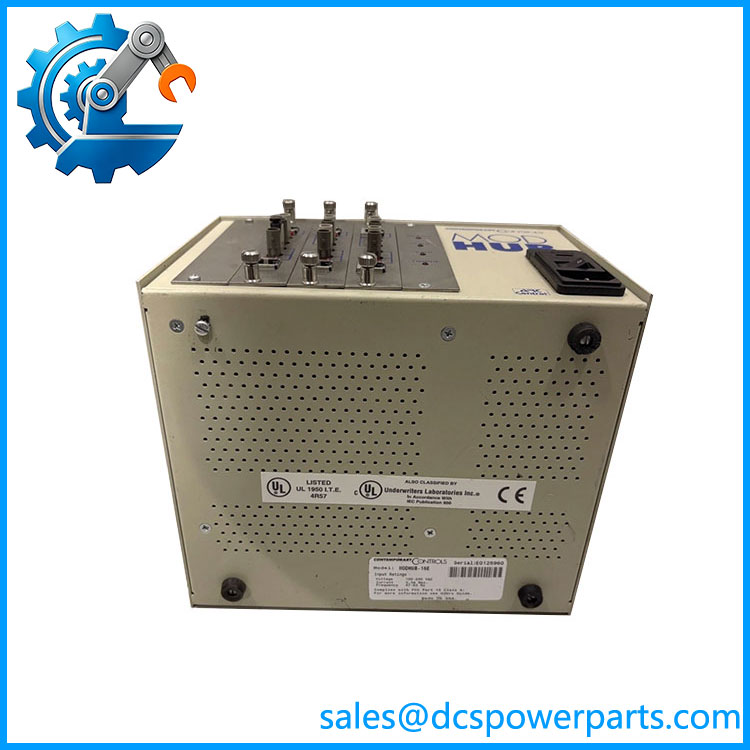
MODHUB-16E
Application Scenarios & Field Pitfalls — The Engineer’s Perspective
Engineering Pain Point
A common problem with older ARCNET-based control networks is that the active hub becomes the single point where several field-network segments converge. When the hub fails, individual network interface modules may still test correctly, but the overall network topology can become unavailable.
The addresses this architecture by providing powered expansion slots for ARCNET connection modules. Its value today is mainly in legacy control-network maintenance, where replacing the existing hub is preferable to redesigning an entire network during a plant outage.
Typical Applications
- Legacy PLC and DCS Networks: Maintaining older controllers and network interface modules that use ARCNET communication.
- Factory Automation: Connecting multiple ARCNET segments in machine-control and production systems.
- Building and Energy Control: Supporting older distributed control networks where ARCNET remains part of the installed infrastructure.
- Brownfield Automation Projects: Keeping an existing ARCNET network operational while migration toward newer communication architectures is performed in stages.
Technical Pitfalls to Avoid
- Do not confuse with a Modbus gateway.
The product documentation identifies the MOD HUB family as an ARCNET active-hub platform. Some recent secondary listings incorrectly describe as an Ethernet/Modbus gateway. That classification should not be used for engineering or replacement decisions. - Check the power suffix carefully.
is the 230 VAC version, while MODHUB-16 is specified as the 120 VAC 50/60 Hz version. The E designation is not a minor revision suffix; it identifies a different input-power configuration. - The chassis is not the complete port configuration.
provides the powered card-cage structure and four expansion slots. The actual network interfaces are installed through EXP-series modules. Confirm which EXP modules are installed before ordering a replacement chassis or rebuilding a network. - Check the physical network media.
The MOD HUB architecture can combine coaxial, twisted-pair, and fiber-optic connections through appropriate EXP modules. Replacing an individual expansion module without matching the existing cable type can leave an otherwise healthy network segment unusable. - Do not treat the unit like a modern managed Ethernet switch.
The documented network rate is 2.5 Mbps ARCNET, not 10/100/1000 Mbps Ethernet. Network troubleshooting should therefore be based on ARCNET topology, interface modules, cable media, termination, and hub behavior rather than Ethernet switch diagnostics.
Related Products
- MODHUB-16: 16-port powered card cage for 120 VAC, 50/60 Hz applications; electrically different from the .
- MODHUB-16F: Flange-mounted 16-port powered card cage for 120 VAC installations.
- MODHUB-16EF: Flange-mounted 16-port powered card cage for 230 VAC installations; the closest enclosure variant to .
- MODHUB-48: Larger 48-port powered card cage for 120 VAC applications.
- MODHUB-48E: 48-port 230 VAC export version for larger ARCNET installations.
- MTG-RAK: Rack-mounting kit designed for MODHUB-16/-16E units or one MODHUB-48.
- EXP-CXS: ARCNET expansion module for coaxial network connections.
- EXP-TPS: ARCNET expansion module for twisted-pair connections.
- EXP-FOG-SMA / EXP-FOG-ST: Fiber-optic expansion modules for applicable ARCNET network configurations.
- ARCNET Network Interface Modules: Controller-side or device-side interfaces that communicate with the MOD HUB network at the supported ARCNET rate.
Procurement Note
For , the critical procurement checks are 230 VAC input, four-slot card-cage configuration, installed EXP modules, and the existing ARCNET cable media. Do not buy based on the model name alone if the objective is to restore an existing network; photograph or record each installed expansion module before replacement.
The strongest available documentation identifies as a 230 VAC, 16-port-capable ARCNET powered card cage, not the Modbus/Ethernet product described by some recent secondary listings. That distinction matters when troubleshooting a legacy PLC, DCS, or factory-control network.