Description
ALSTOM MVTT14R1YB0751E Static Time-Delay Relay
Product Overview
The ALSTOM MVTT14R1YB0751E is a Midos-series static time-delay relay designed to introduce a controlled delay before an output contact operates. The MVTT14 is specifically classified as a time-delay pickup relay, meaning the timing interval begins when the initiating signal is applied and the relay output changes state after the preset period has elapsed. Energy Networks Association records identify the MVTT14 as a modular solid-state time-delay relay with delay on pickup, while current relay-model documentation from IPS Energy classifies the ALSTOM MVTT14 as a static “Time Delay Pick-Up” relay.
The exact MVTT14R1YB0751E ordering reference is associated with a 110–125 VDC auxiliary supply, flush mounting, a Midos Size 3 case, and a 0.01–9.99 second adjustable delay range. The available order record identifies the relay as a self-reset device with two normally open and two changeover contacts. Another technical description of the MVTT14 family identifies its setting system as a digital/solid-state timing arrangement rather than a conventional electromechanical motor timer.
This distinction matters in a protection panel. The MVTT14 is not a numerical protection relay and does not perform overcurrent, differential, voltage, or frequency calculations. It provides timing within an existing protection or control scheme. Typical uses include delaying a trip or alarm signal, coordinating sequential control actions, preventing nuisance operation from short-duration signals, and providing a definite pickup delay between an initiating contact and downstream relay operation. AREVA’s relay application guide lists the MVTT family under time delay applications and identifies it as a static relay capable of delay on pickup or drop-off depending on model.
For replacement work, the complete order number matters. An MVTT15, for example, performs delay on drop-off rather than delay on pickup, so it should not be substituted simply because both devices carry the MVTT family name.
Product Introduction
A protection circuit sometimes needs time discrimination without adding a programmable controller. That is the job of the MVTT14: accept the initiating signal, wait for the selected interval, then operate its output contacts. The family is formally identified as a static delay-on-pickup relay.
For a legacy Midos panel, verify the 110–125 VDC supply, timing range, contact arrangement, case size, wiring, and actual time setting before replacement. The relay’s timing function is part of the protection scheme, so a physically compatible timer with a different operating mode is not an acceptable substitute.
Key Technical Specifications
| Parameter | Specification |
|---|---|
| Product Model | MVTT14R1YB0751E |
| Manufacturer | ALSTOM / AREVA legacy |
| Product Family | Midos |
| Product Type | Static time-delay relay |
| Relay Function | Time-delay pickup |
| Timing Mode | Delay on pickup |
| Time Setting Range | 0.01–9.99 s |
| Auxiliary Supply | 110–125 VDC |
| Operating Voltage Range | 87–150 VDC reported for the associated configuration |
| Contact Configuration | 2 NO + 2 CO, self-reset configuration reported |
| Contact Technology | Silver-plated contacts |
| Contact Rating | 5 A class relay contacts; exact application rating depends on load |
| Mounting | Flush |
| Case | Midos Size 3 |
| Enclosure / Case Protection | IP50 reported |
| Timing Adjustment | Front-panel digital/thumbwheel setting |
| Communication | None |
| Firmware | None |
| Typical Application | Protection and control timing, interlocking, alarm/sequence control |
| Relay Reset | Self-reset |
| Status | Legacy / discontinued family |
The exact-order-number record gives the 110–125 VDC auxiliary supply, flush mounting, Midos Size 3 case, 0.01–9.99 s range, and contact arrangement.
The broader documentation identifies the relay as a static delay-on-pickup device and describes its setting range as a 1000:1 timing range selected through thumbwheel switches.
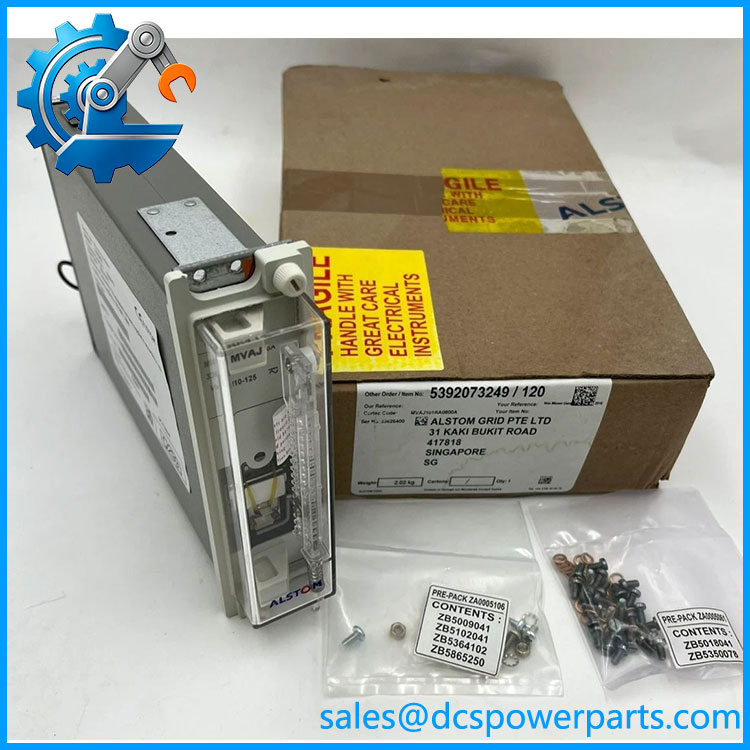
MVAJ101RA0800A
Major Features / Practical Advantages
1. Delay-on-pickup operation
The defining characteristic of the is its pickup delay.
When the initiating input is applied, the relay does not immediately transfer its output contacts. Instead, the internal solid-state timing circuit measures the selected interval. Once that interval expires, the output relay operates.
This is useful where an instantaneous signal should not immediately initiate the next control action.
The Energy Networks Association specifically records as a modular solid-state time-delay relay with delay on pick-up.
2. Wide 0.01–9.99 second setting range
The documented adjustment range extends from 10 ms to 9.99 seconds.
That is a useful range for protection and control applications because it covers both very short discrimination delays and longer sequence-control intervals. The family documentation describes a 1000:1 setting range and front-panel thumbwheel adjustment.
Do not assume that the number displayed or marked on a replacement corresponds to the setting of the removed relay. Record the original setting before replacement.
3. Solid-state timing architecture
The belongs to the static relay category rather than the older motor-driven timer architecture. Relay-model documentation classifies it as a static time-delay pickup relay, while the product documentation describes a solid-state timing design.
For maintenance engineers, this means there is no timing motor or mechanical cam mechanism to service. The timing circuit and output relay remain the critical functional elements.
4. Midos modular construction
The was designed for the Midos modular protection-relay system. The exact MVTT14R1YB0751E record specifies a flush-mounted Midos Size 3 case.
This is important when replacing an older panel relay. Physical fit, terminal arrangement, and case compatibility are separate issues from electrical timing compatibility.
5. Multiple output contacts
The documented exact-order configuration uses two normally open and two changeover contacts in a self-reset arrangement.
Multiple contacts allow the timer to affect more than one downstream circuit. Depending on the protection drawing, the outputs may participate in trip logic, alarm signaling, interlocking, or sequence control.
Do not assume all variants have identical contact arrangements. The complete order number and relay connection diagram should be checked.
6. 110–125 VDC control supply
The exact part-number record identifies a 110–125 VDC auxiliary supply. The same documentation reports an operating range of approximately 87–150 VDC for the associated configuration.
This is typical of substation DC control environments, but it is not a reason to apply DC power blindly to an unknown spare. Confirm the rating plate before energization.
7. Suitable for protection and control schemes
AREVA’s relay application material places MVTT under definite time-delay relays and identifies the device as a static relay for time-delay applications.
Typical applications include:
- Protection trip coordination
- Alarm delay
- Breaker-control sequences
- Interlocking
- Sequential switching
- Auxiliary relay timing
- Nuisance-trip filtering
The timer itself does not determine the protection pickup threshold. It simply adds the required temporal characteristic to an existing circuit.
8. No firmware or software project
There is no PLC program, Ethernet configuration, firmware database, or engineering workstation project associated with the itself.
Configuration is fundamentally hardware/front-panel based: auxiliary supply, timing setting, contacts, wiring, and relay case.
That simplifies some maintenance tasks, but it also means a wrong timing setting can go unnoticed if the replacement is installed without a proper functional test.
9. Timing accuracy must be tested
The available commissioning documentation calls for timing tests after installation and identifies a timing accuracy criterion of approximately ±2% of the setting plus 20 ms, whichever is greater.
For a protection application, this is much more meaningful than simply confirming that the relay’s indicator operates. Test the actual pickup delay at the intended setting.
Related Products
- MVTT15 — Static time-delay relay with delay on drop-off rather than the ‘s delay-on-pickup function.
- MVAJ Series — Midos static high-speed trip relays used for protection trip and control applications.
- MVTD11 — Midos static undervoltage relay.
- MVTD12 — Midos static overvoltage relay.
- MVTD13 — Midos static neutral-displacement relay.
- MVTR Series — Midos static auto-reclosure relay family.
- MVTU11 — Static undervoltage relay family.
- MVTU12 — Static overvoltage relay family.
- MVTU13 — Static neutral-displacement relay.
- MVTW02 — Static destabilizing/intertrip relay.
- MVTW03 — Related destabilizing/intertrip relay.
The IPS Energy relay-model database separately identifies the as time-delay pickup and MVTT15 as time-delay drop-off, while the surrounding Midos models cover voltage, reclosure, and intertrip functions.
FAQ
What is ALSTOM MVTT14R1YB0751E?
It is an ALSTOM/AREVA Midos static time-delay relay used to provide a controlled delay before an output contact operates. Its documented function is delay on pickup.
What is the timing range?
The documented range for the exact configuration is 0.01 to 9.99 seconds.
Is a delay-on-pickup or delay-on-drop-off relay?
is delay on pickup. MVTT15 is the corresponding family for delay on drop-off.
What is the auxiliary voltage?
The exact-order record identifies 110–125 VDC auxiliary voltage. A broader operating range of 87–150 VDC is also reported for the associated configuration. Verify the installed relay nameplate before applying power.
How many contacts does have?
The available exact-order documentation specifies 2 normally open and 2 changeover contacts in the self-reset configuration.
Can I hot-swap this relay?
Do not treat it as a hot-swappable PLC module. It belongs to a protection/control circuit and should be isolated according to the approved switching procedure before removal. The documentation includes explicit installation, commissioning, and safety procedures.
Does have firmware?
No user firmware is associated with the relay. The timing function is hardware-based and adjusted through the relay’s front-panel setting mechanism.
How accurate is the time delay?
The available commissioning information gives a timing accuracy criterion of approximately ±2% of the setting + 20 ms, whichever is greater. Actual acceptance testing should follow the applicable relay documentation and site protection procedure.
Can MVTT15 replace ?
No, not as a routine substitution. provides delay on pickup, whereas MVTT15 provides delay on drop-off. Those functions produce different circuit behavior even if the physical relay format appears similar.
What should I verify before purchasing a replacement?
Check the complete part number, auxiliary voltage, timing range, contact arrangement, Midos case size, terminal layout, original timing setting, and application drawing. For a protection-panel replacement, also perform an actual timing test after installation.
Procurement Note
The should be procured as a specific Midos time-delay relay, not simply as a generic timer.
The strongest available identification is:
ALSTOM — static delay-on-pickup relay, 110–125 VDC, 0.01–9.99 second setting range, flush-mounted Midos Size 3, with the documented self-reset contact arrangement.
There is some poor-quality product information online that incorrectly describes this exact part as a voltage-transducer module or as a permanent-magnet trip relay. Those descriptions conflict with the Midos relay documentation and utility/industry records identifying as a static time-delay pickup relay.
For that reason, procurement should rely on the relay nameplate, original schematic, and technical documentation rather than a generic online description.
Before commissioning a replacement, record the original delay setting, verify the contact logic, confirm the DC supply polarity and rating, inspect the Midos case/socket, and perform a measured pickup-time test. For a protection circuit, “the relay clicks” is not an adequate acceptance test.
If supplied as New Surplus, inspect the front setting mechanism, contacts, socket pins, case condition, indication mechanism, and timing performance. A surplus relay can have the correct part number while still requiring verification of calibration and mechanical condition.
The main replacement risk is not firmware compatibility. It is installing the wrong timing function, contact arrangement, voltage variant, or time setting into an otherwise compatible-looking Midos relay position.