Description
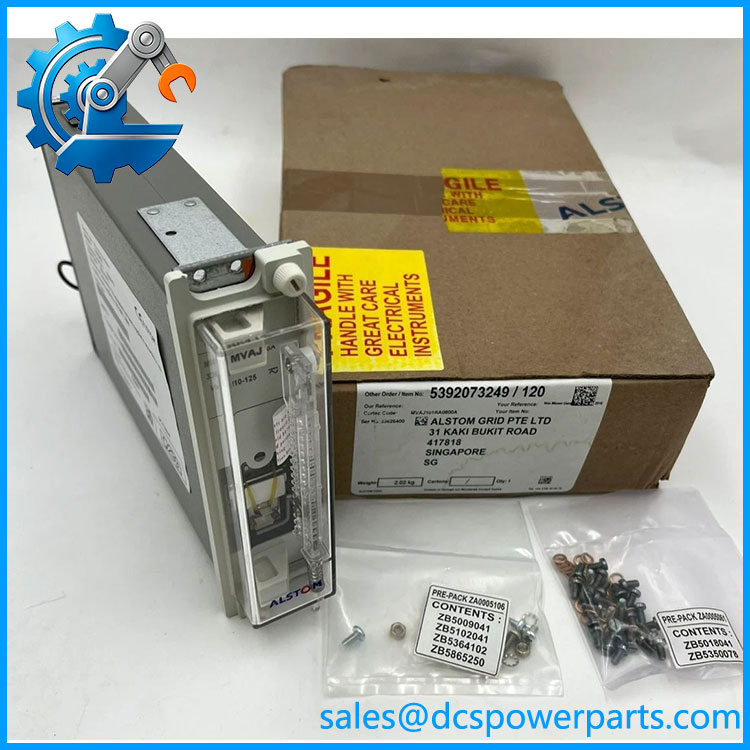
GE / ALSTOM MVAJ101RA0800A Self-Reset Trip Relay
Product Overview
The MVAJ101RA0800A belongs to the MVAJ family of high-speed tripping and control relays used in conventional power-system protection schemes. GE Vernova’s current technical manual identifies MVAJ101 as the 10-contact self-reset version of the MVAJ10 family. The related MVAJ102 is also self-reset but incorporates a delayed reset, while MVAJ103, MVAJ104, and MVAJ105 use different reset arrangements. These distinctions matter because the relay’s reset behavior is part of the protection scheme itself.
Unlike a modern numerical protection IED, the MVAJ101RA0800A does not process protection algorithms, communicate over Ethernet, or store a software application. Its job is physical and direct: receive an electrical operate signal and transfer that command through multiple hardwired contacts. Utility documentation identifies MVAJ101 as an instantaneous self-reset relay with a hand-reset flag, and identifies the closely documented MVAJ101RA0802 110 VDC version as having 8 normally open and 2 normally closed contacts.
That architecture remains common in legacy substations, generator protection panels, transformer protection circuits, and breaker control schemes. One relay operation may need to initiate several electrically isolated actions. The MVAJ101 provides those contacts without requiring a programmable controller or communications network.
The important procurement issue is exact configuration. The public GE documentation provides the MVAJ101 family characteristics but does not safely decode every character of the complete RA0800A order number. For that reason, the exact installed nameplate, connection diagram, contact arrangement, and rated voltage should take precedence over assumptions based solely on the suffix.
Product Introduction
Protection panels built around hardwired relay logic do not give maintenance engineers much room for guesswork. The MVAJ101 is specifically the self-reset member of the 10-contact family, rather than the electrical-reset MVAJ104 used in a different protection scheme.
For a legacy protection replacement, the practical checks are coil rating, contact configuration, reset behavior, burden link, economizing circuit, relay case, and terminal wiring. Software compatibility is not the issue here; electrical behavior is.
Key Technical Specifications
| Parameter | Specification |
|---|---|
| Product Model | MVAJ101RA0800A |
| Relay Family | MVAJ 05 / 10 / 20 |
| Manufacturer / Legacy Brand | GE Grid Solutions / ALSTOM |
| Product Type | High-speed trip and control relay |
| MVAJ Variant | MVAJ101 |
| Contact Family | 10-contact |
| Reset Method | Self-reset |
| Reset Classification | Instantaneous self-reset |
| Hand Indication | Hand-reset flag |
| Contact Configuration | 10-contact arrangement; 8 NO + 2 NC documented for RA0802 variant |
| Operate Circuit | Case terminals 27 (+) and 28 (-) |
| Communication | None |
| Firmware | None |
| Economizing Link | Required for cut-off/economizing function |
| Burden Configuration | High-burden configuration with link arrangement defined by MVAJ documentation |
| Mounting | Plug-in/draw-out relay case |
| Typical Service | Protection trip, breaker control, interlocking, alarm/trip distribution |
| Exact RA0800A Voltage | Verify nameplate / original relay documentation |
| Status | Legacy / maintenance spare |
GE Vernova’s MVAJ manual states that the operate circuit for self-, hand-, electrical-, and hand/electrical-reset versions terminates at 27 (+) and 28 (-). It also identifies as the self-reset 10-contact version.
A utility-approved relay schedule identifies MVAJ101RA0802 as a 110 VDC version with 8 normally open and 2 normally closed contacts. Since that document does not list RA0800A, the exact voltage and suffix interpretation of the requested unit should not be inferred from the RA0802 record.
Major Features / Practical Advantages
1. Ten-contact protection interface
The provides the contact density needed when a single protection operation must be distributed to several downstream circuits.
The documented arrangement is a 10-contact relay. A commonly approved 110 VDC configuration, MVAJ101RA0802, uses 8 normally open and 2 normally closed contacts. The actual RA0800A unit should be checked against its individual connection diagram before assuming an identical contact assignment.
This distinction is important in retrofit work. A relay can fit physically while still producing the wrong electrical result if the contact arrangement differs.
MVAJ101RA0800A
2. Self-reset operation
is specifically the self-reset variant.
The MVAJ family uses different model numbers for different reset functions:
- — self-reset
- MVAJ102 — self-reset with approximately 2-second delayed reset
- MVAJ103 — hand reset
- MVAJ104 — electrical reset
- MVAJ105 — hand and electrical reset
These are functional differences rather than cosmetic variations.
If the original protection logic depends on automatic relay release when the operate signal disappears, replacing with MVAJ104 would fundamentally change circuit behavior.
3. Economized cut-off circuit
One detail specific to deserves attention: the economizing link must remain fitted.
GE’s MVAJ documentation states that and MVAJ201 use the link to place the relay cut-off into its economized state. MVAJ103/203 do not use the same arrangement, while the 104/105 and 204/205 variants have different cut-off/reset-inhibit options.
That means a replacement should be inspected before installation. Do not assume that a relay arriving with altered links has the same electrical configuration as the removed unit.
4. Direct hardwired operation
There is no processor, firmware image, Ethernet port, or configuration software associated with the relay element.
That makes troubleshooting relatively straightforward. When a protection relay of this type fails, engineers normally look at:
- Coil/operate voltage.
- Contact continuity.
- Contact timing.
- Mechanical movement.
- Link configuration.
- External trip-circuit wiring.
The MVAJ technical manual provides commissioning procedures around these exact checks.
5. Fast protection-trip service
is listed as an instantaneous self-reset relay in utility protection documentation. The intended application is therefore direct protection and trip-control service rather than slow auxiliary switching.
In older substations, this type of relay can sit between the protection element and several pieces of switchgear logic. Its response therefore becomes part of the overall trip-chain timing.
6. Draw-out relay construction
The MVAJ documentation describes removal of the relay module from its case using the front handles after the cover is removed. It also warns that mechanical settings must not be disturbed.
That design simplifies maintenance, but it should not be interpreted as permission to hot-swap the device. A protection relay may be directly connected to energized DC trip circuits.
7. Testable contact and operating characteristics
The manufacturer’s commissioning procedure calls for operation testing at 60% of the lower nominal voltage, followed by operating-time and contact-continuity checks at the rated lower nominal voltage. Contact continuity testing is specified using a 5 A test current.
This gives maintenance personnel a concrete acceptance-test approach instead of relying on a visual inspection.
8. Mechanical settings are not user-programmable settings
The MVAJ manual states that relays are accurately adjusted and tested before leaving the factory and warns against disturbing mechanical settings during removal. It also notes that there are no user-serviceable parts inside.
For procurement, that means a used or surplus unit should be evaluated as a complete calibrated relay, not as a generic collection of replaceable electrical parts.
Related Products
- MVAJ101RA0802 — Closely documented 110 VDC variant with 8 NO and 2 NC contacts.
- MVAJ101RA0202 — 30 VDC configuration documented in utility relay schedules; same self-reset relay family with a different control-voltage configuration.
- MVAJ102 — 10-contact self-reset relay with approximately 2-second delayed reset; not a direct functional substitute where instantaneous reset is required.
- MVAJ103 — 10-contact hand-reset relay; reset behavior differs substantially from .
- MVAJ104 — 10-contact electrical-reset relay; requires an electrical reset circuit and is not equivalent to .
- MVAJ105 — 10-contact hand/electrical-reset relay.
- MVAJ051 — 5-contact self-reset version for schemes requiring fewer output contacts.
- MVAJ201 — 20-contact self-reset relay from the larger MVAJ family.
- MVAJ203 — 20-contact hand-reset relay.
- MVAJ204 — 20-contact electrical-reset relay.
- MVAJ205 — 20-contact hand/electrical-reset relay.
The MVAJ technical manual explicitly separates the 5-, 10-, and 20-contact families and their reset configurations.
FAQ
What is the MVAJ101RA0800A?
It is an MVAJ-series high-speed trip and control relay in the 10-contact self-reset family. The architecture is intended for conventional hardwired protection and breaker-control circuits.
Is an electrical-reset relay?
No. is self-reset. MVAJ104 is the electrical-reset version. This distinction should be preserved when selecting a replacement.
How many contacts does have?
The is a 10-contact relay. An approved 110 VDC variant, MVAJ101RA0802, is documented with 8 normally open and 2 normally closed contacts. For RA0800A, confirm the actual connection diagram before using that contact arrangement as an absolute specification.
Is MVAJ101RA0800A a PLC or numerical protection relay?
No. It is a discrete high-speed trip/control relay. There is no PLC program, Ethernet configuration, or user firmware to transfer.
Does have an economizing circuit?
Yes. The technical manual specifically states that the link must remain fitted on to enable the economizing circuit.
Can I hot-swap the ?
Do not treat it as a hot-swappable module. The manufacturer’s maintenance instructions require electrical isolation for work around exposed terminals and describe controlled removal of the relay module from its case.
How should be tested after replacement?
The manufacturer’s procedure includes checking operation at 60% of the lower nominal supply voltage, operating time at full lower nominal voltage, and output-contact continuity. The relay should switch cleanly in one movement.
Can MVAJ102 replace ?
Not automatically. Both are 10-contact self-reset relays, but MVAJ102 has a delayed reset of approximately 2–2.8 seconds according to the manufacturer’s test procedure. If the protection scheme requires instantaneous self-reset, that difference matters.
Can replace ?
Not as a direct functional substitute. is electrically reset, while is self-reset. The external reset circuit and protection logic are therefore different.
What should I verify before buying ?
Verify the complete nameplate, rated control voltage, contact arrangement, relay case, terminal wiring, external links, burden configuration, flag arrangement, and the protection schematic. The public documentation confirms the family but does not provide a reliable character-by-character decoding of every element in RA0800A.
Procurement Note
For , exact part-number matching is more important than simply searching for “.” The family designation establishes the 10-contact self-reset architecture, but the complete suffix identifies the particular hardware configuration.
One point deserves particular caution: publicly available approved-relay schedules document MVAJ101RA0802 as 110 VDC, 8 NO + 2 NC, but they do not list the requested variant. Therefore, the 110 VDC rating and 8-NO/2-NC contact arrangement should not be automatically transferred to the requested unit without checking its nameplate or original connection diagram.
For a legacy protection-panel replacement, record the removed relay’s link positions before extraction. The economizing link is not optional in the standard configuration, and changing link arrangements can alter relay coil/cut-off behavior.
If the replacement is offered as New Surplus, inspect the mechanical flag, armature movement, contact condition, coil resistance, insulation, terminal condition, and economizing-link arrangement. New Surplus status by itself does not establish that the relay has the correct electrical configuration for your panel.
The correct replacement is the one that matches the protection scheme, rated voltage, contact logic, relay case, and MVAJ configuration—not simply one that carries the same family label.