Description
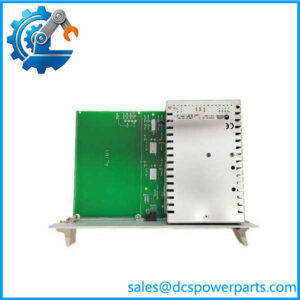
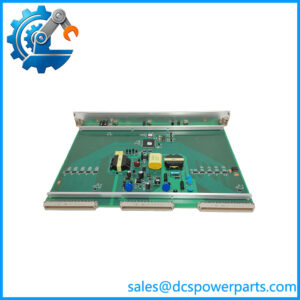
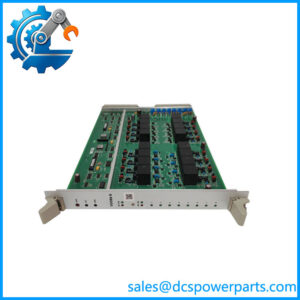
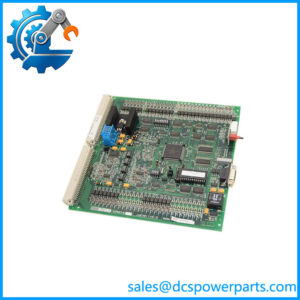
ALSTOM MVAJ104RB0802A High-Speed Trip Relay
Product Overview
The ALSTOM MVAJ104RB0802A belongs to the MVAJ family of high-speed tripping and control relays developed for power-system protection circuits. The MVAJ104 variant is the 10-contact electrical-reset version of the MVAJ10 family. GE Vernova’s current technical manual identifies MVAJ104 specifically as an electrical-reset relay, while the MVAJ10 family uses multiple output contacts to distribute a protection operation into downstream trip, interlocking, alarm, or signaling circuits.
In a conventional substation protection scheme, the MVAJ104RB0802A sits between the protection system and the equipment that must respond to a trip command. It is not a numerical protection IED, PLC CPU, or communications module. Its job is much simpler—and, in a trip circuit, that simplicity is intentional: operate quickly, provide multiple hard contacts, retain the required indication/reset state, and interface reliably with the station DC control circuit. The exact RB0802A order number is also independently documented in relay trade records, supporting its identification as an MVAJ relay rather than a generic spare.
For maintenance teams working on older switchgear, generator, transformer, or feeder protection panels, the important issue is contact behavior rather than processor specifications. MVAJ relays have no user firmware, Ethernet configuration, or software project to preserve. Mechanical contact arrangement, coil rating, burden configuration, reset method, and terminal wiring are the parameters that determine interchangeability.
The MVAJ104RB0802A should therefore be evaluated as a protection-system switching component. A replacement with the same nominal coil voltage but a different MVAJ suffix can still be electrically wrong if the contact arrangement or reset behavior differs.
Product Introduction
Protection engineers sometimes overlook these relays because they are not programmable devices. That is exactly why an MVAJ104 replacement needs careful identification: the relay’s contact logic is physically defined rather than software-configured.
The MVAJ104 uses an electrical reset arrangement and provides 10 contacts. The MVAJ technical manual also documents a high-/low-burden link and a reset-inhibitor/economizing link for the electrical-reset versions.
Key Technical Specifications
| Parameter | Specification |
|---|---|
| Product Model | MVAJ104RB0802A |
| Product Family | MVAJ 05 / 10 / 20 |
| Manufacturer / Legacy Brand | ALSTOM / AREVA |
| Current Product Lineage | GE Vernova Grid Solutions |
| Product Type | High-speed trip and control relay |
| Relay Variant | MVAJ104 |
| Contact Count | 10 |
| Reset Method | Electrical reset |
| Relay Technology | Static/electromagnetic high-speed trip relay assembly |
| Coil Voltage | 110–125 VDC reported for this exact order number; verify nameplate |
| Burden Configuration | High burden as supplied; low-burden conversion available through specified link |
| Contact Arrangement | MVAJ104 10-contact arrangement with make/break combinations defined by the relay wiring diagram |
| Communication | None |
| Firmware | None |
| Mounting | Plug-in/draw-out relay case |
| Typical Application | Substation protection, breaker trip circuits, protection interlocking, trip-signal distribution |
| Status | Legacy / discontinued |
The MVAJ technical manual confirms that is the 10-contact electrical-reset variant. It also states that MVAJ101, 103, 104, and 105 can be converted between high- and low-burden configurations using the specified external link.
The 110–125 VDC coil identification is reported specifically for MVAJ104RB0802A by available product records. Because the public GE manual does not decode every character of the complete commercial suffix, the installed nameplate should remain the final authority for a replacement purchase.
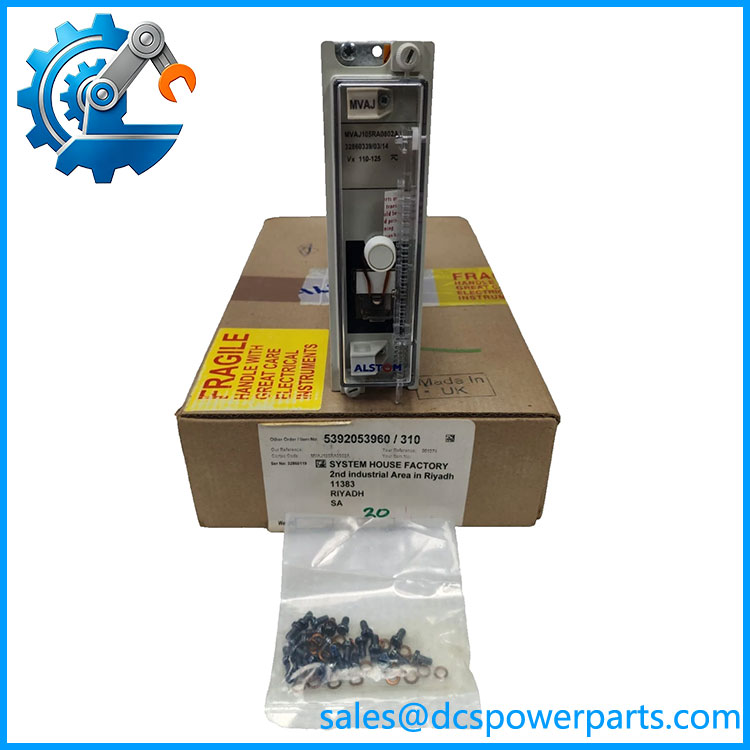
MVAJ104RB0802A
Major Features / Practical Advantages
1. Ten-contact trip distribution
The architecture provides ten relay contacts for distributing a protection operation to multiple downstream circuits. This is useful when one protection output must initiate several actions, such as circuit-breaker tripping, interlocking, alarm signaling, or associated protection logic.
The actual make/break combination is determined by the connection diagram. Do not assume that every 10-contact MVAJ relay has the same contact state merely because the front-panel format looks similar. GE’s manual provides separate connection diagrams for MVAJ101 through MVAJ105.
2. Electrical reset
is specifically the electrical-reset member of the MVAJ10 family. The related MVAJ101 is self-reset, MVAJ103 uses hand reset, and MVAJ105 combines hand and electrical reset. Those are functional differences, not cosmetic suffix variations.
For a protection-panel replacement, that means an MVAJ101 or MVAJ105 should not automatically be treated as a substitute for .
3. High- and low-burden configuration
MVAJ trip relays are supplied as high-burden units. The technical manual states that MVAJ101, 103, 104, and 105 can be converted to low burden by removing the link between case terminals 22 and 24. The MVAJ102 and MVAJ202 versions are exceptions and are configured as high-burden models.
This feature exists for a practical protection-engineering reason. Trip circuits can involve long control cables, DC wiring capacitance, and breaker trip coils. The relay’s burden behavior must therefore match the protection scheme rather than being treated as a generic coil characteristic.
4. Controlled cut-off behavior
The MVAJ10 and MVAJ20 families incorporate a cut-off arrangement that can reduce the relay’s current consumption after operation. For the MVAJ101/103/104/105 and corresponding MVAJ20 variants, the technical documentation distinguishes the high- and low-burden behavior and specifies different cut-off characteristics.
That feature should be preserved during replacement. Altering the external link without checking the original protection drawing can change the electrical behavior of the trip circuit.
5. Reset-inhibitor function
The electrical-reset versions use a second external link associated with terminals 21 and 23. On , MVAJ105, MVAJ204, and MVAJ205, the link can be removed when the reset-inhibitor function is not required.
This is a small detail with real commissioning consequences. If the replacement arrives with a different link arrangement from the removed relay, compare the original relay and scheme documentation before powering it.
6. No software dependency
There is no firmware image, application program, Ethernet configuration, or engineering database associated with the itself. That makes the device fundamentally different from modern numerical protection IEDs.
The tradeoff is mechanical and electrical: the relay’s contact state, coil characteristics, internal adjustment, link positions, and terminal wiring become the configuration. A visual inspection and electrical test are therefore more useful than looking for a firmware revision.
7. Draw-out maintenance design
The MVAJ technical documentation describes the relay module being removed from its case using the front handles after the cover is removed. It also warns that mechanical settings must not be disturbed during removal and replacement.
This is a genuine maintenance advantage for legacy protection panels, but it should not be confused with modern online hot-swapping. The relay is part of a potentially energized protection circuit and must be isolated according to the site’s approved switching procedure.
8. High-speed protection application
is classified in relay-model references as a static high-speed trip relay. The MVAJ10 family is intended for protection trip and control applications where multiple hardwired contacts are required.
This architecture remains relevant when maintaining older switchgear even though modern protection systems increasingly use numerical IEDs and communications-based interlocking.
Related Products
- — 10-contact self-reset MVAJ trip relay. Different reset behavior from .
- MVAJ102 — 10-contact self-reset version with delayed reset characteristics; configured as a high-burden model.
- MVAJ103 — 10-contact hand-reset version with a different operator-reset arrangement.
- MVAJ105 — 10-contact hand-and-electrical-reset relay; functionally different from .
- MVAJ201 — 20-contact self-reset member of the larger MVAJ20 family.
- MVAJ203 — 20-contact hand-reset high-speed trip relay.
- MVAJ204 — 20-contact electrical-reset version.
- MVAJ205 — 20-contact hand-and-electrical-reset version.
- MVAJ051 — 5-contact self-reset member of the smaller MVAJ05 family.
- 6RJ24-10 — Mors Smitt high-speed trip relay cross-reference corresponding to the functional arrangement, with 10 contacts and electrical reset.
These products should be considered functional references rather than automatic drop-in replacements. Contact count alone does not establish interchangeability.
FAQ
What is the ?
It is an ALSTOM/AREVA MVAJ-series high-speed trip and control relay used in power-system protection circuits. The variant has 10 contacts and electrical reset.
Is a numerical protection relay?
No. It is a hardwired trip/control relay rather than a programmable numerical protection IED. It does not replace a protection relay such as a modern MiCOM or Relion device.
What does mean?
Within the MVAJ family, MVAJ10 identifies the 10-contact family and 104 identifies the electrical-reset version. The technical manual lists as self-reset, MVAJ102 as delayed self-reset, MVAJ103 as hand reset, as electrical reset, and MVAJ105 as hand and electrical reset.
Is the high burden or low burden?
The MVAJ trip relays are supplied as high burden. For , the technical manual documents a link between terminals 22 and 24 that can be removed to configure low-burden operation. Verify the original relay’s link position and protection drawing before changing it.
Can I hot-swap this relay?
Do not treat it as a hot-swappable PLC or I/O module. The MVAJ documentation describes isolation, wiring verification, and controlled removal of the relay module. A trip relay may be connected directly into a live breaker trip circuit, so the protection scheme must be placed in an approved maintenance condition before removal.
Does have firmware?
No user firmware is associated with the relay. Its functional configuration is established through the relay’s electrical/mechanical design, contact arrangement, reset mechanism, and external links.
Can replace ?
Not automatically. Both are 10-contact -family relays, but is self-reset while is electrical reset. That difference can change the behavior of a protection or lockout scheme.
What should I verify before ordering an replacement?
Confirm the complete part number, coil voltage, contact arrangement, reset method, high-/low-burden link position, reset-inhibitor/economizing link, relay case, terminal wiring, and the protection scheme drawing. For this exact order number, available records identify a 110–125 VDC coil configuration, but the nameplate on the installed relay should be treated as the final verification point.
Is still a current product?
The MVAJ family is a legacy protection-relay platform. Current GE Vernova documentation still provides technical support information for MVAJ05/10/20 relays, while market records identify specific MVAJ variants as discontinued. Procurement should therefore be handled as a legacy-spares exercise with exact part-number and condition verification.
Procurement Note
The should be purchased by exact order number rather than by the generic description “high-speed trip relay.” The portion establishes the 10-contact electrical-reset architecture, while the remaining suffix identifies the particular hardware configuration. Public documentation does not provide a sufficiently reliable character-by-character decoding of every suffix position, so claiming that each letter and digit independently represents a specific electrical parameter would be misleading.
For a replacement, photograph the existing relay’s front label, rating plate, case, terminal block, and external link positions before removal. Compare the new unit against those records. This is especially important where the relay sits directly in a breaker trip circuit.
If the offered unit is described as New Surplus, that description should not replace electrical inspection. Check contact condition, mechanical operation, coil resistance, insulation condition, flag/reset operation, and the actual contact sequence before returning the protection scheme to service.
Most importantly, do not modify the high-/low-burden link or reset-inhibitor link simply because the replacement relay arrived with a different configuration. Those links form part of the relay’s interface to the protection scheme and should be matched to the approved circuit documentation.
For legacy switchgear, a correct MVAJ replacement is a scheme-matching exercise, not merely a part-number exercise.