Description
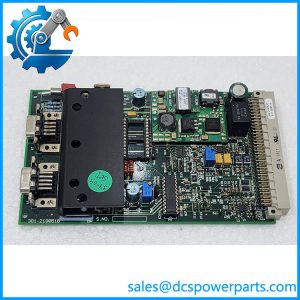
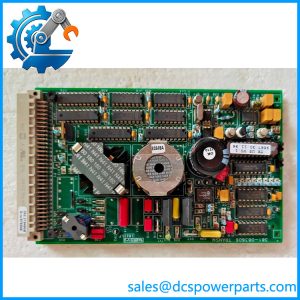
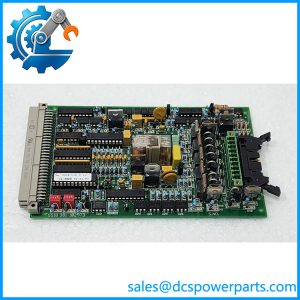
Kongsberg RDIOR420 Remote Digital I/O and Relay Module
Product Overview
The Kongsberg RDIOR420 is a combined remote digital I/O and relay module designed for Kongsberg Maritime automation systems. KM identifies the unit by article number 306713. Its architecture combines 16 solid-state channels that can individually be configured as digital inputs or digital outputs with 16 separate relay channels providing normally open and normally closed contacts. This makes the RDIOR420 useful where a single field station must handle a mixture of monitored contacts, 24 VDC discrete outputs, and relay-isolated switching circuits. Kongsberg documentation identifies the module as an interface between field I/O and the host controller computer through a remote I/O process bus.
Communication is handled through RBUS A and RBUS B, giving the module a redundant remote-I/O connection to the controller architecture. The two bus interfaces use galvanically isolated RS-485 circuitry, while the RDIOR420 itself performs loop monitoring, watchdog supervision, internal diagnostics, and fail-safe handling. The solid-state outputs use short-circuit-protected high-side drivers rated at 1 A per channel, while the relay section is intended for external field circuits rather than internal 24 VDC logic only.
For marine automation maintenance, the distinction between the RDIOR420 and a conventional PLC I/O card matters. This module is tied to the Kongsberg remote-I/O architecture and RBUS addressing, so replacing it with a superficially similar 32-channel digital module is not a valid substitution. The module supports up to 99 RBUS addresses, uses a 2 Mbit/s Manchester-encoded communication link, and can be configured while the system is running. Kongsberg also specifies hardware and software fail-safe behavior, including output de-energization following serious hardware faults and configurable output behavior following loss of controller communication.
In practical terms, the Kongsberg RDIOR420 is best treated as a system-specific marine remote I/O node. It belongs in the field I/O layer of a Kongsberg automation installation rather than the controller/CPU layer. Before purchasing a replacement, confirm the installed module revision, RBUS addressing, terminal arrangement, cabinet wiring, and the exact Kongsberg control-system configuration. Those details can determine whether a spare is genuinely usable.
Product Introduction
Marine control cabinets often combine discrete sensing, solenoid control, alarm contacts, and relay interfaces in the same remote station. The addresses that mixed-I/O requirement with 32 field channels while retaining dual RBUS connectivity to the host control system.
For a legacy Kongsberg system upgrade or replacement, the important point is architectural compatibility, not simply channel count. The module uses a 24 VDC field supply, isolated RS-485 RBUS communication, DIN-rail mounting, and configurable fail-safe behavior.
Key Technical Specifications
| Parameter | Specification |
|---|---|
| Product Model | |
| KM Article Number | 306713 |
| Manufacturer | Kongsberg Maritime |
| Product Type | Remote Digital Input/Output and Relay Module |
| Total I/O Channels | 32 |
| Solid-State Channels | 16, individually configured as DI or DO |
| Relay Channels | 16, NC/NO contacts |
| Input Supply | 24 VDC |
| Supply Range | 18–31.2 VDC |
| Solid-State DI Current | Maximum 4 mA at 24 VDC loop power |
| DI OFF Current | <0.5 mA |
| DI ON Current | >3 mA |
| DI Sampling Rate | Maximum 100 samples/sec |
| Solid-State DO Driver | 1 A high-side driver, short-circuit protected |
| DO Short-Circuit Trip | Minimum 1.4 A |
| Relay DC Load | 15–300 VDC, 100 mA minimum, 5 A maximum at cos φ = 1 |
| Relay AC Load | 15–250 VAC, 2 A recommended maximum at cos φ = 0.4 |
| RBUS Interfaces | 2 |
| RBUS Physical Layer | Isolated RS-485 multidrop |
| RBUS Data Rate | 2 Mbit/s |
| RBUS Encoding | Manchester encoded |
| RBUS Address Range | 1–99 |
| RBUS Cable | Up to 200 m between repeaters; up to 3 repeaters |
| Fail-Safe Hardware Response | Maximum 65 ms |
| Software Fail-Safe Delay | 100 ms–65 sec; 6 sec default |
| Operating Temperature | -15°C to +70°C |
| Storage Temperature | -25°C to +70°C |
| Humidity | Up to 98% RH |
| Protection Rating | IP20 |
| Dimensions | 158 × 355 × 87 mm |
| Weight | 1.35 kg |
| Mounting | Vertical T35 DIN rail |
| Compliance | IACS E10, IEC 61131-2, IEC 60945 |
Specifications above are based primarily on Kongsberg’s published datasheet and hardware documentation.
Major Features / Practical Advantages
1. Mixed solid-state and relay I/O in one module
The does not force every field point into the same electrical interface. Sixteen channels are individually configurable as digital inputs or solid-state outputs, while another 16 channels provide relay contacts. That arrangement is useful in marine control cabinets where contact monitoring and relay switching coexist.
The relay section provides common, normally open, and normally closed contacts, allowing it to interface with equipment that expects conventional dry-contact signaling. Kongsberg specifies a 15–300 VDC relay-load range and a 15–250 VAC range, with the allowable current depending on load conditions.
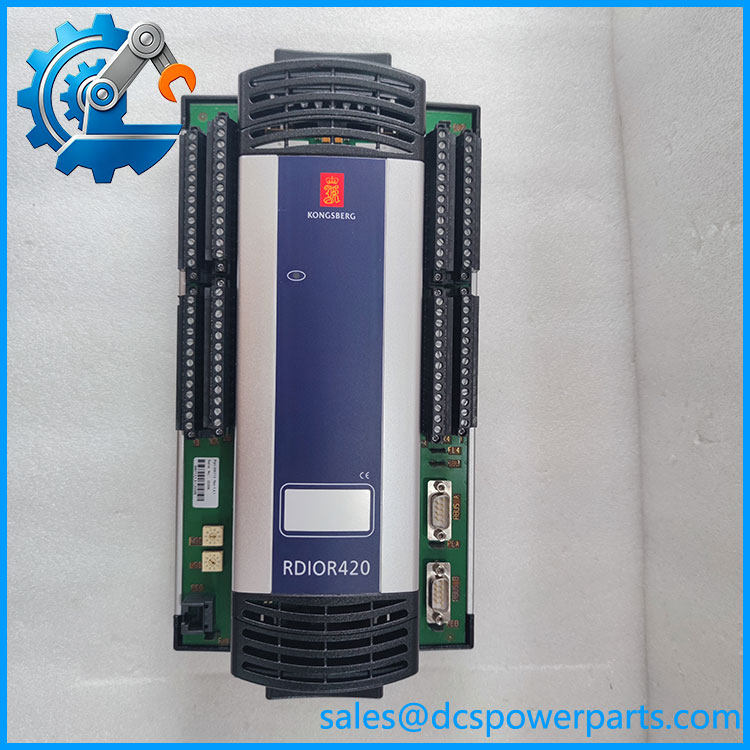
RDIOR420
2. Dual RBUS architecture
Two independent RBUS interfaces are provided for redundant communication with the host controller. The bus interfaces use galvanically isolated RS-485 circuitry and Manchester encoding at 2 Mbit/s. The documented architecture supports up to 99 module addresses on an RBUS.
That matters during troubleshooting. A field I/O module can be electrically healthy while communication redundancy, addressing, or cabling is wrong. replacement therefore requires more than checking whether the front LED illuminates.
3. Short-circuit-protected solid-state outputs
Each solid-state output uses a high-side driver rated at 1 A. Kongsberg documents a software-controlled protection mechanism that disconnects an overloaded channel when the current exceeds the specified threshold. The operator can reset the driver after the fault has been removed.
For maintenance engineers, this diagnostic behavior is valuable because a field short does not necessarily mean that the entire module has failed.
4. Field-loop monitoring
The module can monitor solid-state input and output loops for abnormal conditions, including wiring faults. The hardware documentation describes detection of open and short circuits depending on the selected loop configuration.
This is particularly relevant on marine equipment where long field wiring runs and distributed cabinets make intermittent wiring faults difficult to isolate.
5. Hardware and software fail-safe behavior
Fail-safe behavior is built into the architecture. A serious hardware failure causes outputs to be de-energized, while software-controlled fail-safe settings can define either predetermined output states or a freeze condition after controller communication is lost. The default software down-counter is documented as 6 seconds, with a configurable range from 100 ms to 65 seconds.
Do not change these settings casually during a replacement. The fail-safe state can be part of the vessel’s operational philosophy and alarm/shutdown logic.
6. Marine environmental compliance
The published datasheet specifies compliance with IACS E10, IEC 61131-2, and IEC 60945. The documented operating temperature range is -15°C to +70°C, with up to 98% RH, and the enclosure protection is IP20.
IP20 should not be misunderstood as field-enclosure protection. The module is intended to be installed inside an appropriate cabinet or protected equipment space.
7. Practical replacement design
Kongsberg documents a straightforward replacement procedure involving removal of power, field terminal connectors, RBUS connectors, grounding connections, and the DIN-rail fasteners. The replacement module must have its address correctly set before commissioning.
This is not a true “pull it out and push the new one in while energized” situation. Isolate the module and its field circuits according to the vessel’s approved maintenance procedure.
8. Relay loading requires engineering judgment
The 5 A relay rating should not be interpreted as a universal 5 A switching capability for every application. Kongsberg gives separate voltage/current limits and specifically warns about inductive and capacitive loads. Snubber circuitry may be required, and the published endurance figures decrease as switching load increases.
That is a useful procurement detail: if the replacement is being installed on solenoids, contactors, or other inductive loads, check the original loop design instead of relying on the headline relay rating.
Related Products
- RMP420 — Kongsberg Remote Multi-Purpose I/O module used for mixed analog/digital field signals; functionally broader than the .
- RMP420S — Related RMP420-series remote I/O variant used within Kongsberg automation architectures.
- RDIO420S — Remote digital I/O hardware from the same Kongsberg RIO family; useful when comparing digital-only field interface requirements.
- RDIO401S — Another Kongsberg remote digital I/O platform for system-specific field interfaces.
- RMP422 — Remote multi-purpose I/O module in the Kongsberg RIO family; application and channel architecture should be checked before considering replacement.
- RMP422i — Related RMP422-series I/O hardware for Kongsberg control installations.
- RTB420 — Kongsberg remote I/O terminal/interface hardware associated with the 420-series architecture.
- RCU502 — Kongsberg Remote Control Unit used as a controller-side component for compatible remote I/O architectures.
- RCU502i — Updated RCU platform used with Kongsberg automation systems; compatibility depends on system generation and software configuration.
Kongsberg documentation and marine certification records place the alongside these RIO and RCU components in Kongsberg automation architectures.
FAQ
What is the Kongsberg used for?
It is a remote field-I/O interface module for Kongsberg automation systems. It handles 16 configurable solid-state DI/DO channels plus 16 relay channels and communicates with the host controller through redundant RBUS connections.
Is a PLC CPU?
No. It is a remote I/O and relay interface. The host controller/RCU performs the higher-level control functions, while the provides field signal acquisition and switching.
Can the 16 solid-state channels be configured individually?
Yes. Each of the 16 solid-state channels can be configured as either a digital input or a digital output.
What communication protocol does use?
The module uses Kongsberg’s RBUS remote I/O process bus. The physical layer is isolated RS-485, with two RBUS interfaces for redundant communication. The documented bus rate is 2 Mbit/s with Manchester encoding.
Can I hot-swap the ?
Do not assume that it can be hot-swapped. Kongsberg’s documented replacement procedure begins by turning off the power circuit supplying the RIO module, disconnecting field and RBUS wiring, removing the module, setting the replacement address, and reconnecting the wiring.
Does the support firmware upgrades?
The Kongsberg datasheet identifies firmware upgrade capability as a feature. The exact firmware version installed in a particular spare should not be inferred from the model number alone. Confirm the module revision and installed Kongsberg system software before performing an upgrade.
What happens if communication with the controller is lost?
The module provides configurable software fail-safe behavior. Depending on system configuration, outputs can move to predefined fail-safe states or retain the last received values. A hardware fault can cause outputs to be de-energized, while the software fail-safe delay can be configured from 100 ms to 65 seconds, with 6 seconds documented as the default.
Can I replace with another 32-channel digital I/O module?
Not as a generic channel-for-channel substitution. The depends on the Kongsberg RBUS architecture, module addressing, terminal arrangement, communication configuration, and host-system software. Another 32-channel I/O product may have a similar channel count but still be electrically and logically incompatible.
What should be checked before ordering a replacement?
At minimum, verify the designation, KM article number 306713, assembly/revision information, terminal arrangement, RBUS wiring, module address, host controller type, system software revision, and existing field-I/O configuration. Kongsberg specifically instructs users to reference the module name together with assembly, revision, and serial information when communicating about the module.
Procurement Note
The is a system-specific marine automation component, so procurement should be based on exact hardware identification rather than a generic “32-channel digital I/O” description. The KM article number is 306713, while the hardware documentation identifies the module as .
For a replacement unit, request clear photographs of the nameplate, assembly/revision markings, terminal connectors, and RBUS connectors. Verify that the supplied hardware matches the existing cabinet wiring before installation. If the offered unit is described as New Surplus, do not interpret that description as proof that it has never been installed or energized; inspection and revision matching remain necessary.
Because the relay section can switch external AC and DC circuits, field isolation is particularly important. Check the actual load, inductive characteristics, suppression components, and existing fail-safe philosophy before commissioning. The module’s published relay rating is conditional on voltage, current, power factor, and load type.
For legacy Kongsberg installations, preserving the existing RBUS address, field wiring, I/O channel configuration, controller mapping, and fail-safe settings is more important than simply installing a module with the same channel count.