Description
Metso Automation IOP351 16-Channel Form A/B Relay Output Module
Key Technical Specifications
| Parameter | Specification |
|---|---|
| Manufacturer | Metso Automation / MAX Controls |
| Model | IOP351 |
| System | maxPAC I/O |
| Module Type | Digital Relay Output |
| Relay Type | Form A / Form B |
| Number of Channels | 16 |
| Channel Isolation | Channel-to-channel isolated |
| Field-to-Logic Isolation | Optical isolation |
| Maximum Contact Rating | 5 A @ 250 VAC |
| DC Contact Rating | 3 A @ 30 VDC |
| Maximum Operating Speed | 20 cycles/minute |
| Relay Operating Time | 15 ms maximum, excluding contact bounce |
| Relay Release Time | 5 ms maximum, excluding contact bounce |
| Expected Mechanical Life | 5 × 10⁶ operations @ 180 cycles/minute |
| Expected Electrical Life | 10⁵ operations @ 20 cycles/minute, resistive load |
| Output Status | Individual LED per channel |
| Module Status | Active LED |
| I/O Bus Address | One address |
| Communication-Loss Setting | Reset/drop or hold |
| Form A Default | Yes |
| Form B Configuration | Onboard resistor configuration |
The published maxPAC specifications give the 5 A / 250 VAC and 3 A / 30 VDC contact ratings, 16-channel configuration, relay timing, expected life, and 20-cycle/minute operating limit.
Product Introduction
The Metso Automation IOP351 is a 16-channel relay output module designed for the maxPAC I/O subsystem. Each output uses an isolated relay contact, allowing the DCS to switch external loads such as contactors, solenoids, alarms, and other discrete field devices. The module communicates with the DPU through the maxPAC I/O bus and provides an individual front-panel LED for output status.
A notable feature is its Form A/Form B configurability. The standard configuration is Form A, while individual channels can be changed to Form B through the specified onboard resistor configuration. The W1 setting also determines whether outputs drop or hold their state when I/O-bus communication is lost for more than approximately 0.7 seconds.
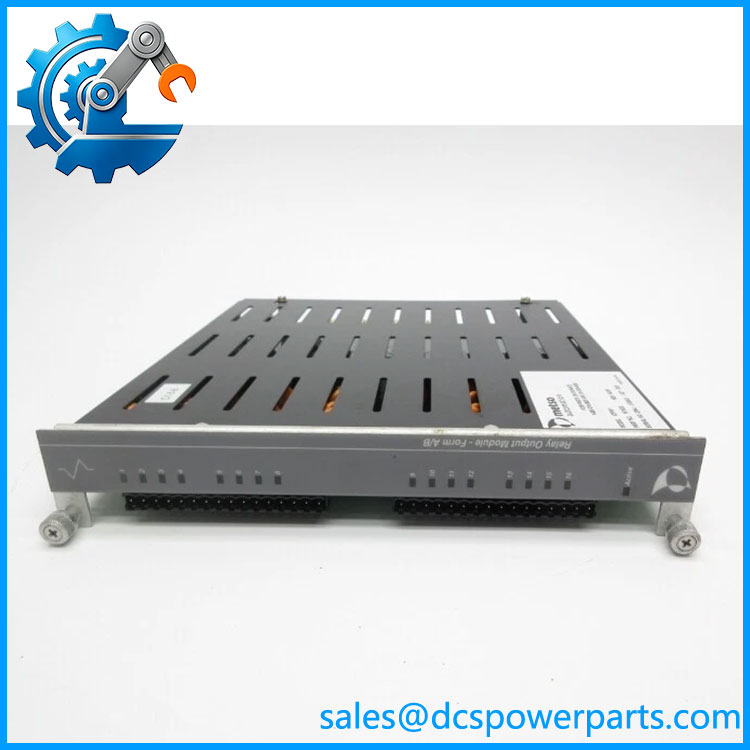
IOP351
Applications & Field Pitfalls — Engineer’s Perspective
The IOP351 is best understood as a relay output device within the maxPAC architecture, not as a high-speed solid-state output module. Relay contact ratings and operating-cycle limitations become important when the connected load is frequently switched. The configuration of each channel also needs to match the original cabinet wiring because Form A and Form B provide different contact behavior.
Typical Application Areas
- Motor control — switching contactor or interposing-relay circuits.
- Valve and actuator commands — providing discrete relay outputs to field equipment.
- Alarm and annunciator circuits — switching external alarm devices.
- Process interlocks — controlling discrete permissive or shutdown-related circuits.
- Legacy maxPAC DCS installations — direct replacement of an existing IOP351 relay-output module.
Field Pitfalls
- Form A vs. Form B must be verified. The module supports both configurations, but the default is Form A. Individual channel configuration is determined by the onboard resistor arrangement.
- Do not treat the 5 A rating as a universal load rating. The published 5 A figure applies at 250 VAC; the documented DC rating is 3 A at 30 VDC. Motor, solenoid, and inductive loads may require additional consideration because contact stress is different from a resistive load.
- Check the communication-loss behavior. Jumper W1 determines whether outputs reset/drop or hold their state when the module is no longer scanned by the DPU for more than approximately 0.7 seconds. This setting can directly affect the behavior of controlled equipment.
- Relay speed is limited. The documented maximum operating speed is 20 cycles per minute. High-frequency switching applications are not an appropriate use of this relay module.
- Verify the I/O bus address. IOP351 uses one I/O bus address, with digital output module addresses occupying the designated output-address range. An address mismatch can appear as a module or communication fault during commissioning.
Related Products
- IOP350 — 10-channel Form C relay output module. It provides changeover contacts rather than the 16-channel Form A/B arrangement of .
- IOP353 — 16-channel relay-driver output module. Unlike , it provides relay-driver outputs rather than onboard mechanical relay contacts.
- IOP330 — 16-channel 24 VDC common digital input module.
- IOP331 — 16-channel 48 VDC common digital input module.
- IOP332 — 16-channel 120 VAC/DC isolated digital input module.
- IOP333 — 16-channel 240 VAC/DC isolated digital input module.
- IOP334 — 16-channel 24 VDC isolated digital input module.
- IOP371 — Optical Bus Extender for distributing the maxPAC I/O bus over longer distances; documented optical links can extend the bus up to 2,000 m.
- IOP320 — 8-channel 4–20 mA common analog output module.
Procurement Note
Specify the item as:
Metso Automation — maxPAC — 16-Channel Form A/B Relay Output Module
When replacing an installed unit, verify the model, channel configuration, Form A/Form B resistor settings, W1 communication-loss setting, I/O bus address, and field terminal wiring.
For used or surplus hardware, inspect the relay contacts and terminal connections carefully. Mechanical relay wear is more relevant here than simply checking whether the module powers up. If the module has been switching contactors or inductive loads for years, the relay condition should be assessed before returning it to a critical service.
The should not be confused with the IOP350: IOP350 provides 10 Form C relay channels, while provides 16 Form A/B channels.